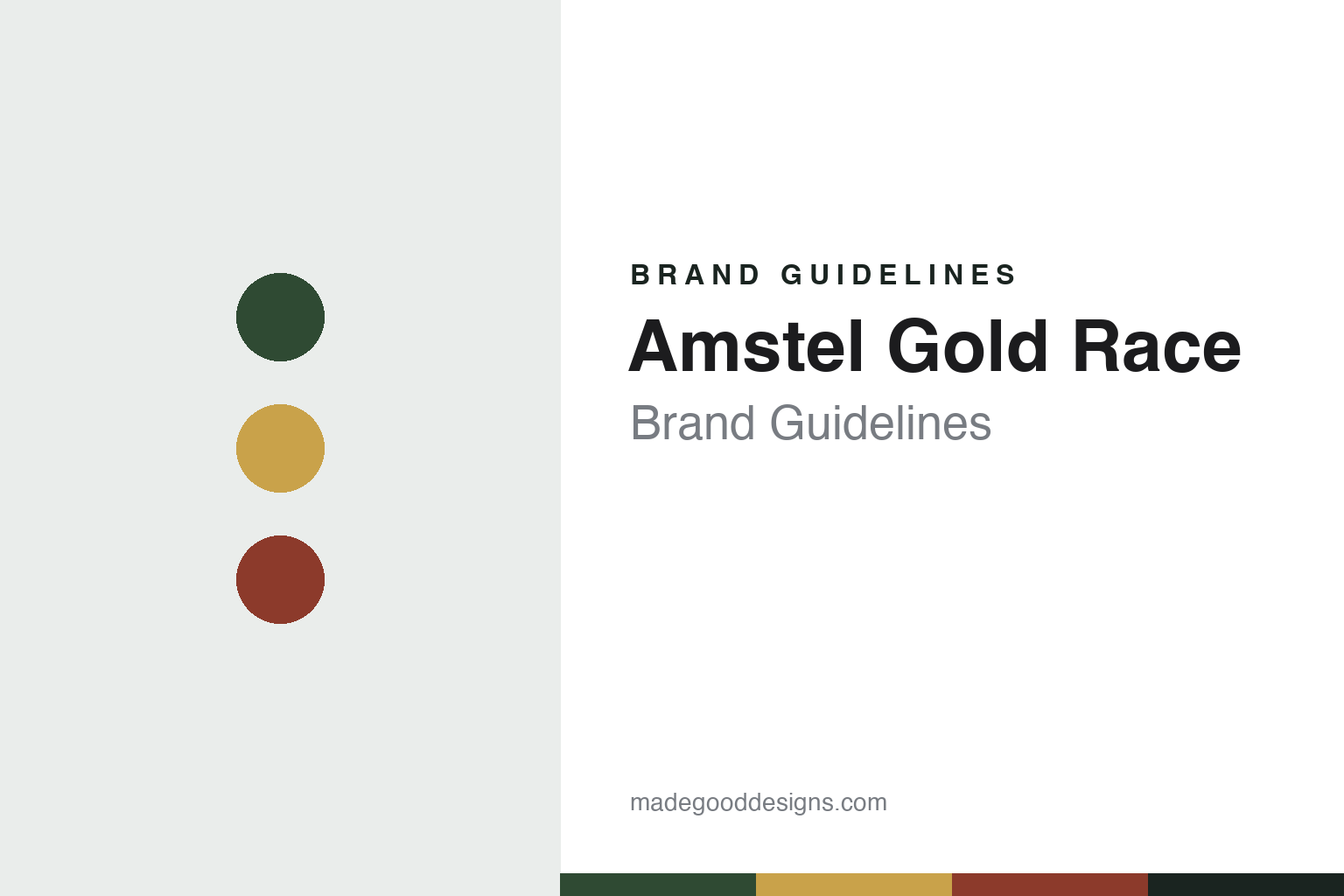
Amstel Gold Race Brand Guidelines
Thirty-odd short hills, a sponsor’s name and a finish below the Cauberg.
Aa
Two constants: a Limburg green, harvest gold and brick red palette and a condensed sans register. Abstract homage — not an Amstel Gold Race asset; no logo, trophy or race graphic is reproduced.
A Dutch classic from 1966
Two promoters, a beer sponsor and a route that kept moving.
The Amstel Gold Race is a one-day professional road race held each spring in the province of Limburg in the south of the Netherlands. It was created by the Dutch promoters Ton Vissers and Herman Krott, who ran a company called Inter Sport, English Wikipedia says. Dutch Wikipedia explains the name: it comes from the main sponsor, the beer brand Amstel, which at the time also sold a beer called Amstel Gold. English Wikipedia adds that Amstel has been the title sponsor since the first edition, and that the name does not refer directly to the river Amstel.
The race organisation traces the idea to 1965, saying it was first discussed in a café on the Vrijthof square in Maastricht. The first edition was raced on 30 April 1966, from Breda in North Brabant to Meerssen in Limburg, after the planned start in Amsterdam and several alternatives were dropped, English Wikipedia says. There were 120 starters, and the winner was Jean Stablinski of France.
The start then moved towards the hills. In 1967 it went to Helmond, in front of Amstel’s factory, and in 1968 the race was held on 21 September, the only autumn edition, according to English Wikipedia. Dutch Wikipedia gives the later starts as Helmond until 1970, Heerlen from 1971 to 1997 and Maastricht from 1998. The finish was in Meerssen until 1990, apart from Elsloo in 1968, and in Maastricht from 1991 to 2002. From 2003 to 2012 it sat at the top of the Cauberg climb in Valkenburg; since 2013 it has been near Vilt and Berg en Terblijt, about 1.8 km beyond the top of the Cauberg, a location English Wikipedia links to the 2012 UCI Road World Championships in Valkenburg.
The race organisation notes that it has had just two race directors in sixty years. Inter Sport stopped trading in 1970, and Krott directed the race himself until 1995, English Wikipedia says. Leo van Vliet took over in 1996; the race organisation said in January 2026 that the 60th edition, on 19 April 2026, would be his last as race director.
Colour
Heineken’s race, Flanders Classics’ organisation, Limburg’s hills.
The ownership is set out on Dutch Wikipedia: Heineken, the owner of the Amstel beer brand, owns the race, and the race licence passed to Flanders Classics after the 2024 edition. Cyclingnews reported on 22 September 2023 that the Belgian organiser would manage and organise the race from 2025, adding it to a portfolio that includes the Tour of Flanders, Omloop Het Nieuwsblad and Gent-Wevelgem, and that van Vliet would stay on to oversee the changeover. NOS reported the same arrangement on 21 September 2023. In January 2026 the race organisation described HEINEKEN Nederland as the parent company of Amstel.
The race has been part of the UCI’s top season-long series since 1989: the Road World Cup from 1989 to 2004, the ProTour from 2005 and the World Tour since 2011, according to English Wikipedia. In 2004 it swapped calendar places with Liège–Bastogne–Liège, and it is now held on the Sunday after Paris-Roubaix and before the Flèche Wallonne.
The course is defined by the hills of South Limburg, the only hilly part of the Netherlands. English Wikipedia describes a route of more than 30 short climbs, all on asphalt, that come closer together as the race goes on, with the Cauberg, the Keutenberg and the Eyserbosweg among the steepest; the highest point is the Vaalserberg at 322.7 m, and since 2005 the race has stayed in Dutch Limburg apart from a short passage through Gemmenich in Belgium. In 2017 the final climb of the Cauberg was taken out, leaving the Bemelerberg 7.4 km from the finish, Dutch Wikipedia says; in 2025 the Cauberg returned as the last climb for the first time in nine years, on a route of 34 hills from the market square in Maastricht.
There is also a women’s race and a ride for amateurs. Three women’s editions were held from 2001 to 2003, and the race returned in 2017 on the same day as the men’s race, over 121.6 km and 17 hills that year, according to Dutch Wikipedia; it is part of the Women’s World Tour. A touring version for recreational riders has been held on the day before the professional race since 2001, English Wikipedia says, and NOS credited van Vliet with adding it. The Dutch rider Jan Raas holds the record of five wins.
Typography
How races present themselves.
Professional cycling races and mass-participation rides present themselves through a small set of public materials: the race name and logo, the leaders’ jerseys, the route map and the start and finish. Organisers publish these on their own websites each year, often next to a list of past winners and editions, so a race’s identity is visible as both a current event and a long archive.
Names change more often than the races do. Many events carry a title sponsor or a regional partner in their official name, and those names come and go with contracts, while the core name stays in press coverage and in records of past editions. Some races have been renamed outright, and their organisers usually say so on their history pages. Jersey colours can change too: one Grand Tour moved its leader’s jersey from gold to red in 2010.
Route graphics carry much of the design work. Stage races publish profiles for each day, with climbs and their categories marked; one-day races on rough roads publish numbered sectors, sometimes graded with stars by the organiser. Start towns, finish lines on a city square or a velodrome, and podium settings appear in photographs year after year, alongside trophies, finishers’ medals and official merchandise. Mass-participation rides, which often share roads and branding with a professional race, use similar maps and markers for a much larger field.
Behind each race sits an organiser, and often a parent company. Some of the oldest races were founded by newspapers; many are now run by event companies, sports federations, trusts or regional tourism bodies, and some belong to groups that run several races at once. This guide sets out, for each race, who founded it, who organises and owns it today, and how its name, jerseys and route are presented, from dated sources.
Aa
A condensed sans for hill names, distances and route boards. (Specimen set in Barlow Condensed, a sans STAND-IN; NOT the Amstel Gold Race logo.)
Amstel Gold Race
A sponsor’s name worn for sixty years.
The Amstel Gold Race is an unusual case of a race that has carried one sponsor’s name since its first edition. The beer brand and the race are separate subjects, but the name ties them together, and the owner of one is the owner of the other. Since 2025 the organisation has also sat alongside the Belgian spring races run by Flanders Classics, so the race now shares an organiser with the Tour of Flanders while keeping its Dutch setting and its Heineken ownership.
Its visual material comes from the course. The race is known by its hills, and the names Cauberg, Keutenberg, Eyserbosweg and Bemelerberg recur in the race’s route from edition to edition. The start in Maastricht, on the market square or, from 2019 to 2023, on the Vrijthof according to English Wikipedia, and the finish near the Cauberg give the race two fixed places, while the winding route between them is redrawn as climbs are added, removed or reversed.
The history also gives the race a clear timeline to show: a first edition in 1966, a move of the start to Maastricht in 1998, a finish on and then near the Cauberg from 2003, a women’s race from 2017 and a new organiser from 2025.
For a design guide, the Amstel Gold Race shows how a race can hold a sponsor’s name for decades while its route, organiser and finish change around it. Compare it with the Tour of Flanders, organised by the same company, and with Liège–Bastogne–Liège, the hilly classic it swapped calendar places with in 2004. For this guide we use a Limburg green, a harvest gold and a brick red with a condensed sans, an unofficial interpretation; no product or logo is reproduced.
Explore & save
Keep Amstel Gold Race’s identity on hand — save it to a board in the Made Good inspiration library.
Amstel Gold Race identity set
Pin the Amstel Gold Race Limburg green, harvest gold and brick red palette and the condensed sans register to your own board.
Source & notes
Frequently Asked Questions
What font can I use to match the Amstel Gold Race look?
This guide describes Amstel Gold Race’s type as “A condensed sans for hill names, distances and route boards”. Its type specimen is set in Barlow Condensed from Google Fonts as a stand-in; Barlow Condensed is not Amstel Gold Race’s own lettering.
What colours are in the Amstel Gold Race palette?
This guide’s Amstel Gold Race palette is Limburg green #2F4A33, Harvest gold #C9A24A, Brick red #8C3A2B, Marl ink #1A2420 and Paper #F6F4EF. The tones are the guide’s own unofficial interpretation, not official Amstel Gold Race hex codes.
Who founded Amstel Gold Race?
Amstel Gold Race was founded by Ton Vissers and Herman Krott.
Who owns Amstel Gold Race?
Amstel Gold Race is owned by Heineken (organised with Flanders Classics since 2025).