Antoine-Louis Barye turned the animal into a serious subject for sculpture. Where earlier animal figures often decorated clocks and centrepieces, his tigers, lions and leopards fight, stalk and rest with real anatomy and real tension. The critic Théophile Gautier called him the “Michelangelo of the menagerie”, a phrase that the Brooklyn Museum used as the title of its 2005 exhibition of his bronzes. For designers, Barye is a lesson in silhouette, compression and how to make a small object feel large.
For more cleared images from museum collections, browse the MGD museum inspiration collection.
Who was Antoine-Louis Barye?
Barye was born and died in Paris. His birth year is recorded two ways: the Met gives 1795, as did Antiques and The Arts Weekly’s 2005 report on the Brooklyn show, while the Cleveland Museum of Art, the Flagler Museum and the art historian Michelle Facos’s online textbook An Introduction to Nineteenth Century Art give 1796. Facos dates his death to 25 June 1875.
According to Facos, he was the son of a goldsmith and trained with his father, in the workshop of a military engraver named Fourier and with the goldsmith Martin-Guillaume Biennais, before studying with the sculptor François-Joseph Bosio and the painter Antoine-Jean Gros and attending the École des Beaux-Arts in Paris from 1818 to 1823. The Brooklyn Museum report, published in Antiques and The Arts Weekly on 12 April 2005, adds that he served in the Napoleonic army before formal art studies and began by modelling small animals as embellishments for luxury decorative objects.
Antoine-Louis Barye at the Salon and the Jardin des Plantes
Barye’s source was the menagerie. The 2005 Brooklyn report says he frequented menageries in and around Paris, most notably the zoo at the Jardin des Plantes, and attended dissections at the Museum of Natural History, where he served as master of zoological drawing from 1854 until his death. Facos gives the same 1854 appointment.
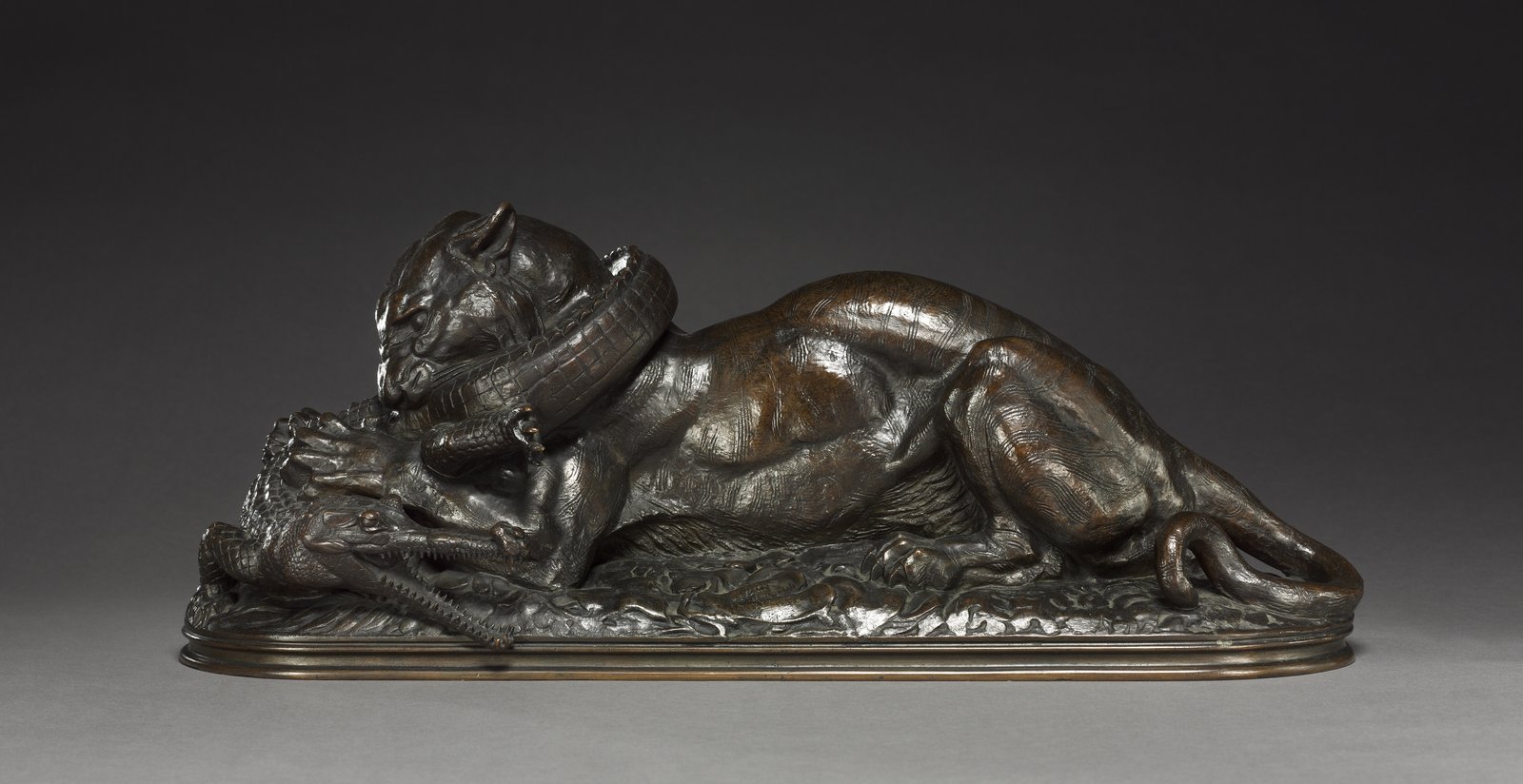
His breakthrough came in the early 1830s. Both Facos and the Brooklyn report record that Tiger Devouring a Gavial was shown at the Salon of 1831 and Lion Crushing a Serpent in 1833, and the Brooklyn report says these predator scenes won raves and led to commissions from the house of Orléans and from the state. Facos also lists his appointment as a Chevalier of the Legion of Honour in 1833 and, in the early 1850s, a commission for decorative masks on the Pont Neuf in Paris. The Cleveland Museum of Art holds a bronze Tiger Devouring a Gavial dated 1831, measuring about 20 cm high, shown above.
His work belongs to Romanticism: the Brooklyn report describes how he blended the Romantic taste for the exotic with the exactness of the new zoology.

Small bronzes for a new market
The Brooklyn report says that after a refusal from the Salon in the late 1830s, Barye concentrated on the fabrication of small bronzes. Facos records that in 1845 he formed Barye & Cie with Émile Martin to produce casts of smaller sculptures for middle-class customers, and the Flagler Museum’s 2008 exhibition text says he produced extensive editions of bronzes for the rapidly expanding middle class.
The walking animals show the format clearly. Cleveland’s Walking Leopard (1831) is under 8 cm high, and the same collection holds Walking Lion (after 1836) and Walking Tiger (about 1836); the Met holds a sand-cast Walking Tiger modelled in 1841. Each animal moves in strict profile along a slim base, like a frieze in three dimensions. The Flagler text notes that its exhibition paid attention to distinctions between casts made in Barye’s lifetime and posthumous casts, which matters when you date a Barye bronze.
What to look at in Barye’s sculpture
The closed silhouette. In Tiger Devouring a Gavial the tiger and crocodile lock into one compact mass, with limbs, tail and jaws folded inwards. From any angle the outline reads clearly, which is why the piece works at tabletop size.
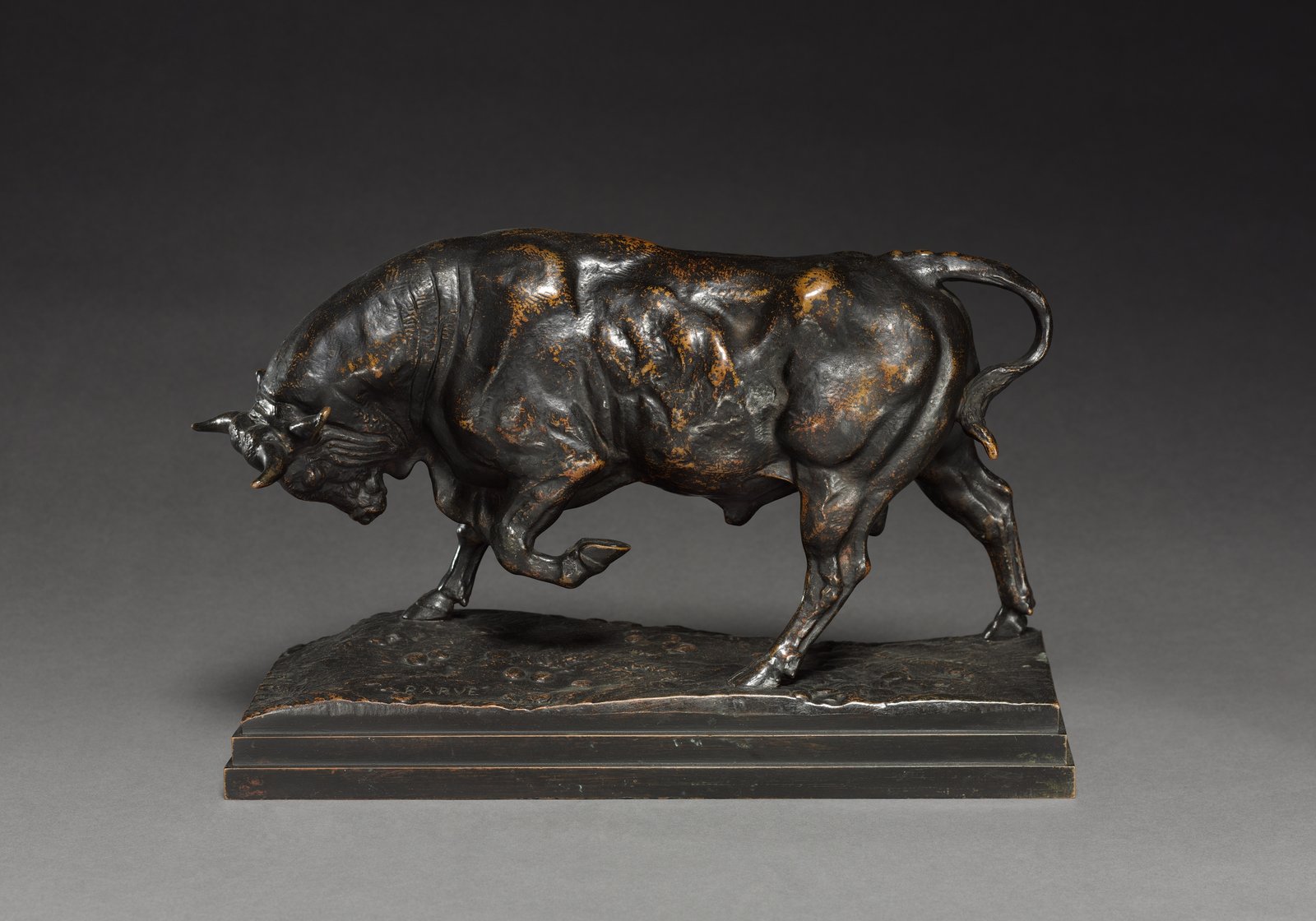
Coiled energy. Barye’s animals are caught just before or during action: shoulders bunched, head lowered, tail curling. The Bull (about 1841) barely moves, yet the weight in its neck and shoulders implies a charge.
Surface as anatomy. Muscle, rib and tendon show through the skin, the result of the dissections and zoo studies recorded by Brooklyn. Fur and scale are suggested rather than carved hair by hair, so light catches the forms underneath.
Ornament from nature. Cleveland also holds bronze candlesticks and a plaque of an eagle with a snake, reminders of his goldsmith training and of the decorative arts in which animal motifs had long served.
Drawings, watercolours and lithographs
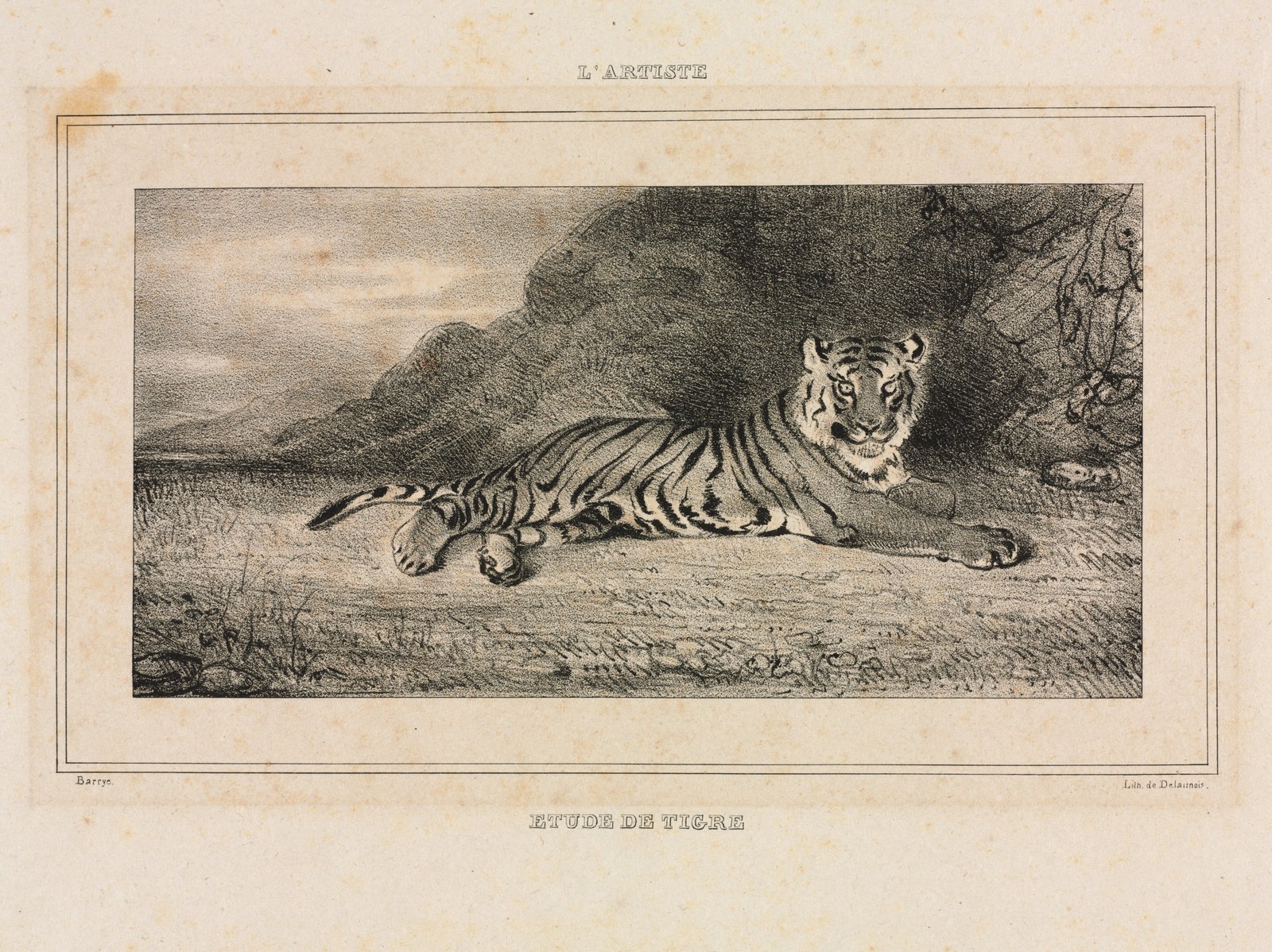
Barye worked on paper as well as in bronze. Cleveland holds a lithograph, Study of a Tiger (1832), and a sheet with a watercolour landscape on one side and animal studies on the other, dated about 1823–75. The Met holds a watercolour, Tiger Rolling on Its Back, and an oil, Tiger in Repose (about 1850–65). The Flagler Museum’s exhibition text, drawn from the Walters Art Museum’s Barye collection, describes him as a member of the Barbizon School of artists and explored the relationship between his bronzes and drawings. For a contemporary who painted the same countryside, see Théodore Rousseau.
Teaching and influence
The Flagler text names Auguste Rodin as an early pupil of Barye, and Facos quotes Rodin’s later recollection of him as a sad, poorly dressed man with great power who made his own editions and sold them with difficulty. Facos also records that in 1848 Barye was appointed director of plaster casting and curator of the plaster-cast gallery at the Louvre. Read our guide to Auguste Rodin for the pupil’s side of the story, and compare the animal painter Rosa Bonheur.
How designers can borrow Barye’s ideas
Design for the silhouette first. Logos, mascots and icons live or die by their outline. Barye’s compact groups show how to fold limbs and tails into one readable shape.
Show the moment before action. A crouch, a lowered head or a lifted paw carries more energy than a mid-leap pose, a useful rule for brand animals and character design.
Use profile for rhythm. His walking animals are frieze-like. Lined up, they would make a border or a running pattern.
Scale with care. His small editions brought sculpture into ordinary homes, a reminder that a strong form survives reduction. Test your own marks at icon size.
Frequently asked questions
What is Antoine-Louis Barye known for?
He is known for Romantic animal sculpture, especially predator scenes such as Tiger Devouring a Gavial (Salon of 1831) and Lion Crushing a Serpent (1833), and for small bronze editions of animals.
What is an animalier?
An animalier is an artist who specialises in animals. The term is used above all for nineteenth-century French sculptors such as Barye, whose bronzes the Flagler Museum showed in its 2008 exhibition “Untamed”.
When was Barye born?
The Met gives 1795, while the Cleveland Museum of Art and Michelle Facos give 1796. All agree he was born in Paris and died there in 1875.
Can I use images of Barye’s work?
The Cleveland Museum of Art releases the photographs shown here under CC0, and the Met flags several Barye works as public domain. Check each museum’s terms before using any other image.