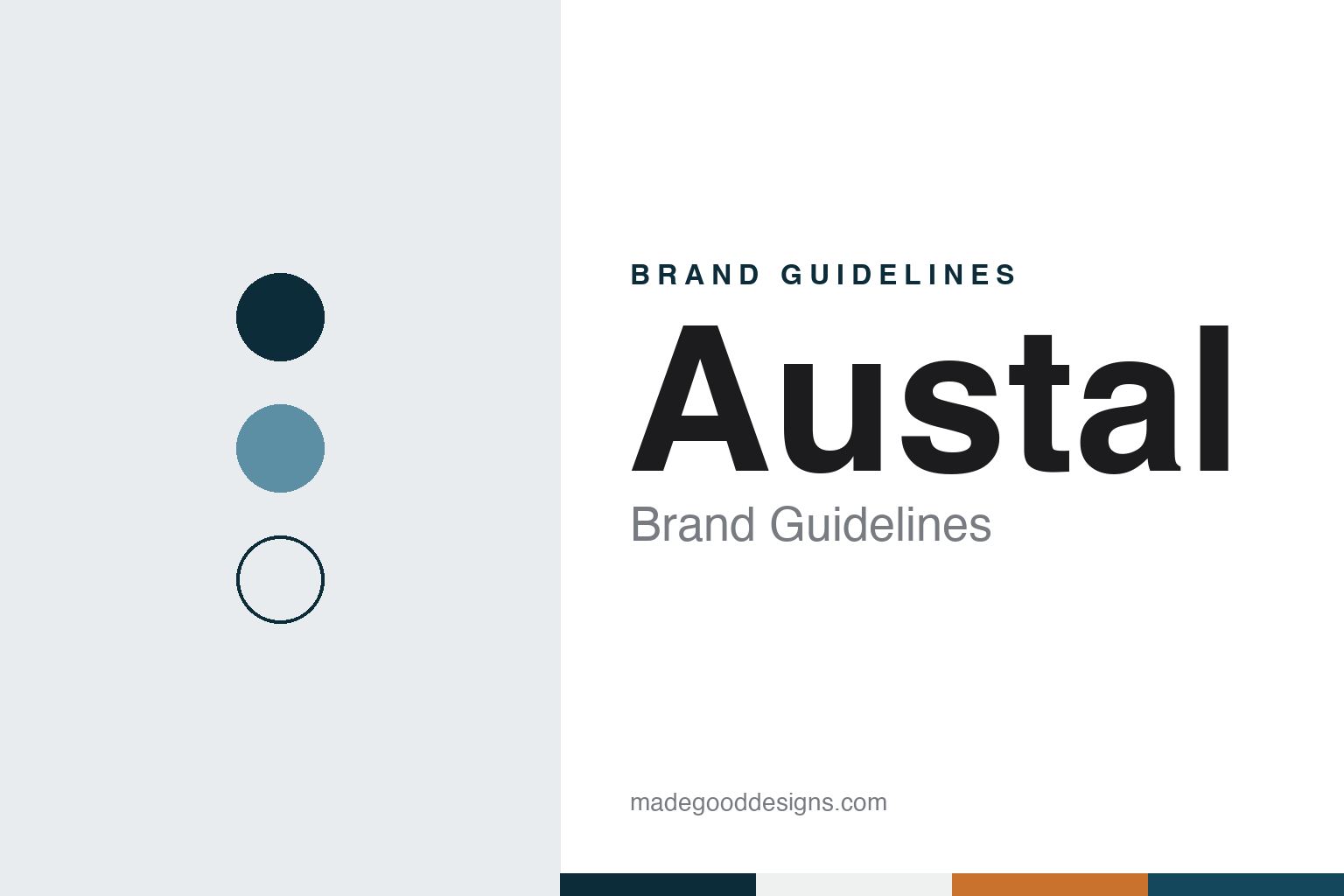
Austal Brand Guidelines
The Henderson yard that took aluminium hulls to two navies.
Aa
Two constants: a teal, aluminium grey and ochre palette and an industrial sans register. Abstract homage — not an Austal product or mark; no ship, logo or nameplate is reproduced.
Henderson, 1988
A commercial yard south of Perth.
Austal began in 1988 at Henderson, on the coast south of Perth in Western Australia. English Wikipedia names its founder as John Rothwell, and the company says it started there “with a vision to build high quality commercial vessels for the international market.” Its corporate headquarters is still at the Henderson shipyard.
The early business was commercial, and its speciality was fast aluminium ferries. English Wikipedia describes how large high-speed catamarans carrying vehicles transformed the ferry trade in the early 1990s, and how most builders of large fast catamarans had stopped production by the end of that decade. It names Austal and Incat, of Hobart, as the two companies that came through, and says they remain the only two building fast multi-hull ferries of about 60 to 120 metres.
Austal was listed on the Australian Securities Exchange in December 1998, according to both English Wikipedia and the company. Acquisitions followed. English Wikipedia records the purchase of the yacht builder Oceanfast in May 1999; the North West Bay Shipping yard at Margate in Tasmania in February 2007, closed in August 2010; and a shipyard at Balamban, on the island of Cebu in the Philippines, in November 2011. The company says it opened a further yard at Vung Tau in southern Vietnam in 2018.
Today Austal describes a range of “passenger and vehicle-passenger ferries, patrol boats, high speed support vessels, surface combatants and multi-role vessels,” built in aluminium and steel. It also designs ship systems such as its MARINELINK monitoring and control platform, and says it has more than 4,000 staff.
Colour
Mobile, Alabama, and two navies.
The step that made Austal a defence builder in the United States came in December 1999, when Austal USA was formed in Mobile, Alabama, as a joint venture with Bender Shipbuilding & Repair, English Wikipedia says. Austal bought Bender’s share in September 2006. The company calls itself the first international shipbuilder contracted to deliver vessels for the US defence forces.
Mobile became the yard for two US Navy programmes. In October 2005 a team of Austal and General Dynamics won a contract to build the first ship of its design for the Littoral Combat Ship programme, and the keel of USS Independence was laid at Mobile on 19 January 2006. English Wikipedia says the trimaran design was based on Austal’s 127-metre ferry Benchijigua Express, and that from 2010 Austal USA held the contract for the Independence variant on its own. In November 2008 Austal also won the contract to design and build the Spearhead-class Expeditionary Fast Transport, a large catamaran.
The Maritime Executive, reporting in September 2026, listed the yard’s later work as Offshore Patrol Cutters for the US Coast Guard, auxiliary vessels for the US Navy and modules for the Virginia-class and Columbia-class submarines, with a repair operation in San Diego started in 2021.
In Australia, Henderson built patrol boats for the Royal Australian Navy and the border agencies. English Wikipedia records fourteen Armidale-class patrol boats delivered between 2005 and 2008, eight Cape-class boats for Australian Customs delivered between 2013 and 2015, and an order for six Evolved Cape-class boats for the Royal Australian Navy in May 2020, with further orders later. Export patrol boats went to Malta and to Trinidad and Tobago, and high-speed support vessels to Oman.
On 28 August 2025 the Australian government and a new subsidiary, Austal Defence Shipbuilding Australia, signed a Strategic Shipbuilding Agreement at Henderson, Naval News reported. It names the subsidiary as the government’s strategic shipbuilder for Tier 2 surface combatants at Henderson, starting with the LAND 8710 Landing Craft Medium and Landing Craft Heavy programmes for the Australian Army.
Typography
Shipbuilders and their public face.
Shipbuilders present themselves to a small number of very large customers: navies, coast guards, shipowners and energy companies. Their identities therefore lean on a short, sturdy wordmark, often a set of initials or a group name, set in navy, blue or red against white, and repeated on yard gates, crane girders, hard hats and the hulls of ships still on the slipway. Many yards sit inside wider industrial groups, so the mark on the crane is frequently the parent’s symbol rather than the yard’s own.
The photography does most of the work. Launch ceremonies, float-outs and naming days, sea trials with a bow wave, aerial views of a dry dock with a goliath crane spanning it: these are the standard images on yard websites and in annual reports. Scale is the message, and a single picture of a hull in dock is usually given more room than any slogan.
Ships are named by type and class, in the words the yards themselves use: LNG carriers, container ships, tankers and bulk carriers, ferries and research vessels, and, for naval yards, patrol vessels, frigates, corvettes and submarines described by programme or class name. Specification panels with length, beam, deadweight and capacity in containers or cubic metres stand in for product shots, and order books are reported ship by ship.
Most shipbuilder websites follow a similar plan: a history page told as a timeline of yards, mergers and renamings; sections for new builds, repair and conversion, and offshore work; a page on facilities, docks and cranes; and, for listed and state-owned yards, investor pages with annual reports. For a designer, the sector shows how an identity can be built from places, dates and ship classes rather than from consumer advertising.
Aa
An industrial sans for a yard that builds in aluminium and steel. (Specimen set in Barlow, a sans STAND-IN; NOT the Austal logo.)
Austal today
A court case, a stakeholder and offers for the US yard.
Austal’s recent history includes a legal finding in the United States. In August 2024 Austal USA pleaded guilty to securities fraud and to obstructing an audit by the Defense Contract Audit Agency, gCaptain reported, resolving a Justice Department investigation. The case concerned the years 2013 to 2016, when an accounting measure for several Littoral Combat Ships was kept artificially low, overstating the profits reported by Austal USA and Austal Limited. Under the plea agreement the company accepted three years of probation and an independent compliance monitor for three years.
Ownership has also become a public matter. According to gCaptain, the South Korean group Hanwha made an unsuccessful attempt to buy the whole of Austal in 2024 and first acquired a stake in March 2025. In December 2025 Australia’s Treasurer approved, with conditions, Hanwha’s application to raise its direct shareholding from 9.9% to 19.9%.
In August 2026 Hanwha Defense USA confirmed a preliminary, non-binding offer to acquire Austal USA, the business behind the Mobile yard, gCaptain reported; the offer did not cover Austal Limited itself or its yards in Australia, the Philippines and Vietnam, and any sale would need reviews by US authorities. On 9 September 2026 Austal told the stock exchange that it had also received a non-binding indication of interest from Wildcat Infrastructure, a Florida-based investment firm, the Maritime Executive reported. Neither proposal had become a completed sale at the time of writing.
Meanwhile the Henderson yard has kept building. The company announced in June 2026 the launch of the first Evolved Cape-class patrol boat for the Australian Border Force, and in May 2026 a contract for two more.
For a design guide, Austal shows how a ferry builder’s plain one-word name can carry across commercial and naval work on three continents. Compare Hanwha, the group that holds a stake in Austal, and Fincantieri, another builder of both naval and commercial ships. For this guide we use a deep teal, an aluminium grey and an ochre with a sans, an unofficial interpretation; no product or logo is reproduced.
Explore & save
Keep Austal’s identity on hand — save it to a board in the Made Good inspiration library.
Austal identity set
Save the Austal teal, aluminium grey and ochre palette and the industrial sans register for your own reference.