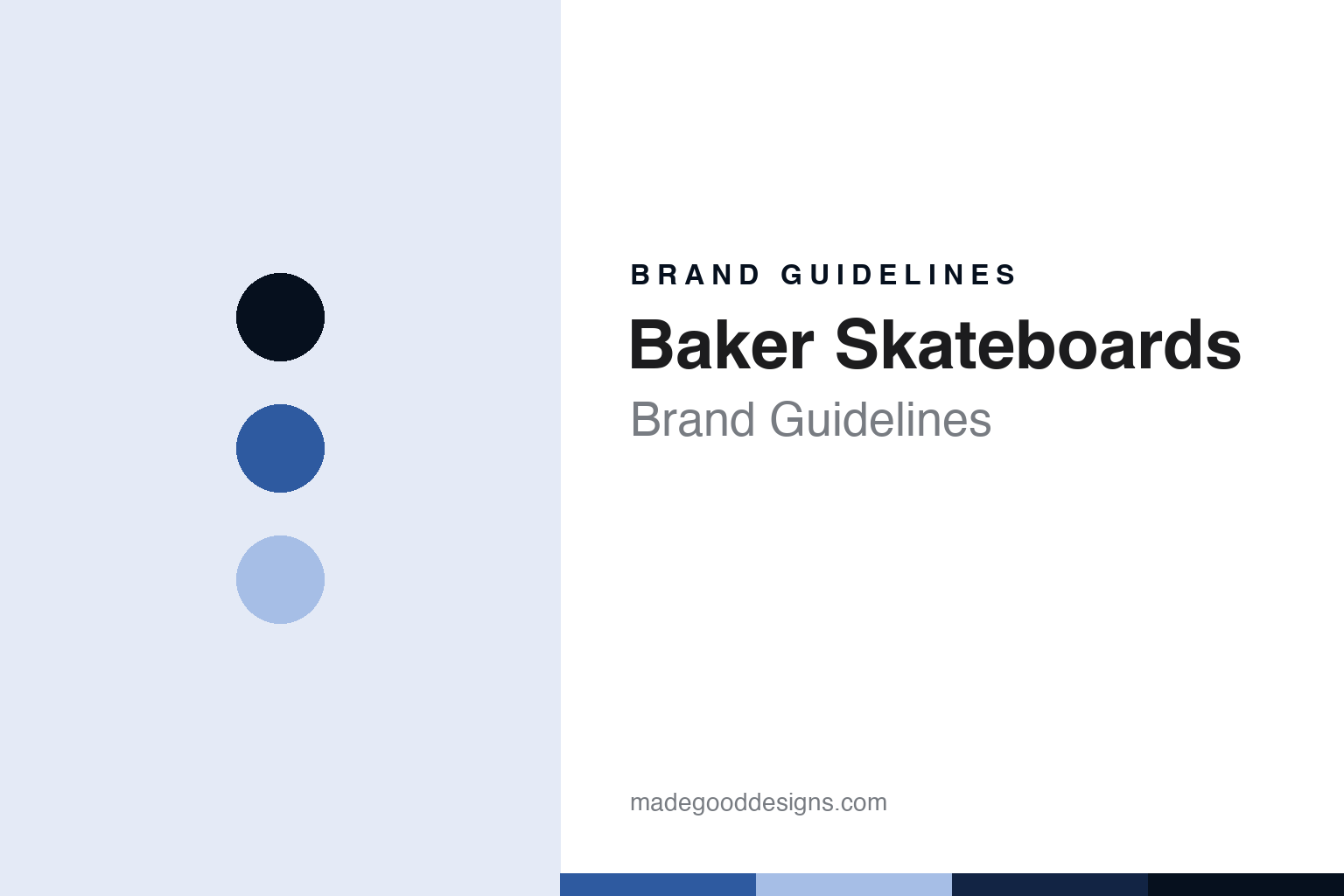
Baker Skateboards Brand Guidelines
The Bakerboys deck brand.
Aa
Two constants: a Baker-blue palette and a Bakerboys-sans register. Abstract homage — not a Baker product or mark; no deck, graphic or logo is reproduced.
The Bakerboys deck brand
Baker Skateboards is the deck brand founded in 2000 by Andrew Reynolds and Jay Strickland, run by Bakerboys Distribution.
Baker Skateboards brings the distribution round a house it built for itself — the deck brand founded in 2000 by Andrew Reynolds and Jay Strickland, whose distribution is run by Bakerboys Distribution, a house Reynolds set up with friends to run Baker and its family of brands. Baker makes and sells the decks, and its answer to a round about distribution is a house of its own making. A brand, self-housed.
Its identity is the Bakerboys deck brand. The Reynolds-and-Strickland founding, the Bakerboys house and the family of brands are the story here. A brand, self-housed. The Bakerboys deck brand.
(Honest notes, so the co-founder is credited, and the house is dated. Baker Skateboards sells skateboard decks as its heroes, and we report its performance language as the brand’s own. It was founded in 2000 by Andrew Reynolds and Jay Strickland — Reynolds is the public face, but the co-founder Strickland is often omitted, so we include him. On who runs it, the star theme of this round, its distribution is handled by Bakerboys Distribution, established in 2007 by Reynolds with Jim Greco and Erik Ellington; Bakerboys came to manage Baker’s distribution around 2011, and the house’s family includes Deathwish, Shake Junt and Heroin, among others. Its headquarters, commonly given as Los Angeles, we could not confirm, so we leave the city open. Its graphics carry edgy, profane themes and are its IP, so we describe the brand but reproduce none of the artwork. Its designs are IP we describe but do not reproduce; there is no official brand hex; these tones are an unofficial interpretation.)
Colour
Baker lives in a Baker blue. Click a swatch to copy the hex.
Baker’s identity is self-housed, brash and American — a Baker blue, an ink, a pale steel, a deep navy, and a paper. The palette leans Baker blue and pale steel: a bold register that nods to the brand’s blunt block-letter world rather than a loud logo colour. It signals a Bakerboys deck brand. The honest caveat: with no published brand hex, these values are an original, unofficial interpretation, not first-party colours.
The lesson is a Baker blue signals a self-housed, brash identity. Baker’s world is a deck with its own distribution house. For designers, it is a reminder that a Baker blue and a soft pale steel can carry a skate brand — a bold tone held as colour not as a graphic. Because these tones can fail as small text, keep type dark and let the colour live in the accents, palette and band. The takeaways: credit Reynolds and Strickland; name the Bakerboys house; note the family of brands; and treat any single hex as unofficial.
Typography
The register is a Bakerboys sans — self-housed, plain, brash.
Baker’s identity carries a self-housed, plain, brash spirit — a deck brand with its own house, not a graphics label. A Bakerboys sans captures the mood: clean, blunt and confident, the register of a self-made house. Set in a Baker-blue palette, the Bakerboys sans feels self-housed and brash — exactly the personality Baker carries. It is a made deck rather than a logo, mirroring maple veneer. (Baker’s real decks, graphics and logo are things we describe but do not reproduce, and the exact typeface is not ours to use.) Because it is not ours to use, the honest description is “a Bakerboys-sans brand,” shown here in a stand-in. The type behaves like the brand: self-housed, plain and brash.
Aa
A Bakerboys-sans brand — self-housed and brash. (Specimen set in Archivo, a Bakerboys-sans STAND-IN; NOT the Baker logo or any deck graphic.)
The distribution
Baker Skateboards stands for the Bakerboys deck brand.
Baker Skateboards brings the distribution round a house it built for itself. A Baker-blue palette, a Bakerboys sans and a 2000 founding make one thing — the Bakerboys deck brand — the whole identity: self-housed, brash and American. The Bakerboys house is the pitch, and the family of brands is the proof. The point is a deck brand that runs its own distribution, in a round about distribution.
Put to work, the identity is the brand told straight, co-founder credited and house dated. A maker in this spirit would credit Reynolds and Strickland, name the Bakerboys house, and note the family of brands. A reader in this spirit would keep the facts right: Baker Skateboards sells skateboard decks as its heroes; it was founded in 2000 by Andrew Reynolds and Jay Strickland, the co-founder often omitted; its distribution is run by Bakerboys Distribution, established in 2007 by Reynolds with Jim Greco and Erik Ellington, which came to manage Baker’s distribution around 2011, its family including Deathwish, Shake Junt and Heroin; its headquarters, commonly given as Los Angeles, is held open; and its edgy graphics are its IP, reproduced nowhere here. Baker sits among the round’s self-housed brands. The honest editorial moves are to date it to 2000, to credit both founders, to name and date the Bakerboys house, and to hold the city open.
For designers and brand-builders, Baker continues the distribution: credit the co-founder — and name the house the brand built. The lessons: let a deck carry a self-made distribution identity; include a co-founder the casual account omits; name and date a house a brand set up; note the family of brands under it; and never reproduce a mark. It is also a reminder to stay precise: Baker Skateboards is the deck brand founded in 2000 by Andrew Reynolds and Jay Strickland, run by Bakerboys Distribution — with the palette here an unofficial interpretation. Read that way, Baker is less a deck than a self-housed brand: brash, American, house-owning. The lesson for a brand is that a credited co-founder and a named house reinforce each other, and including Strickland keeps the story earned. Baker made the-Bakerboys-deck-brand the identity — proof that distribution carries the round.
Explore & save
Keep Baker Skateboards’s identity on hand — save it to a board in the Made Good inspiration library.
Baker Skateboards identity set
Pin the Baker-blue palette and the Bakerboys-sans register to your own board.