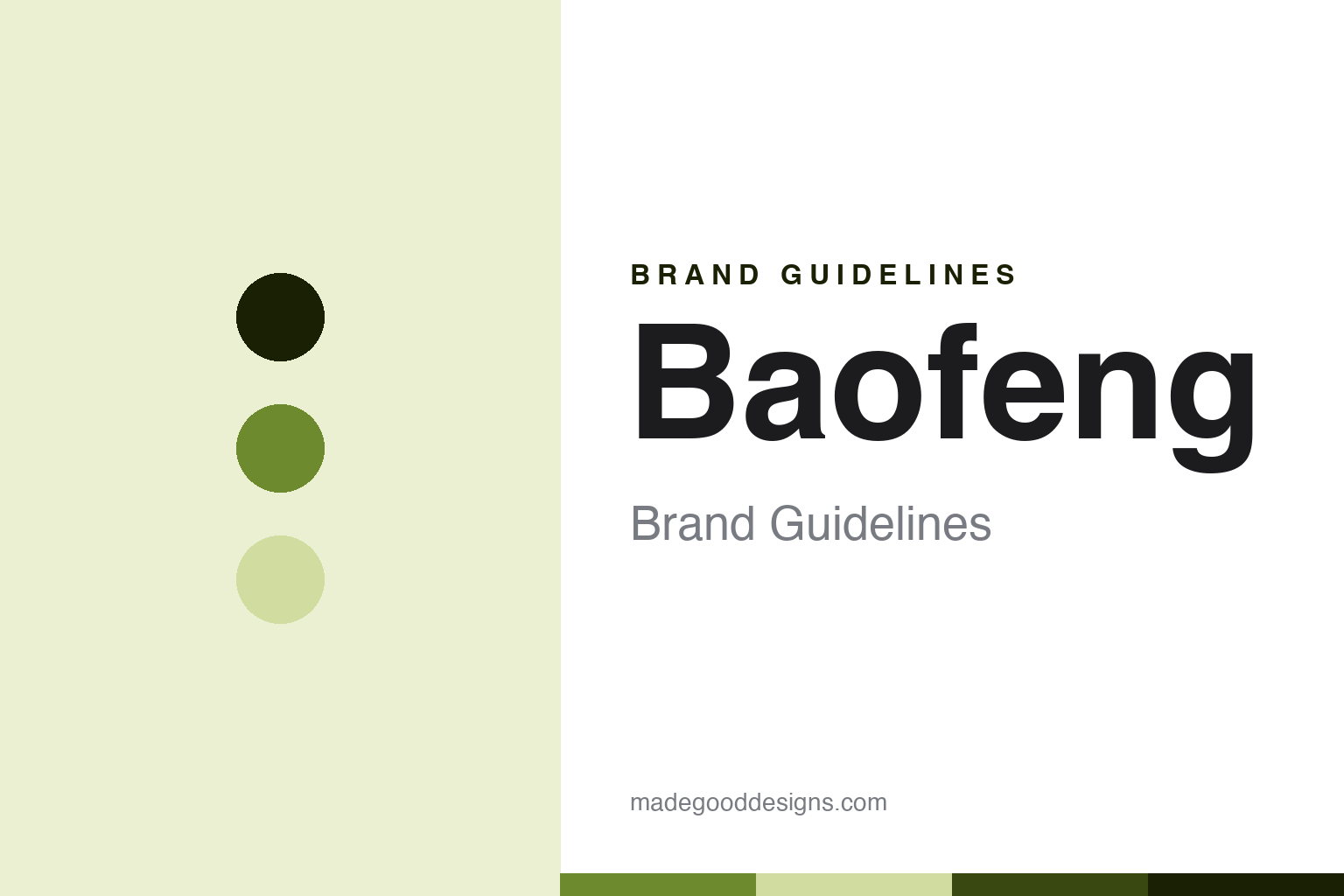
Baofeng Brand Guidelines
The ultra-cheap ham radio.
Aa
Two constants: a utility-olive palette and a value-sans register. Abstract homage — not a Baofeng product or mark; no radio, antenna or logo is reproduced.
The ultra-cheap ham radio
Baofeng is the Fujian maker whose sub-$30 UV-5R democratized amateur radio worldwide — and whose low-cost imports drew FCC device-compliance attention.
Baofeng follows Uniden as the round’s value-disruptor node — the Chinese maker whose extremely cheap handheld radio put amateur radio within reach of anyone, and whose low-cost imports drew device-compliance attention from regulators. Its answer to a round about who owns the radios is the value one: a private Chinese company that undercut the entire category.
Its identity is the ultra-cheap ham radio. The Fujian origin, the UV-5R and the FCC compliance context are the story here. Cheap, iconic, scrutinised. The ultra-cheap ham radio.
(Honest notes, so the origin, the product, the making and, above all, the regulatory context are framed carefully. Baofeng sells ultra-low-cost radios as its heroes — the UV-5R and its siblings; we report its language as the brand’s own. On origin: Baofeng is Fujian Baofeng Electronics, based in Nan’an, Fujian, founded in 2001 by Wang Jinding, which we treat as reasonably reliable rather than primary-sourced, and it is a privately held Chinese company. On the product: the UV-5R is the iconic best-seller, widely described as the first dual-band handheld successfully distributed by a Chinese brand, passing FCC certification in 2012 and opening the US market, and it is credited with democratizing cheap handhelds for hams. On the making: China. On the regulatory context, dated, attributed and never a ban: in 2018 the FCC cited the US importer Amcrest for marketing UV-5R-series radios capable of operating outside their authorized scope, aimed at the importer’s marketing rather than Baofeng, and separately issued a generic advisory that many low-cost imported radios do not comply with FCC rules, neither of which is a ban on Baofeng, and a more recent Baofeng-specific action we could not verify, so we do not assert one. Its designs and the Baofeng name are IP we describe but do not reproduce; there is no official brand hex; these tones are an unofficial interpretation.)
Colour
Baofeng lives in a utility olive. Click a swatch to copy the hex.
Baofeng’s identity is ultra-cheap, iconic and China-made — a utility olive, an ink, a pale olive, a deep olive, and a paper. The palette leans utility olive and deep olive: a functional, field register that nods to a no-frills tactical handheld rather than a loud logo colour. It signals the ultra-cheap ham radio — ultra-cheap, iconic and China-made. The honest caveat: with no official brand hex, these values are a functional, unofficial interpretation, not first-party colours.
The lesson is a utility olive signals a functional, value identity. Baofeng’s world is the pocket handheld. For designers, it is a reminder that a utility olive and a pale olive can carry a value, functional brand — a field tone held as an accent, not a product shot. Because a mid hue can fail as small text, keep type dark and let the colour live in the accents, palette and band. The takeaways: date the founding to 2001 and hedge Wang Jinding; credit the UV-5R and its 2012 FCC certification; say made in China; and frame the FCC context as device-compliance, aimed at the importer, never a ban.
Typography
The register is a value sans — ultra-cheap, iconic, China-made.
Baofeng’s identity carries an ultra-cheap, iconic spirit — a value disruptor that undercut everyone. A value sans captures the mood: clean, plain and functional, the register of a no-frills handheld. Set in a utility-olive palette, the value sans feels functional and direct — exactly the personality Baofeng carries. It behaves like a made, field thing rather than a loud logo, mirroring a signal-wave and an antenna-dot. (Baofeng’s real products and the name are things we describe but do not reproduce, and the exact typeface is not ours to use.) Because it is not ours to use, the honest description is “a value-sans brand,” shown here in a stand-in. The type behaves like the brand: ultra-cheap, iconic and China-made.
Aa
A value-sans brand — functional and direct. (Specimen set in Jost, a value-sans STAND-IN; NOT the Baofeng logo or products.)
The two-way-radio node
Baofeng stands for the ultra-cheap ham radio.
Baofeng sits fifth in the round as its value-disruptor node. A utility-olive palette, a value sans and a 2001 founding make one thing — the ultra-cheap ham radio — the whole identity: ultra-cheap, iconic and China-made. The Fujian origin is the pitch, the UV-5R is the icon, and the FCC compliance context is the honest, carefully-framed detail. The point is a private Chinese company that undercut the entire category, in a round about who owns the radios.
Put to work, the identity is the brand told straight, the product credited and the regulatory context framed precisely. A brand in this spirit would date the founding to 2001 and hedge Wang Jinding, credit the UV-5R and its 2012 FCC certification, say made in China, and frame the FCC context as device-compliance aimed at the importer, never a ban. A reader in this spirit would keep the facts right: Baofeng sells the UV-5R and its siblings; it is Fujian Baofeng Electronics, founded 2001; the UV-5R democratized cheap handhelds and was FCC-certified in 2012; and the 2018 FCC actions concerned device compliance and the importer’s marketing, not a ban. Baofeng sits after Uniden and before Retevis. The honest editorial moves are to date the founding, to credit the product, to say the making, and to frame the regulatory context.
For designers and brand-builders, Baofeng carries the two-way-radio node: frame a regulatory matter precisely — device-compliance, not a ban. The lessons: a brand can democratize a category by price, here Baofeng and the UV-5R; a founding is dated to 2001 and Fujian Baofeng Electronics, with the founder Wang Jinding treated as reasonably reliable rather than primary-sourced; a product is credited, the UV-5R as the iconic best-seller, widely described as the first dual-band handheld successfully distributed by a Chinese brand, FCC-certified in 2012; a making is stated as China; and a regulatory matter is framed precisely, dated and attributed, the 2018 FCC citation of the importer Amcrest over UV-5R marketing and the generic 2018 advisory on non-compliant imports, neither a ban on Baofeng, with a more recent Baofeng-specific action left unverified. It is also a reminder to stay precise: Baofeng is the ultra-cheap, China-made ham-radio brand of the radio aisle — with the palette here an unofficial interpretation and the regulatory context never overstated as a ban. The hook is that reach: Baofeng is the ultra-cheap ham radio, the Fujian maker whose sub-thirty-dollar UV-5R democratized amateur radio worldwide, and whose low-cost imports drew FCC device-compliance attention. Read that way, Baofeng is less a single radio than the ultra-cheap ham radio: ultra-cheap, iconic, China-made. The lesson for a brand is that framing a regulatory matter precisely as device-compliance rather than a ban reinforces the honesty, and dating the founding keeps it earned. Baofeng made the-ultra-cheap-ham-radio the identity — proof that an honestly-framed value disruptor can anchor a node.
Explore & save
Keep Baofeng’s identity on hand — save it to a board in the Made Good inspiration library.
Baofeng identity set
Pin the utility-olive palette and the value-sans register to your own board.