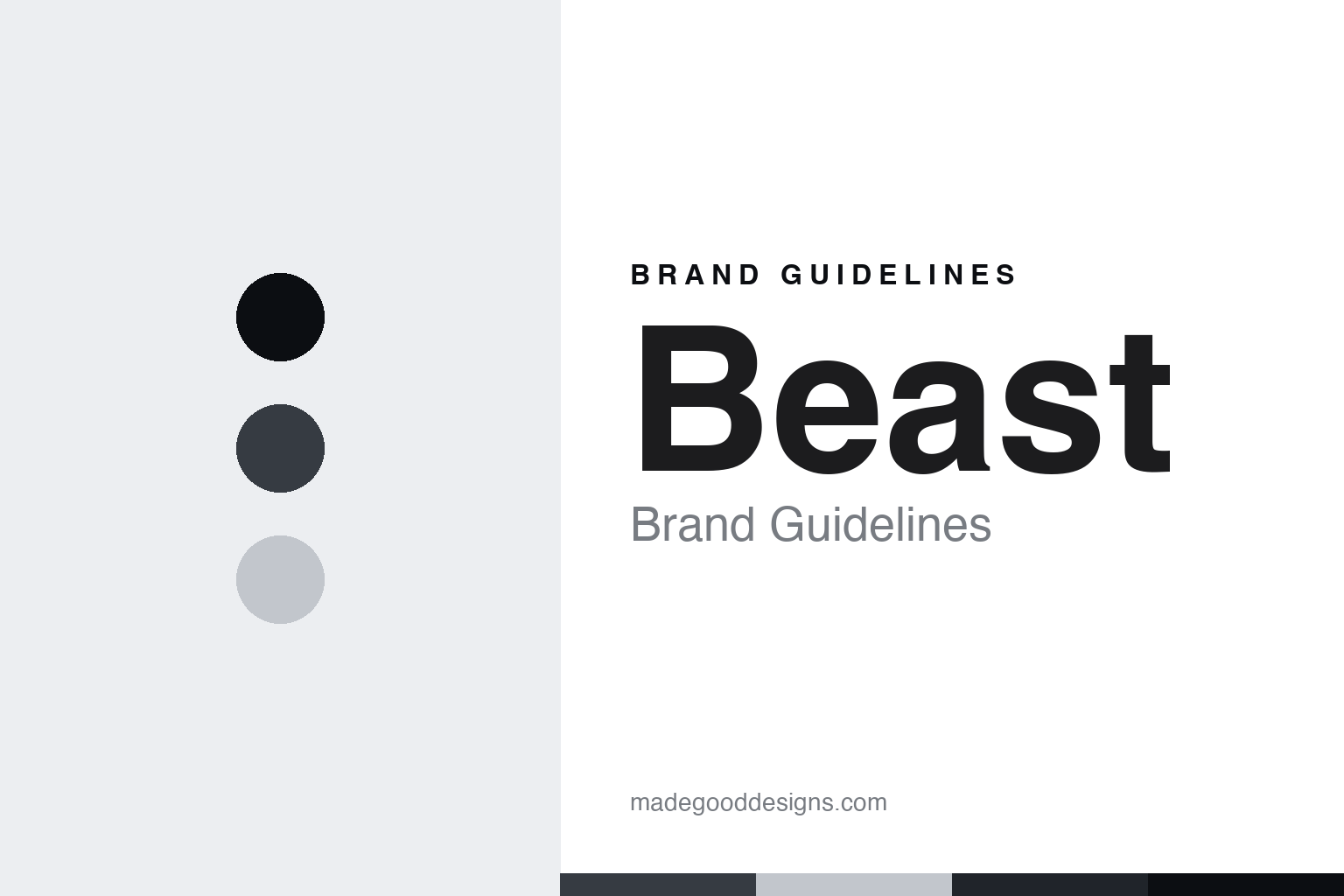
Beast Brand Guidelines
The design-led second act.
Aa
Two constants: a Beast-graphite palette and a modern-sans register. Abstract homage — not a Beast product or mark; no blender, vessel or logo is reproduced.
The design-led second act
Beast is the design-forward personal blender from the NutriBullet founder, a separate California venture built around a fluted vessel.
Beast brings the round its second-act node — the design-forward personal blender launched by the entrepreneur behind the NutriBullet, this time as a premium object rather than an infomercial buy. It is Beast Health, based in Santa Monica, California, and its answer to a round about who owns the blender and where it is made is a founder story with an honest gap: a separate Sapire venture, likely made in China though the country is not disclosed.
Its identity is the design-led second act. The design-forward vessel, the NutriBullet-founder lineage and the premium personal-blender positioning are the story here. A blender, a second act. The design-led second act.
(Honest notes, so the founder link, the ownership and the manufacturing are framed accurately. Beast sells a design-forward personal blender as its hero — the Beast Blender, with a distinctive ridged, fluted vessel — across a range including the Mega, Mighty, Mini and a cordless GO, plus a “Blended in Steel” stainless collection, with claims of medical-grade stainless vessels, stainless gearing rather than plastic, and PFAS- and BPA-free materials; we report these as the brand’s claims. On the founder link, the point that matters: Beast Health’s own materials credit its founder, Colin Sapire, as the entrepreneur who revolutionised the personal blender — the direct link to his earlier Magic Bullet and NutriBullet career, which is why he appears twice in this round. On the ownership distinction: Beast is a separate Sapire venture, not part of Capital Brands, the current owner of NutriBullet, so we do not imply the two are connected corporately. On founding: around 2020, hedged. On where it is made: not disclosed, and almost certainly China, so we say likely China. Its designs, the Beast name, the “Blended in Steel” and “strong inside” marks and the fluted vessel are IP we describe but do not reproduce; these tones are an unofficial interpretation.)
Colour
Beast lives in a Beast graphite. Click a swatch to copy the hex.
Beast’s identity is design-led, premium and modern — a Beast graphite, an ink, a pale steel, a deep slate, and a paper. The palette leans Beast graphite and pale steel: a refined, industrial register that nods to a design-forward object rather than a loud logo colour. It signals the design-led second act — design-led, premium and modern. The honest caveat: with no adopted brand hex, and with the fluted vessel treated as trade dress, these values are an original, unofficial interpretation, not first-party colours.
The lesson is a Beast graphite signals a design-led, premium identity. Beast’s world is a beautiful personal blender you leave out on the counter. For designers, it is a reminder that a refined Beast graphite and a soft pale steel can carry a hardware brand — a premium tone held as colour, not the fluted form. Because these tones can fail as small text, keep type dark and let the colour live in the accents, palette and band. The takeaways: credit Colin Sapire as founder; separate Beast from Capital Brands; hedge the year; say likely-China; and treat the fluted vessel as protected.
Typography
The register is a modern sans — design-led, premium, modern.
Beast’s identity carries a design-led, premium, modern spirit — a considered second act, not a mass gadget. A modern sans captures the mood: clean, confident and current, the register of a design-forward object built to be seen. Set in a Beast-graphite palette, the modern sans feels design-led and premium — exactly the personality Beast carries. It behaves like a made, considered thing rather than a loud logo, mirroring a vortex swirl and a fluted-facet texture. (Beast’s real products, the names and the vessel are things we describe but do not reproduce, and the exact typeface is not ours to use.) Because it is not ours to use, the honest description is “a modern-sans brand,” shown here in a stand-in. The type behaves like the brand: design-led, premium and modern.
Aa
A modern-sans brand — design-led and premium. (Specimen set in Archivo, a modern-sans STAND-IN; NOT the Beast logo or the fluted vessel.)
The blender
Beast stands for the design-led second act.
Beast brings the round its second-act node. A Beast-graphite palette, a modern sans and a founder lineage make one thing — the design-led second act — the whole identity: design-led, premium and modern. The design-forward vessel is the pitch, and the NutriBullet-founder pedigree is the proof. The point is the personal-blender pioneer returning with a premium object, in a round about who owns the blender and where it is made.
Put to work, the identity is the brand told straight, the founder credited and the corporate line kept clear. A brand in this spirit would credit Colin Sapire, separate Beast from Capital Brands, and hedge the year. A reader in this spirit would keep the facts right: Beast sells the fluted Beast Blender and a stainless collection as heroes; it is Beast Health of Santa Monica, founded by Colin Sapire around 2020; it is a separate venture from Capital Brands and NutriBullet; and it is likely made in China. Beast sits sixth in the round, after Magic Bullet. The honest editorial moves are to credit Sapire, to separate Beast from Capital Brands, to hedge the year, to say likely-China, and to treat the fluted vessel as protected.
For designers and brand-builders, Beast closes the personal-blender thread of the blender: return to a category as a premium design play — and keep the corporate lines honest. The lessons: a founder who defined a mass category can re-enter it at the premium end, selling design where they once sold volume; a distinctive vessel can be the whole identity; keep a new venture legally distinct from a former one rather than imply a corporate tie; and hedge a year and a factory you cannot confirm. It is also a reminder to stay precise: Beast is the design-forward personal blender from the NutriBullet founder, a separate California venture built around a fluted vessel — with the palette here an unofficial interpretation. The hook is that return: the entrepreneur who made the personal blender a mass-market phenomenon with Magic Bullet and NutriBullet came back with Beast, this time selling a fluted, design-forward object as a premium counter piece — a second act, separate from his former company, closing the personal-blender arc of the round. Read that way, Beast is less a gadget than a design-led second act: design-led, premium, modern. The lesson for a brand is that a design play and honest corporate lines reinforce each other, and separating Beast from Capital Brands keeps the story earned. Beast made the-design-led-second-act the identity — proof that a founder can return and carry a round.
Explore & save
Keep Beast’s identity on hand — save it to a board in the Made Good inspiration library.
Beast identity set
Pin the Beast-graphite palette and the modern-sans register to your own board.