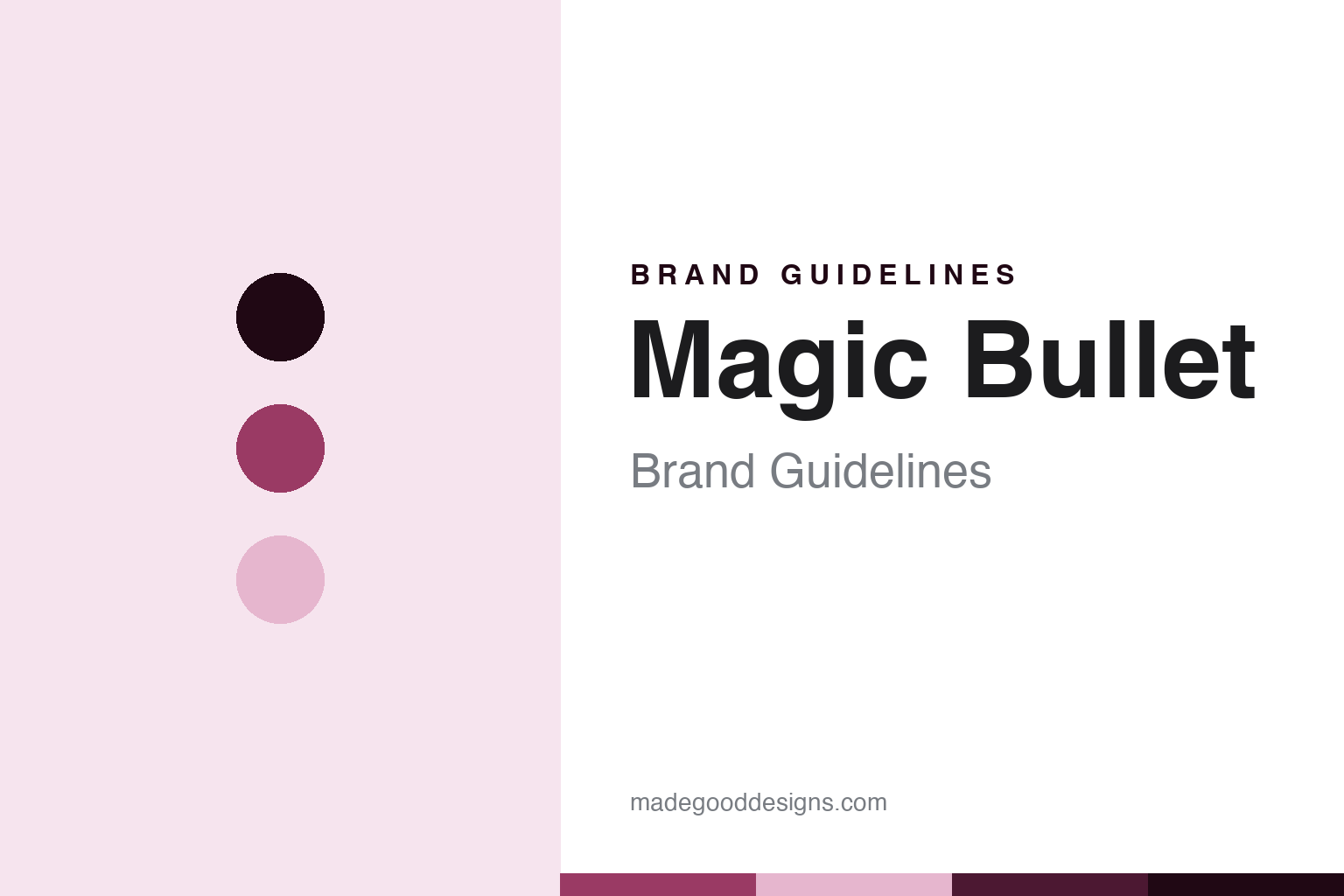
Magic Bullet Brand Guidelines
The infomercial personal blender.
Aa
Two constants: a bullet-berry palette and a popular-sans register. Abstract homage — not a Magic Bullet product or mark; no blender, cup or logo is reproduced.
The infomercial personal blender
Magic Bullet is the Capital Brands compact personal blender, sold by infomercial, that seeded the NutriBullet phenomenon.
Magic Bullet brings the round its personal-blender node — the compact, blend-in-the-cup machine that a late-night infomercial turned into a household name, and the seed of a much bigger franchise. Its answer to a round about who owns the blender and where it is made is a franchise story: a Capital Brands product, made in China, and the origin of the NutriBullet.
Its identity is the infomercial personal blender. The compact bullet form, the infomercial marketing and the NutriBullet lineage are the story here. A blender, personal. The infomercial personal blender.
(Honest notes, so the ownership, the origin and the family are framed accurately. Magic Bullet sells the original compact personal blender — a blend-in-the-cup, twist-to-lock machine — plus spin-offs like the Baby Bullet, as its heroes, and we report its language as the brand’s own. On the origin: the Magic Bullet was introduced in October 2003 by Homeland Housewares, with a development team that included Lenny Sands, Brady Caverly and Jeff Clifford, and the personal-blender empire was built by the entrepreneur Colin Sapire. On the marketing, the defining engine: it was sold through thirty-minute infomercials, reportedly earning around 250 million dollars in its first seventeen months. On the family, the point that matters: the higher-powered NutriBullet grew out of the Magic Bullet franchise, so the two are the same corporate family, not competitors, and today the operating entity is Capital Brands, doing business as nutribullet, LLC. On a report we hold back: Capital Brands has been reported to have been acquired around 2020 by another appliance group, but we could not confirm that, so we state the owner as Capital Brands. On where it is made: China. Its designs, the Magic Bullet and NutriBullet names and the bullet-cup form are IP we describe but do not reproduce; these tones are an unofficial interpretation.)
Colour
Magic Bullet lives in a bullet berry. Click a swatch to copy the hex.
Magic Bullet’s identity is popular, compact and accessible — a bullet berry, an ink, a pale rose, a deep plum, and a paper. The palette leans bullet berry and pale rose: a bright, energetic register that nods to a small, fun countertop machine rather than a loud logo colour. It signals the infomercial personal blender — popular, compact and accessible. The honest caveat: with no published brand hex, these values are an original, unofficial interpretation, not first-party colours.
The lesson is a bullet berry signals a popular, accessible identity. Magic Bullet’s world is a small cup that blends a single smoothie in seconds. For designers, it is a reminder that a bright bullet berry and a soft pale rose can carry a hardware brand — a fun tone held as colour, not the bullet-cup form. Because these tones can fail as small text, keep type dark and let the colour live in the accents, palette and band. The takeaways: date it to 2003; credit Colin Sapire and the infomercial; frame NutriBullet as the same family; name Capital Brands as owner; and place manufacturing in China.
Typography
The register is a popular sans — popular, compact, accessible.
Magic Bullet’s identity carries a popular, compact, accessible spirit — a mass-market personal blender, not a premium tool. A popular sans captures the mood: clean, friendly and approachable, the register of a machine sold to everyone on television. Set in a bullet-berry palette, the popular sans feels popular and accessible — exactly the personality Magic Bullet carries. It behaves like a made, functional thing rather than a loud logo, mirroring a vortex swirl and a pour-ripple. (Magic Bullet’s real products, the names and the bullet-cup form are things we describe but do not reproduce, and the exact typeface is not ours to use.) Because it is not ours to use, the honest description is “a popular-sans brand,” shown here in a stand-in. The type behaves like the brand: popular, compact and accessible.
Aa
A popular-sans brand — popular and compact. (Specimen set in Space Grotesk, a popular-sans STAND-IN; NOT the Magic Bullet logo or the bullet-cup form.)
The blender
Magic Bullet stands for the infomercial personal blender.
Magic Bullet brings the round its personal-blender node. A bullet-berry palette, a popular sans and a 2003 introduction make one thing — the infomercial personal blender — the whole identity: popular, compact and accessible. The compact bullet form is the pitch, and the infomercial reach is the proof. The point is a small machine that television made ubiquitous and that grew into the NutriBullet, in a round about who owns the blender and where it is made.
Put to work, the identity is the brand told straight, the origin credited and the family named. A brand in this spirit would date it to 2003, credit Colin Sapire and the infomercial, and frame NutriBullet as the same family. A reader in this spirit would keep the facts right: Magic Bullet sells the compact personal blender and spin-offs as heroes; it was introduced in 2003 by Homeland Housewares, built by Colin Sapire; it was sold via infomercials; the NutriBullet grew from it; the owner is Capital Brands; and it is made in China. Magic Bullet sits fifth in the round, after Waring. The honest editorial moves are to date it to 2003, to credit Sapire and the infomercial, to frame NutriBullet as the same family, to name Capital Brands, and to place manufacturing in China.
For designers and brand-builders, Magic Bullet continues the blender: make a format and a channel the identity — and map the franchise family honestly. The lessons: invent a format, here the personal blend-in-the-cup, and own it; let a channel, the infomercial, define reach as much as the product; understand that a spin-off — NutriBullet — can outgrow the original while staying family; and attribute ownership to the entity you can confirm rather than an unverified acquisition. It is also a reminder to stay precise: Magic Bullet is the Capital Brands compact personal blender, sold by infomercial, that seeded the NutriBullet phenomenon — with the palette here an unofficial interpretation. The hook is that lineage: the little Magic Bullet, sold in thirty-minute infomercials from 2003, was the seed from which the higher-powered NutriBullet grew — the same corporate family, the same personal-blender idea scaled up, and the same entrepreneur, Colin Sapire, who reappears later in this very round. Read that way, Magic Bullet is less a gadget than an infomercial personal blender: popular, compact, accessible. The lesson for a brand is that a format-and-channel identity and an honest family map reinforce each other, and naming Capital Brands keeps the story earned. Magic Bullet made the-infomercial-personal-blender the identity — proof that a format can carry a round.
Explore & save
Keep Magic Bullet’s identity on hand — save it to a board in the Made Good inspiration library.
Magic Bullet identity set
Pin the bullet-berry palette and the popular-sans register to your own board.