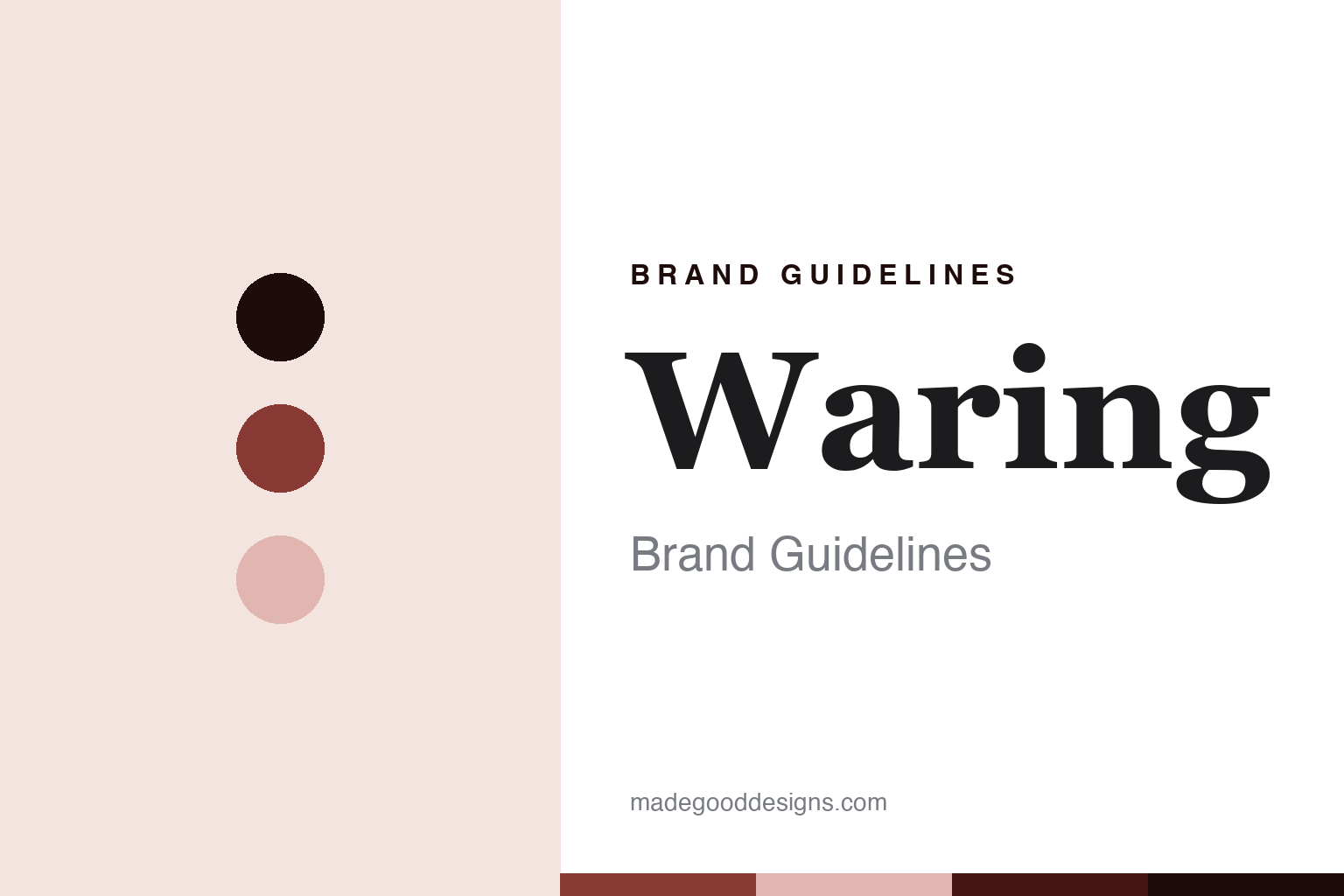
Waring Brand Guidelines
The pioneering blendor.
Aa
Two constants: a vintage-oxblood palette and a vintage-serif register. Abstract homage — not a Waring product or mark; no blender, jar or logo is reproduced.
The pioneering blendor
Waring is the Conair-owned name behind the pioneering Waring Blendor, invented by Frederick Osius and famously used in Salk’s polio research.
Waring brings the round its pioneering node — the name on one of the first commercially successful electric blenders, and a machine that ended up in a laboratory as often as a bar. It is a division of Conair, and its answer to a round about who owns the blender and where it is made is a history that needs one correction: the bandleader Fred Waring gave the machine his name and his money, but he did not invent it.
Its identity is the pioneering blendor. The pioneering electric blender, the corrected invention record and the scientific footnote are the story here. A blender, pioneering. The pioneering blendor.
(Honest notes, so the invention, the ownership and the history are framed accurately, because the origin is widely told wrong. Waring sells commercial bar blenders as its heritage flagship, and we report its language as its own. On the invention, the correction that matters: the device was invented by Frederick J. Osius, who filed a patent in 1937 that was granted in 1938, and it debuted as the “Miracle Mixer”; the bandleader Fred Waring was the promoter and financier and namesake, and in 1938 the Miracle Mixer Corporation was renamed the Waring Corporation and the product the “Waring Blendor,” with the “-or” spelling deliberate. So Fred Waring did not invent the blender. On the overclaim, corrected: it was one of the first commercially successful electric blenders, not the first ever, since earlier drink-mixer devices existed, so we say pioneering, not first. On a genuine footnote: Jonas Salk used a Waring Blendor in his polio-vaccine research, and the millionth Blendor sold in 1954. On ownership: Waring is a division of Conair, privately controlled by the Rizzuto family. On where it is made: its commercial foodservice line is partly US-made or assembled, while consumer products are largely imported. Its designs, the Waring name and the historic branding are IP we describe but do not reproduce; these tones are an unofficial interpretation.)
Colour
Waring lives in a vintage oxblood. Click a swatch to copy the hex.
Waring’s identity is pioneering, historic and foodservice-rooted — a vintage oxblood, an ink, a pale rose, a deep maroon, and a paper. The palette leans vintage oxblood and pale rose: a heritage, mid-century-bar register that nods to a pioneering electric blender rather than a loud logo colour. It signals the pioneering blendor — pioneering, historic and foodservice-rooted. The honest caveat: with no adopted brand hex, these values are an original, unofficial interpretation, not first-party colours.
The lesson is a vintage oxblood signals a pioneering, historic identity. Waring’s world is a chrome bar blender from the age when the machine was new. For designers, it is a reminder that a vintage oxblood and a soft pale rose can carry a hardware brand — a heritage tone held as colour, not a product shot. Because these tones can fail as small text, keep type dark and let the colour live in the accents, palette and band. The takeaways: credit Osius as inventor, not Fred Waring; say one-of-the-first, not the first; keep the Salk footnote and the deliberate “Blendor” spelling; name Conair; and split the where-made.
Typography
The register is a vintage serif — pioneering, historic, foodservice-rooted.
Waring’s identity carries a pioneering, historic, foodservice-rooted spirit — a heritage name from the birth of the category, not a modern brand. A vintage serif captures the mood: classic, warm and established, the register of a machine that has been on bars and in labs for decades. Set in a vintage-oxblood palette, the vintage serif feels pioneering and historic — exactly the personality Waring carries. It behaves like a made, lasting thing rather than a loud logo, mirroring a vortex swirl and a chrome-facet texture. (Waring’s real products and the historic branding are things we describe but do not reproduce, and the exact typeface is not ours to use.) Because it is not ours to use, the honest description is “a vintage-serif brand,” shown here in a stand-in. The type behaves like the brand: pioneering, historic and foodservice-rooted.
Aa
A vintage-serif brand — pioneering and historic. (Specimen set in Cormorant, a vintage-serif STAND-IN; NOT the Waring logo or any historic label.)
The blender
Waring stands for the pioneering blendor.
Waring brings the round its pioneering node. A vintage-oxblood palette, a vintage serif and a 1937–38 origin make one thing — the pioneering blendor — the whole identity: pioneering, historic and foodservice-rooted. The pioneering electric blender is the pitch, and the corrected invention record is the honest twist. The point is a machine that helped start the category and still runs foodservice bars, in a round about who owns the blender and where it is made.
Put to work, the identity is the brand told straight, the inventor credited and the overclaim corrected. A brand in this spirit would credit Osius as inventor, say one-of-the-first, and keep the Salk footnote. A reader in this spirit would keep the facts right: Waring sells commercial bar blenders as its heritage flagship; the Waring Blendor was invented by Frederick Osius and named for financier Fred Waring; it was one of the first successful electric blenders, not the first; Jonas Salk used one in polio research; and it is a division of Conair. Waring sits fourth in the round, after Oster. The honest editorial moves are to credit Osius, to say one-of-the-first, to keep the Salk footnote and the “Blendor” spelling, to name Conair, and to split the where-made.
For designers and brand-builders, Waring continues the blender: own a pioneering history — and correct the invention record honestly. The lessons: a brand can be genuinely pioneering without being literally first, so “one of the first” is the honest claim; a namesake is not always the inventor, and crediting the real one, Osius, respects the record; a surprising true footnote — a blender in polio research — is worth keeping; and heritage branding is to describe, not reproduce. It is also a reminder to stay precise: Waring is the Conair-owned name behind the pioneering Waring Blendor, invented by Frederick Osius and famously used in Salk’s polio research — with the palette here an unofficial interpretation. The hook is that correction: the “Waring Blendor” carries a bandleader’s name, but the machine was invented by Frederick Osius as the “Miracle Mixer,” financed and renamed by Fred Waring in 1938 — a pioneering electric blender, one of the first though not the first, that even helped Jonas Salk’s polio research. Read that way, Waring is less a bandleader’s invention than a pioneering blendor: pioneering, historic, foodservice-rooted. The lesson for a brand is that a pioneering history and an honest invention record reinforce each other, and crediting Osius keeps the story earned. Waring made the-pioneering-blendor the identity — proof that history, told straight, can carry a round.
Explore & save
Keep Waring’s identity on hand — save it to a board in the Made Good inspiration library.
Waring identity set
Pin the vintage-oxblood palette and the vintage-serif register to your own board.