Cleanblend Brand Guidelines
The value challenger.
Aa
Two constants: a power-tangerine palette and a value-sans register. Abstract homage — not a Cleanblend product or mark; no blender, jar or logo is reproduced.
The value challenger
Cleanblend is the founder-owned San Diego brand offering high-power, Vitamix-class blending at a value price.
Cleanblend closes the blender round as its value node — the challenger that offers high-power, near-premium blending for a fraction of the flagship price. It is Cleanblend, based in San Diego, California, and its answer to a round about who owns the blender and where it is made is a plain value story: a small, founder-owned brand, likely made in China, competing on power per dollar.
Its identity is the value challenger. The high-power value blending, the founder ownership and the price-to-power pitch are the story here. A blender, value. The value challenger.
(Honest notes, so the ownership, the positioning and the unknowns are framed accurately. Cleanblend sells a high-power countertop blender as its hero — the Cleanblend Classic and Commercial, with a roughly three-horsepower, 1800-watt motor, a stainless eight-blade assembly and a large BPA-free jar, backed by a five-year warranty — and we report its performance claims as its own. On ownership: it is privately held by its co-founders, Doug Hall and Alex Podell, with no parent company. On founding: around 2013 to 2014, hedged. On the positioning, the real identity: Cleanblend is a value challenger, offering a high-power blender as an alternative to premium names like Vitamix and Blendtec at a lower price, and it markets a philanthropic tie to a children’s charity. On where it is made: not stated, and likely China, so we say likely China. Its designs and the Cleanblend name are IP we describe but do not reproduce, and we imply no affiliation with the premium brands it is compared to; these tones are an unofficial interpretation.)
Colour
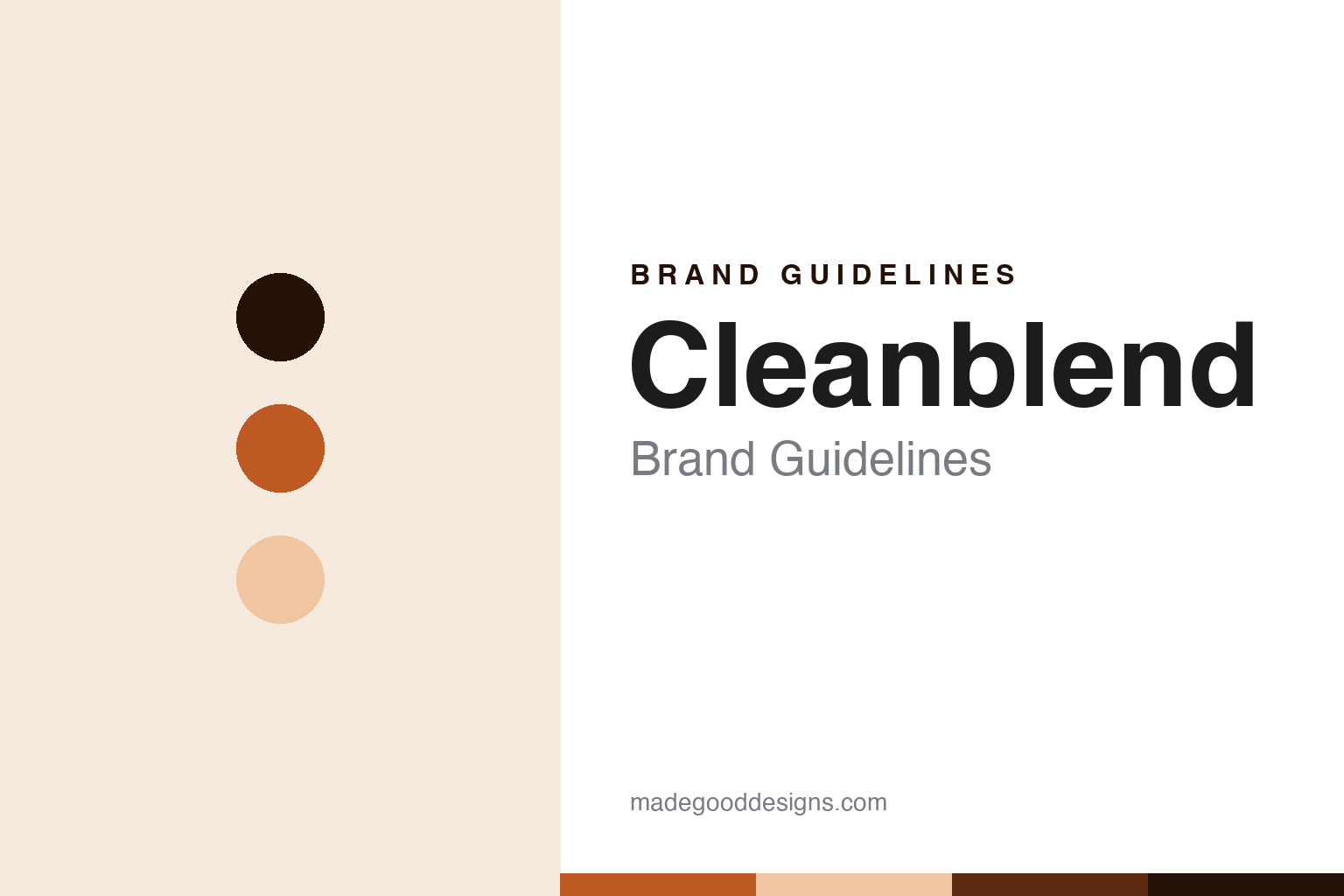
Cleanblend lives in a power tangerine. Click a swatch to copy the hex.
Cleanblend’s identity is powerful, affordable and direct — a power tangerine, an ink, a pale peach, a deep rust, and a paper. The palette leans power tangerine and pale peach: a warm, energetic register that nods to high-power value rather than a loud logo colour. It signals the value challenger — powerful, affordable and direct. The honest caveat: with no published brand hex, these values are an original, unofficial interpretation, not first-party colours.
The lesson is a power tangerine signals a powerful, affordable identity. Cleanblend’s world is a big-motor blender that costs far less than the premium name. For designers, it is a reminder that a warm power tangerine and a soft pale peach can carry a hardware brand — an energetic tone held as colour, not a product shot. Because these tones can fail as small text, keep type dark and let the colour live in the accents, palette and band. The takeaways: name the co-founders; hedge the year; keep it a value challenger; say likely-China; and imply no affiliation with the premium brands.
Typography
The register is a value sans — powerful, affordable, direct.
Cleanblend’s identity carries a powerful, affordable, direct spirit — a value challenger, not a heritage maker. A value sans captures the mood: clean, plain and confident, the register of a high-power machine at a fair price. Set in a power-tangerine palette, the value sans feels powerful and affordable — exactly the personality Cleanblend carries. It behaves like a made, functional thing rather than a loud logo, mirroring a vortex swirl and a blade-star texture. (Cleanblend’s real products and the name are things we describe but do not reproduce, and the exact typeface is not ours to use.) Because it is not ours to use, the honest description is “a value-sans brand,” shown here in a stand-in. A value sans also keeps the promise plain — power and price, stated without ornament, the way a challenger earns trust against names that spend more on the badge than the motor. The type behaves like the brand: powerful, affordable and direct.
Aa
A value-sans brand — powerful and affordable. (Specimen set in Work Sans, a value-sans STAND-IN; NOT the Cleanblend logo or livery.)
The blender
Cleanblend stands for the value challenger.
Cleanblend closes the blender round as its value node. A power-tangerine palette, a value sans and a founder ownership make one thing — the value challenger — the whole identity: powerful, affordable and direct. The high-power value blending is the pitch, and the price-to-power ratio is the proof. The point is a small brand that offers premium power for less, in a round about who owns the blender and where it is made.
Put to work, the identity is the brand told straight, the founders named and the unknowns hedged. A brand in this spirit would name the co-founders, hedge the year, and keep it a value challenger. A reader in this spirit would keep the facts right: Cleanblend sells a high-power Classic and Commercial blender as heroes; it is founder-owned by Doug Hall and Alex Podell in San Diego; it launched around 2013; it competes on power per dollar against Vitamix and Blendtec; and it is likely made in China. Cleanblend closes the round, after Beast. The honest editorial moves are to name the co-founders, to hedge the year, to keep it a value challenger, to say likely-China, and to imply no affiliation with the premium brands.
For designers and brand-builders, Cleanblend closes the blender: compete on power per dollar — and stay honest about being a challenger, not a heritage brand. The lessons: win a slice of a premium category by matching its power at a lower price; keep a small, founder-owned structure as a genuine identity; be clear that a challenger is inspired by, not affiliated with, the premium names it is compared to; and hedge a year and a factory you cannot confirm. It is also a reminder to stay precise: Cleanblend is the founder-owned San Diego brand offering high-power, Vitamix-class blending at a value price — with the palette here an unofficial interpretation. The hook is that value: where the round runs from a Utah powerhouse to a mid-century icon to a design-led second act, Cleanblend closes it on the value end, a small founder-owned brand offering a three-horsepower motor at a fraction of the premium price — a challenger, honest about being an alternative rather than an heir. Read that way, Cleanblend is less a premium rival than a value challenger: powerful, affordable, direct. The lesson for a brand is that price-to-power and honest positioning reinforce each other, and staying clear of any premium affiliation keeps the story earned. Cleanblend made the-value-challenger the identity — proof that value can close a round.
Explore & save
Keep Cleanblend’s identity on hand — save it to a board in the Made Good inspiration library.
Cleanblend identity set
Pin the power-tangerine palette and the value-sans register to your own board.