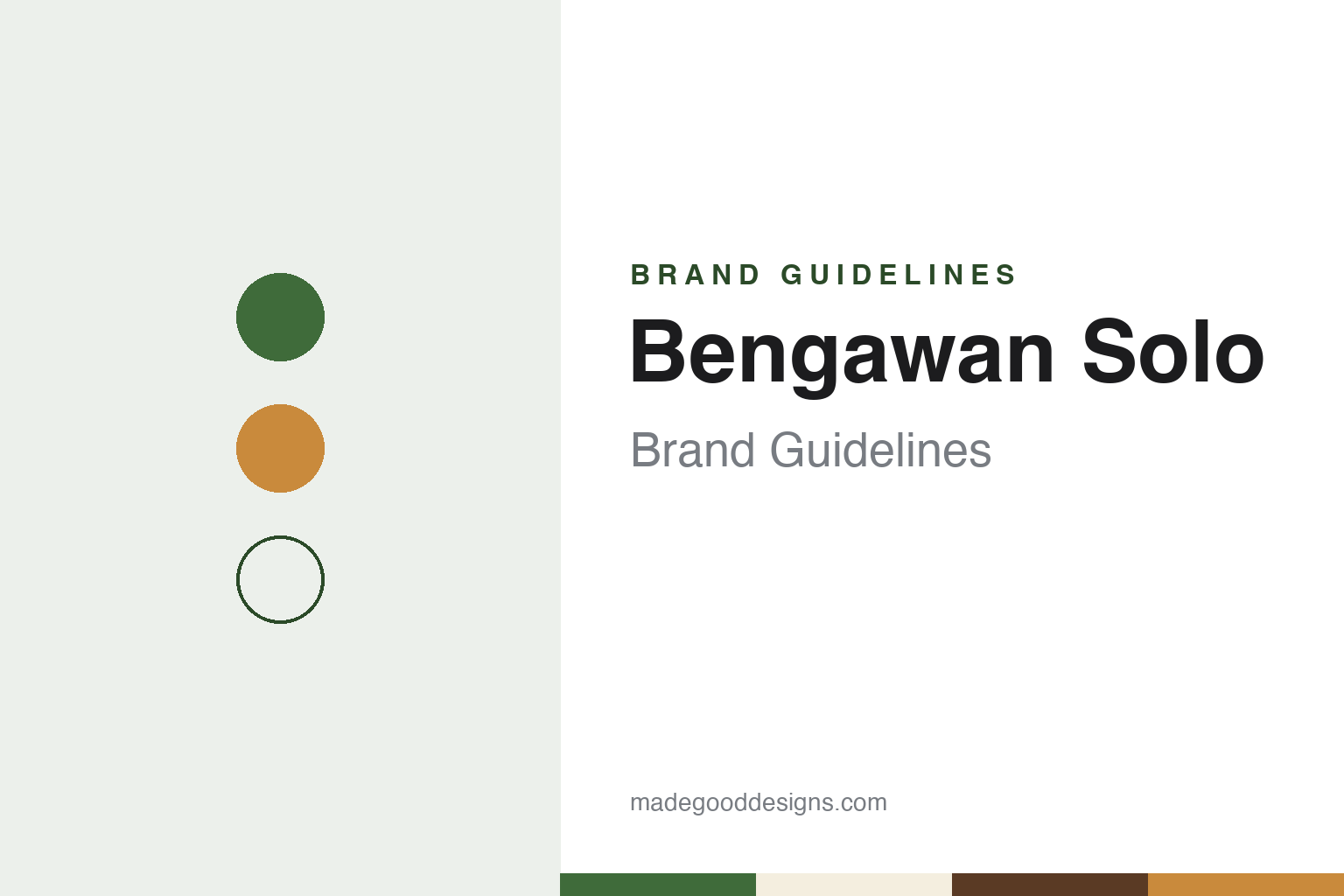
Bengawan Solo Brand Guidelines
A Marine Terrace corner shop that took kueh to the airport.
Aa
Two constants: a pandan green, batik brown and cream palette and a woodcut-style serif register. Abstract homage — not a Bengawan Solo product or mark; no cake, logo or packaging is reproduced.
Marine Terrace
A home kitchen, a licence and a corner shop.
Bengawan Solo began in a home kitchen in Singapore. Its founder, Anastasia Liew (also written Anastasia Tjendri-Liew), came to Singapore from Palembang in Indonesia in the early 1970s, English Wikipedia says. She baked butter cakes, lapis sagu and chiffon cakes at home and sold them through supermarkets and shops. English Wikipedia dates the start of that home business to 1975; Monocle, in a November 2014 profile, dates it to 1976 and says she had learned the craft from her mother.
The shop came because the rules required one. Monocle reported that the business was “officially created in 1979” after it emerged that she lacked the proper licence, and that she chose to open a shop rather than stop selling. CNN reported in May 2025 that she “had to open a shop to meet the licensing requirements to sell to department stores.” The first Bengawan Solo Cake Shop opened in 1979 as a small neighbourhood corner store at Marine Terrace, on Singapore’s east coast, the company says.
The name is borrowed. The company says Liew named the shop after a song she loved about the Solo River in Java; “bengawan” is an old Javanese word for river. English Wikipedia ties the name to the Indonesian song and to the river of the same name.
Growth followed a steady line. In 1983 the second shop opened at Centrepoint on Orchard Road, according to both the company and English Wikipedia. By 1987, after three more outlets, the business needed a central kitchen, which it set up in Harvey Road, Macpherson. By 1997 the company says it had about 18 stores, and production moved north that year to a single site in Woodlands; Monocle gives the same year for the move and adds that a new wing followed in 2009. The company says it doubled its production space by taking over the neighbouring unit in 2010.
The business has stayed with the family. Monocle described Liew’s son Henry Liew learning the recipes alongside her in the Woodlands kitchen while heading business development, and CNN identified him in 2025 as a company director. The company trades as Bengawan Solo Pte Ltd.
Colour
Kueh, chiffon and a central kitchen.
Bengawan Solo’s range is built on Indonesian-style and Singaporean kueh alongside Western-style cakes. English Wikipedia lists pandan chiffon, lapis cake, pineapple tarts and ondeh-ondeh among its most popular items, and explains the Indonesian character of the range through the founder’s Palembang roots. The company’s own list adds kueh salat, lapis sagu, macadamia sugee cookies and kueh bangkit, a coconut cookie, as well as celebration cakes, mooncakes and licensed character cakes.
Monocle described the range in 2014 as a product line of about 100 cakes and pastries, and singled out kueh lapis, an 18-layer spiced cake that takes about two hours to bake. It also described ondeh ondeh as coconut-dusted glutinous rice dumplings filled with palm sugar.
Everything is baked centrally. English Wikipedia says all products are prepared at the central kitchen in Woodlands and delivered to the stores two to three times a day. Monocle reported in 2014 that the kitchen sent 54,000 cakes a day to 40 shops and rested for two days at Chinese New Year, and that the company then employed about 400 staff.
The pandan chiffon cake is the product most associated with the brand. CNN reported in May 2025 that pandan chiffon cakes began appearing in Singapore in the 1970s, according to the food historian Khir Johari, and that Johari credits one family-owned bakery with helping take the cake citywide. CNN described the pandan chiffon as the product the company is most widely known for. It also reported that the family uses mostly local ingredients and buys its pandan leaves from just across the border in Malaysia.
One custom became a product line. In the mid-1990s, the company says, it introduced Baby’s First Month vouchers, built on the tradition of giving cakes, red eggs and angku kueh when a baby turns one month old, so that the gift could be redeemed at any of its shops.
Typography
Singapore’s café and bakery chains.
Malaysian and Singaporean food chains tend to tell their story through the shop itself. Kopitiam chains present a coffee-shop past inside modern premises: Ya Kun Kaya Toast puts the same posters about its old stall in every outlet, according to a case study by the World Intellectual Property Organization, while Killiney Kopitiam still trades from the shophouse where its predecessor opened in 1919. Bakery, cake and bubble-tea chains often lean instead on bright counters, packaged goods and the look of the cup, box or bag a customer carries away.
Menus are written dish by dish and drink by drink. Kaya toast, soft-boiled eggs, laksa and nasi lemak appear under their everyday names, and coffee and tea orders often keep the local shorthand of the kopitiam, such as kopi O or teh C, which some chains explain on their own websites for newcomers.
Store networks are something the companies publish themselves. Websites list outlets at home and abroad, often in malls, food courts and airport terminals, and franchise pages set out what a partner receives: the trade name, trademarks, training and support. Counts change quickly, so this guide gives each one with the date and source it comes from.
Ownership is described plainly. Some chains remain family businesses passed to a second generation; others belong to listed groups or larger food companies, or have changed hands as their franchise networks grew. Corporate pages on founders, owners and franchise partners are where each company sets out its own account, and this guide marks clearly which facts rest only on that account.
Aa
A woodcut-style serif — the company describes its 2005 logo as using woodcut-style letters. (Specimen set in Fraunces, a serif STAND-IN; NOT the Bengawan Solo logo.)
Bengawan Solo
From pink script to batik.
The company has changed its look twice in ways it documents itself. In the 1990s, it says, the logo was redrawn in a lighter script in pink with green accents, and the shops took on clean lines and a pink-and-cream scheme. In 2005 a further rebranding returned to South-East Asian roots: batik became a stylistic feature, and the new logo was “inspired by a traditional Asian crest” with woodcut-style letters, the company says. The shops were fitted in dark wood, with bold colours and pictures of the signature products on the walls.
The airport became the shop window. The company says its first branch at Changi Airport opened in 1998 in the Terminal 1 departure lounge, followed by outlets in Terminal 2 and in the Terminal 1 transit area. CNN reported in May 2025 that there were five Bengawan Solo stores at Changi, one in each departure terminal. CNN also reported that the family had considered opening shops abroad but had met barriers such as high rents in Hong Kong.
Other formats have been tried. In 2008, the company says, it opened a shop-café in Serangoon Gardens serving local coffee and tea, kaya toast and eggs alongside its cakes. In 2019, for its 40th anniversary, the company says, it opened a flagship store at Jewel Changi Airport, with references to the Botanic Gardens, fresh flowers and batik, and a demonstration counter where visitors could watch kueh lapis being made.
As of May 2025, Bengawan Solo had more than 40 shops in Singapore, CNN reported; English Wikipedia gives a figure of 45 outlets. The company remains Singapore-based and family-run, with production in Woodlands.
For a design guide, Bengawan Solo shows how a bakery can carry its origins into its identity: a name taken from a Javanese river song, batik patterns on the shop walls and a single kitchen behind every counter. Compare BreadTalk, another Singapore bakery chain, and Old Chang Kee, a Singapore snack chain. For this guide we use pandan green, batik brown and a warm cream with a serif, an unofficial interpretation; no product or logo is reproduced.
Explore & save
Keep Bengawan Solo’s identity on hand — save it to a board in the Made Good inspiration library.
Bengawan Solo identity set
Pin the Bengawan Solo pandan green, batik brown and cream palette and the woodcut serif register to your own board.
Source & notes
Frequently Asked Questions
What font can I use to match the Bengawan Solo look?
This guide describes Bengawan Solo’s type as “A woodcut-style serif — the company describes its 2005 logo as using woodcut-style letters”. Its type specimen is set in Fraunces from Google Fonts as a stand-in; Fraunces is not Bengawan Solo’s own lettering.
What colours are in the Bengawan Solo palette?
This guide’s Bengawan Solo palette is Pandan green #3F6B3A, Batik brown #5A3A24, Lapis amber #C98A3C, Rice cream #F4EEDF and Kitchen ink #1F1C17. The tones are the guide’s own unofficial interpretation, not official Bengawan Solo hex codes.
When was Bengawan Solo founded?
Bengawan Solo was founded in 1979 (first shop), in Marine Terrace, Singapore.
Who founded Bengawan Solo?
Bengawan Solo was founded by Anastasia Liew in 1979 (first shop).


