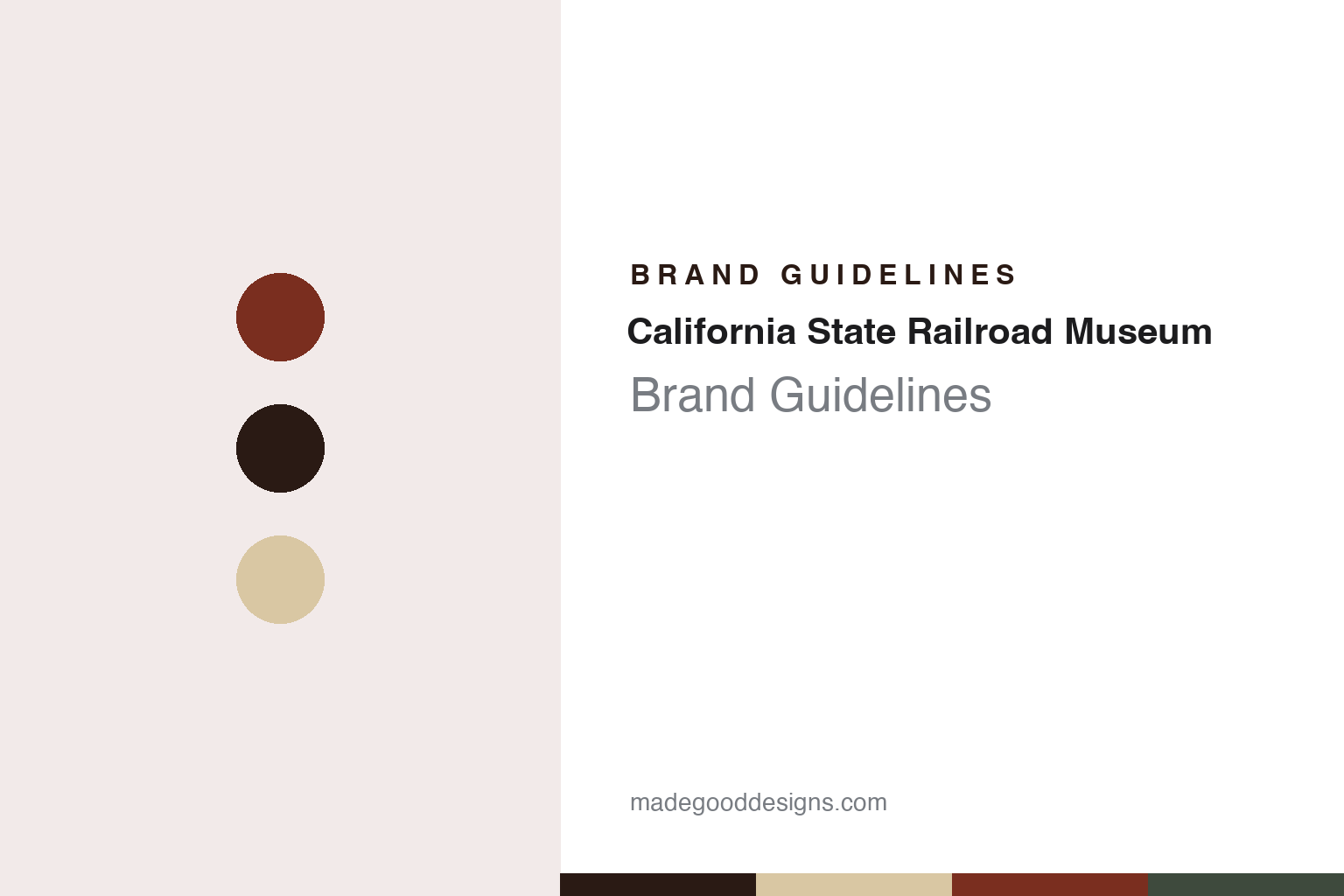
California State Railroad Museum Brand Guidelines
A state park museum of Western railroading on the Sacramento riverfront.
Aa
Two constants: a brick red, smokebox black and ballast sand palette and a depot slab serif register. Abstract homage — not a California State Railroad Museum asset; no locomotive, logo or sign is reproduced.
From a society to a state museum
Enthusiasts, a state park and a riverfront.
The California State Railroad Museum sits in Old Sacramento State Historic Park, on the riverfront of California’s capital, and is part of the California State Parks system, the museum says. Its roots go back further than its buildings. English Wikipedia traces the idea to 1937, when railroad enthusiasts in the San Francisco Bay Area formed the Pacific Coast Chapter of the Railway & Locomotive Historical Society. That group spent years arguing for a railroad museum and gave historic locomotives and cars to the California Department of Parks and Recreation as the nucleus of a state-run museum in Sacramento.
The museum’s own account of its collection dates that founding gift to 1969, followed in 1977 by a major transfer of existing railroad collections from the state parks department. The first building to open, in 1976, was a reconstruction of the Central Pacific Railroad Passenger Station on Front Street, according to English Wikipedia; the main building, the Railroad History Museum, followed in 1981. The Smithsonian’s affiliate listing gives 1981 as the year the museum was established and says it is operated by the State of California together with the California State Railroad Museum Foundation. A reconstructed Central Pacific freight depot opened in 1987, English Wikipedia says, and in 1992 Railtown 1897 State Historic Park in Jamestown, in the Sierra foothills, came under the museum. The museum became a Smithsonian affiliate in June 2017.
The setting carries much of the story. California State Parks describes Old Sacramento as a district of more than 50 historic buildings, significant as the western end of the Pony Express, of what the agency calls the first transcontinental railroad, and of the transcontinental telegraph; the National Park Service named the original 1850s business district a National Historic Landmark in 1965. Its Gold Rush commercial buildings include the 1849 Eagle Theater, the 1853 B. F. Hastings Building, once home to the California Supreme Court, and the 1855 Big Four Building, the agency says.
Colour
Locomotives, railcars and the people around them.
The main building holds 21 restored locomotives and cars, the museum says, within more than 225,000 square feet of exhibit space across the complex. Among them are a Pullman-style sleeping car, a dining car laid with railroad china and a Railway Post Office car that visitors can step into. English Wikipedia describes a large “Sierra Scene,” a recreation of construction high in the Sierra Nevada near Donner Pass around 1867, built around the locomotive Gov. Stanford, Central Pacific No. 1, a Norris-built engine of 1862. Other locomotives it lists include the C. P. Huntington of 1863 and Southern Pacific 4294, a Baldwin “cab-forward” of 1944 that it describes as the only survivor of its type. The museum’s visitor pages point families to the cab-forward and the mail car as places to get hands-on.
The collection reaches well beyond full-size equipment. The museum says it holds rolling stock, fine art, scale models and millions of photographs, documents and recordings, and that its holdings have grown through gifts from institutions and railroads including the Bancroft Library, the Smithsonian Institution, Southern Pacific, Western Pacific, Union Pacific and the Santa Fe. A library and archive hold books, technical drawings, photographs and railroad ephemera; English Wikipedia notes that a large share of the drawings came from the Southern Pacific and the Lima Locomotive Works.
Exhibits also cover the people who built and used the railroads. The museum describes displays on the contributions of Chinese railroad workers and on the experience of early 20th-century passengers. Not everything is on show at once: English Wikipedia says equipment rotates through a roundhouse area and is otherwise stored and worked on in surviving buildings of the former Southern Pacific shops at the Sacramento Railyards. California State Parks says the state’s Public Works Board approved buying the Boiler Shop and leasing the Erecting Shop there in September 2017, with the deal closing in early 2018.
Typography
The category.
A transport, railway or maritime museum usually has an organisation behind its name: a charitable trust, a city service, a state or national agency, or a museum group that runs several sites under one umbrella. Some began as collections kept by railway companies or transport operators, which set aside old buses, locomotives or carriages as they left service, and only later passed into public hands. The founding date of a collection and the opening date of its present building are often decades apart.
The buildings are often second-hand. Former flower markets, locomotive depots, goods yards, goods stations and railway stations have been turned into galleries, and many keep the features of their first use: a turntable at the centre of an engine shed, long roofs over former platforms, rail links that still let large vehicles in and out. Other museums commission purpose-built halls, sometimes with dramatic roofs, and a few are built around a single ship that sits at the heart of the museum.
Collections are usually described in general terms: locomotives and rolling stock, buses, trams, cars, aircraft and vessels, together with signals, tickets, uniforms, models, posters, photographs and engineering drawings. Many museums keep a separate store or depot for objects not on show, open to visitors on set days, and run programmes for schools, families and researchers, from libraries and archives to guided tours.
Visual identity in this category tends to borrow from transport design itself. Museums linked to a transport operator may use that operator’s symbols, lettering and colours, and the liveries, nameplates and posters in the collection give designers a ready vocabulary of their own. Refurbishments and reopenings, each with its own dates and architects, often bring a refreshed identity with them.
Aa
A sturdy slab serif in the spirit of depot boards and timetable headings. (Specimen set in Zilla Slab, a slab-serif STAND-IN; NOT the California State Railroad Museum logo.)
California State Railroad Museum
A museum for all ages, inside a historic district.
The museum describes a mezzanine with building blocks and chalkboards, a third floor of toy trains with a full-size toy layout and a play area for children aged five and under, a weekly railroad story time for toddlers, and a replica hardware store outside the main building where visitors can try historic woodworking tools. It also offers school field trips, digital programmes and a podcast, and says it has received sensory-inclusive certification from KultureCity, with sensory bags and quiet areas available. The museum says more than 500,000 people visit each year.
Two organisations stand behind the name. The museum itself is a unit of California State Parks, while the California State Railroad Museum Foundation describes itself as an official cooperating association with California State Parks and a non-profit that funds programmes at the museum and at Railtown 1897 in Jamestown. The museum’s collection pages say it operates some of its full-size equipment, digitises archival documents for researchers and frames its collecting around the line “Our lives are made of railroad stories,” telling railroad history through the people who lived it.
For a design guide, the California State Railroad Museum shows how a state agency, a volunteer society and a historic street front can share one name, with locomotives as the headline and archives behind them. Compare Union Pacific, one of the railroads the museum names among its collection donors, and the Petersen Automotive Museum, another California transport museum. For this guide we use a brick red, a smokebox black and a ballast sand with a slab serif, an unofficial interpretation; no product or logo is reproduced.
Explore & save
Keep California State Railroad Museum’s identity on hand — save it to a board in the Made Good inspiration library.
California State Railroad Museum identity set
Pin the brick red, smokebox black and ballast sand palette and the depot slab serif register to your own board.
Source & notes
Frequently Asked Questions
What font can I use to match the California State Railroad Museum look?
This guide describes California State Railroad Museum’s type as “A sturdy slab serif in the spirit of depot boards and timetable headings”. Its type specimen is set in Zilla Slab from Google Fonts as a stand-in; Zilla Slab is not California State Railroad Museum’s own lettering.
What colours are in the California State Railroad Museum palette?
This guide’s California State Railroad Museum palette is Firebox brick #7A2E1F, Smokebox black #2A1A14, Ballast sand #D9C7A3, Depot green #3E4A3D and Ticket paper #F6F1E7. The tones are the guide’s own unofficial interpretation, not official California State Railroad Museum hex codes.
When was California State Railroad Museum founded?
California State Railroad Museum was founded in 1976 (first building); main museum 1981, in Sacramento, California.