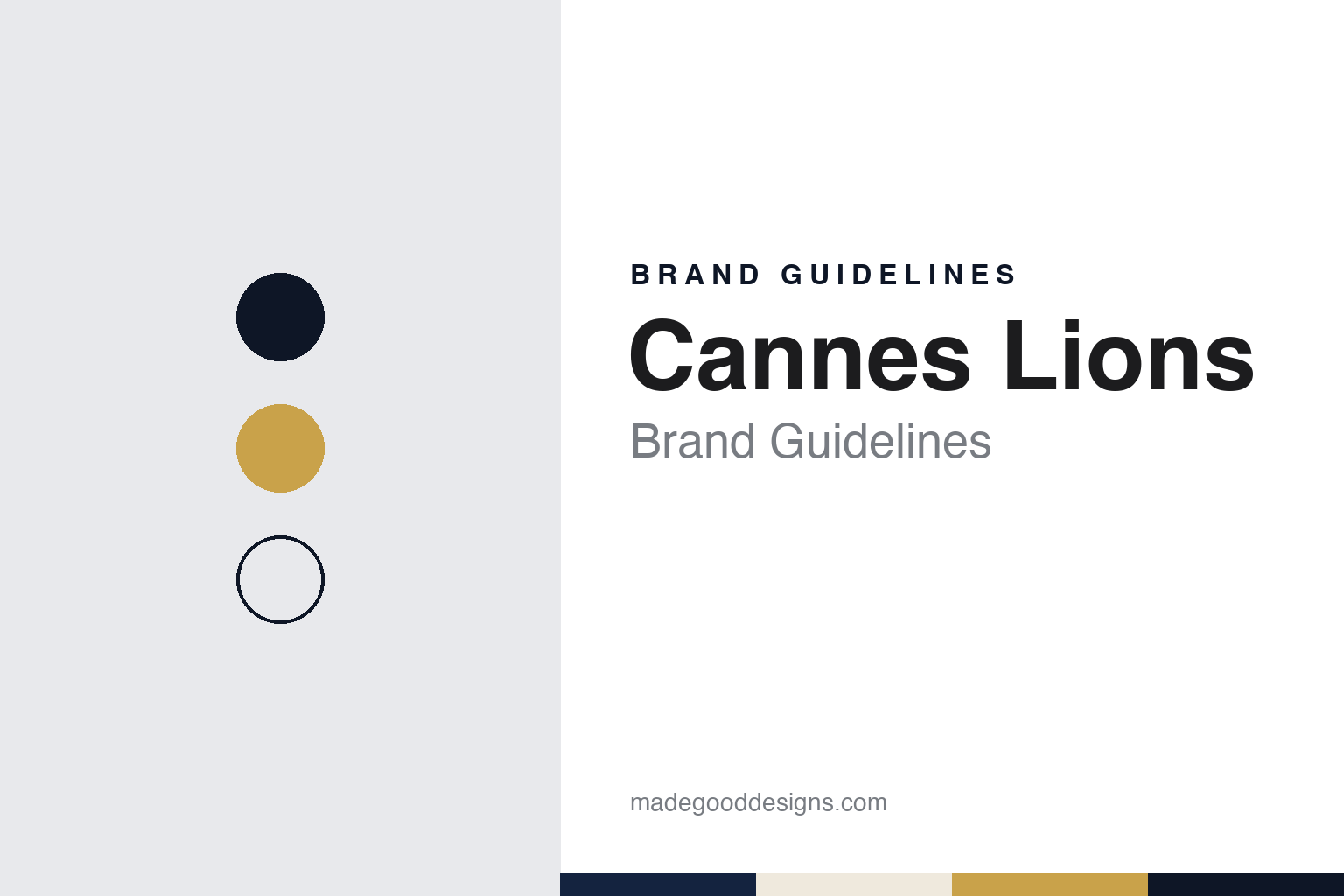
Cannes Lions Brand Guidelines
A lion from Venice, a week in June on the Croisette.
Aa
Two constants: a Riviera navy, lion gold and limestone palette and a Festival grotesque register. Abstract homage — not a Cannes Lions asset or mark; no trophy, logo, key visual or wordmark is reproduced.
From the Lido to the Croisette
Cinema-advertising contractors, Venice and a lion.
Cannes Lions began in Venice in September 1954 as the International Advertising Film Festival. According to shots, which looked back on the festival’s history for its 60th edition in May 2013, it was set up by a group of cinema screen advertising contractors belonging to the Screen Advertising World Association (SAWA), who felt that advertising films deserved the kind of recognition the Cannes Film Festival gave to feature films. French Wikipedia describes the founders in the same terms, as European producers of advertising films drawn to the festivals of Cannes and Venice.
The trophy came from the first host city. shots wrote in 2013 that the Lion was inspired by the lion of the Piazza San Marco in Venice, where the first festival was held. English Wikipedia describes the model as the winged lion statue on the square, and says that after the festival settled in France, Italian officials barred it from using replicas of the Venetian winged lion, so the organisers redesigned the trophy as a wingless lion. The animal has given the festival its everyday vocabulary ever since: the awards are “Lions,” and the company that runs the festival trades as LIONS.
The festival moved around in its early decades. After a single edition in Monte Carlo in 1955, shots reported, it alternated between Venice and Cannes; French Wikipedia describes the same pattern as an alternation between the Lido and the Croisette. In 1984 it settled permanently in Cannes. For its first thirty years the competition was about film: cinema advertising from the start, then television, which was merged with cinema in 1983 to form a single Film category, according to the same 2013 account.
A new phase began in 1987, when the French businessman Roger Hatchuel took over the running of the festival from SAWA. shots credits him with building a programme of seminars alongside the awards and with widening the categories, starting with Press and Outdoor in 1992. French Wikipedia notes that the word “film” was dropped from the name when the festival opened to print that year, making it the International Advertising Festival.
Colour
Categories, levels and a week in June.
The awards are organised into specialist categories, each called a Lion. When the organisers announced a new strapline in London on 18 November 2010, as Mumbrella reported the next day, they listed thirteen categories for 2011: Film, Press, Outdoor, Cyber, Media, Direct, Radio, Promo & Activation, Design, PR, Film Craft, Titanium & Integrated and Creative Effectiveness. French Wikipedia counts 24 categories by 2017, among them Health, Innovation and Mobile Lions. Today the organiser describes the Lions as covering every sector and discipline of the industry, with creative excellence and effectiveness recognised side by side.
Each category has its own international jury. English Wikipedia sets out the levels: entries are first shortlisted, then may receive a Bronze, Silver or Gold Lion; a Grand Prix may be chosen from the Gold-winning work as the strongest entry in the category, and is not given if the jury decides that no entry reaches the required standard. There is also a competition for younger professionals: shots reported in 2013 that the Young Lions, formerly called Young Creatives, had first been held in 1995.
The year follows a fixed rhythm. The organiser’s awards page shows entries for the next edition opening in mid-January, with the festival itself held in June at the Palais des Festivals et des Congrès in Cannes, the building that also hosts the Cannes Film Festival. The organiser’s news pages show the 2026 festival announcing its final awards on 25 June 2026. Talks and learning programmes run alongside the awards, and part of the programme is grouped into communities such as LIONS Sport, LIONS Creators and LIONS B2B. According to English Wikipedia, the 2020 festival did not take place; the 2021 edition was held online, and the festival returned to Cannes in June 2022.
Typography
Awards with a trophy for a name.
Advertising and creative awards tend to present themselves through very few elements. The name is usually short: a set of initials, a club’s name, or the city where the festival takes place. Next to it sits a trophy with a name and a shape of its own, such as a lion, a pencil, a statuette, a cube or an eye, and that object often does the work of a logo, lending its name to the levels of award and to the everyday talk around them.
The organisations behind these programmes vary. Some are associations or clubs formed by working designers, art directors and copywriters; some are registered charities or non-profits; others are run by publishers or events companies, and a few have changed owners as those companies were bought and sold. Where a programme has a parent company, the festival name usually stays in front and the owner appears in the small print.
Most follow a yearly cycle. Entries open months ahead, juries of practitioners meet in rounds, a shortlist is published, and the awards are given at a ceremony or during a festival week, often with talks, workshops and student competitions alongside. Award levels are typically graded, from a shortlist through bronze, silver and gold or their equivalents, with a top prize that juries may decide not to give.
The visual identity has two speeds. A steady wordmark and trophy carry over from year to year, while a key visual is refreshed for each edition, and the selected work is kept in an annual book or an online archive. This guide describes those elements as the organisers and dated sources set them out, and the colours and type shown here are an unofficial interpretation.
Aa
A festival grotesque — firm capitals for a one-word name. (Specimen set in Archivo, a sans STAND-IN; NOT the Cannes Lions logo.)
LIONS
Emap, Ascential and Informa.
The festival has changed hands twice since the Hatchuel era began. In August 2004 Emap Communications, the British business-to-business publisher and events organiser, acquired what was then called the Cannes Lions International Advertising Festival, shots reported on 11 August 2004; the festival had been run by Roger Hatchuel since 1987 and was formerly owned by a trust company based in Jersey. Campaign Asia carried the same news two days later. Emap’s events and information business later became Ascential; shots described the festival’s owner in 2013 as Top Right Group, formerly Emap, with Philip Thomas as the festival’s chief executive.
The present name followed a rethink of what the event covered. In the November 2010 announcement reported by Mumbrella, the organisers said the strapline would change from “The International Advertising Festival” to “The International Festival of Creativity,” reflecting a shift from advertising alone to creative work in all forms of communication. shots recalled in 2013 that the festival was rebranded in 2011 as the Cannes Lions International Festival of Creativity, quoting Thomas that delegates from PR, media and digital work had found the word “advertising” too narrow.
The latest change of owner came in 2024. Informa, the business-to-business events, digital services and academic markets group, announced on 9 October 2024 that it had completed its acquisition of Ascential, as InPublishing reported that day, and said it was creating a division called Informa Festivals from 1 January 2025, with Lions alongside events such as Money20/20, Black Hat and GDC. English Wikipedia also dates the completion to October 2024. The festival’s website now states that LIONS is brought to you by Informa Events (Europe) Limited and its affiliated entities.
For a design guide, Cannes Lions shows how a festival can take its name from its trophy: a lion borrowed from Venice, redrawn without wings once the event settled in France, and a single word that now names the awards, the company and its communities. Compare D&AD and The One Show, two other awards built around a named trophy. For this guide we use Riviera navy, lion gold and a warm limestone white with a sans, an unofficial interpretation; no product or logo is reproduced.
Explore & save
Keep Cannes Lions’s identity on hand — save it to a board in the Made Good inspiration library.
Cannes Lions identity set
Pin the Riviera navy, lion gold and limestone palette and the Festival grotesque register to your own board.
Source & notes
Frequently Asked Questions
What font can I use to match the Cannes Lions look?
This guide describes Cannes Lions’ type as “A festival grotesque — firm capitals for a one-word name”. Its type specimen is set in Archivo from Google Fonts as a stand-in; Archivo is not Cannes Lions’ own lettering.
What colours are in the Cannes Lions palette?
This guide’s Cannes Lions palette is Riviera navy #14233F, Ink #0E1626, Lion gold #C9A24A, Limestone #EFE9DD and Paper #F8F6F1. The tones are the guide’s own unofficial interpretation, not official Cannes Lions hex codes.