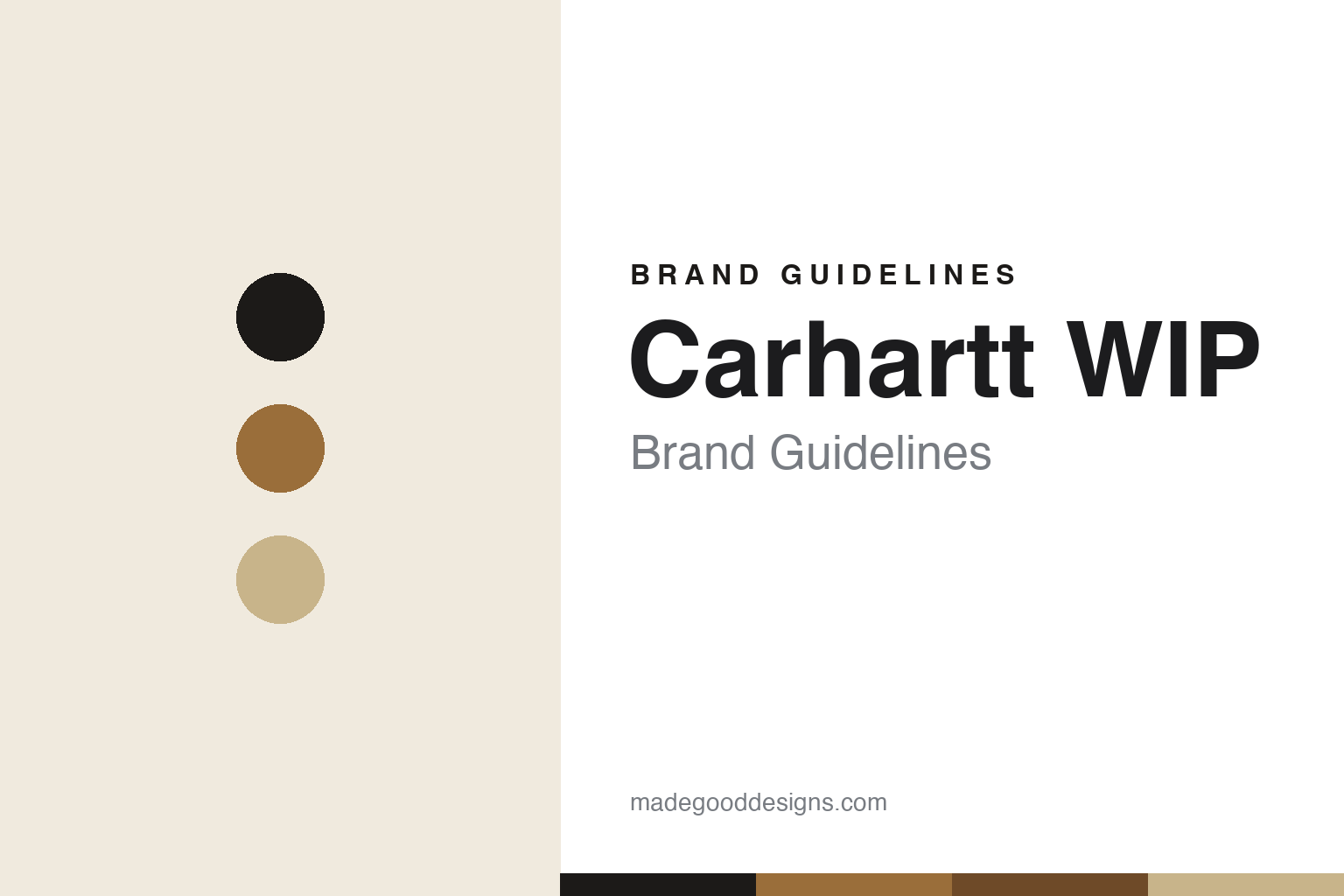
Carhartt WIP Brand Guidelines
Workwear, reworked.
Aa
Two constants: a workwear-brown palette and a condensed workwear register. Abstract homage — not the Carhartt wordmark or its square-C logo.
Workwear, reworked
Carhartt WIP put workwear into street culture.
Carhartt WIP is a lesson in heritage workwear, translated for the street. Crucially, it is not the American workwear company: Carhartt WIP (“Work In Progress”) is the European streetwear licensee — the German company Work In Progress Textilhandels GmbH, in Weil am Rhein, run by Edwin Faeh — which began importing Carhartt in 1989 and won the licence to design its own collections in 1994.
Its brand identity is utilitarian, heritage and workwear-rooted: the Detroit Jacket, chore coats, duck canvas and hickory stripe, the Carhartt “C” wordmark and the famous square-C woven flag label — all reinterpreted for European skate, graffiti and music culture.
(Honest notes: US Carhartt (founded 1889 in Detroit) and Carhartt WIP are separate companies sharing one trademark — WIP is a licensed European operation, not a division US Carhartt owns. The licence dates to 1994 (1989 is when Faeh began importing). Its signature is “Carhartt Brown”/duck-canvas tan, but there’s no official brand hex, so the tones here are an unofficial interpretation.)
Colour
Carhartt WIP lives in workwear brown. Click a swatch to copy the hex.
Carhartt WIP’s identity is utilitarian, heritage and earthy — a black, a duck brown, a hamilton brown, a hickory tan, and a paper. The palette is anchored by “Carhartt Brown” / duck-canvas tan with black and earth tones — the register of hard-wearing workwear. It signals durability, utility and heritage rather than fashion gloss. The honest caveat: with no published brand hex, these tones are an original, unofficial interpretation, not first-party values.
The lesson is workwear browns signal durability and heritage. Carhartt WIP’s world is a duck-canvas jacket. For designers, it is a reminder that earthy workwear tones — duck brown, hamilton brown, hickory tan — carry heritage and utility, grounding even a streetwear reinterpretation in real workwear. The takeaways: anchor with duck brown; add black and earth tones; and treat any single hex as unofficial — using black for small text so the browns stay earthy.
Typography
The register is a condensed workwear sans — sturdy and utilitarian.
Carhartt WIP’s identity carries a sturdy, utilitarian, heritage spirit — workwear reinterpreted for the street. A condensed, workwear-poster sans captures the mood: it is sturdy and industrial, the register of a work label and a poster. Set in workwear browns, the condensed sans feels sturdy and utilitarian — exactly the personality Carhartt WIP carries. It is sturdy rather than delicate, mirroring a duck-canvas garment. (Carhartt’s real wordmark and its square-C logo are trademarks we describe but do not reproduce, and the exact brand typeface is not ours to use.) Because the mark is not ours to use, the honest description is “a condensed workwear sans spirit,” shown here in a stand-in. The type behaves like the brand: sturdy, utilitarian and heritage.
Aa
A condensed workwear sans spirit — sturdy and utilitarian. (Specimen set in Oswald, a condensed sans STAND-IN; NOT the Carhartt wordmark or square-C logo, which are trademarks.)
Heritage as identity
Carhartt WIP stands for workwear made street.
Carhartt WIP is a lesson in translating heritage workwear into streetwear. A workwear-brown palette, real utilitarian garments and the square-C label make heritage utility the whole brand — durable, authentic, culturally embedded. The workwear heritage is the differentiator. The differentiator is a utilitarian, heritage, street-embedded identity.
For designers and brand-builders, Carhartt WIP offers a clear takeaway: heritage can be recontextualised into culture. The lessons: honour real utility (workwear silhouettes, materials); anchor with heritage colours; and embed the brand in a culture (skate, music). It is also a reminder to stay accurate: Carhartt WIP is a separate licensed European company (not US Carhartt), the licence dates to 1994, and the palette here is an unofficial interpretation. Carhartt WIP made workwear street — proof that heritage can be the difference.
Explore & save
Keep Carhartt WIP’s identity on hand — save it to a board in the Made Good inspiration library.
Carhartt WIP identity set
Pin the workwear-brown palette and the condensed-sans register to your own board.