Celestron Brand Guidelines
The consumer-telescope giant.
Aa
Two constants: a cosmos-indigo palette and a heritage-serif register. Abstract homage — not a Celestron product or mark; no telescope, orange tube or logo is reproduced.
The consumer-telescope giant
Celestron is the California-founded consumer-telescope giant behind the orange-tube Schmidt-Cassegrain — now owned by Synta and built in China.
Celestron opens the telescope round as its consumer anchor and its hidden-conglomerate story — the most familiar name in amateur astronomy, and the one that reveals who really owns the field. It was founded in 1964 by Tom Johnson, as a division of his company Valor Electronics, in California, and its orange-tube C8 Schmidt-Cassegrain, launched in 1970, put a serious telescope in ordinary hands. Celestron makes and sells the telescopes, and its answer to a round about where telescopes are made and who owns them is a candid one: an American brand, now owned by a Taiwanese parent, and built in China.
Its identity is the consumer-telescope giant. The category-defining reach, the Synta ownership and the orange-tube heritage are the story here. A brand, giant. The consumer-telescope giant.
(Honest notes, so the ownership is named and the founding date corrected. Celestron sells telescopes as its heroes — the orange-tube C8 Schmidt-Cassegrain, the NexStar computerised range and the StarSense and EdgeHD lines — and we report its performance language as the brand’s own. On a point of accuracy: it was founded in 1964, as a division of Valor Electronics, so we use 1964 rather than a vague 1960s. On ownership, the point that carries the round: Celestron is owned by Synta — acquired in 2005 by a Synta affiliate — and the same Synta parent also created and owns Sky-Watcher, with both brands built at Synta’s Suzhou Optical factory in China; this is the round’s hidden-giant twist. On where it is made: Celestron is a US-founded, California-headquartered brand, but its telescopes are largely made in China through Synta, so we frame it that way. Its designs, the iconic orange tube colour and the logo are IP we describe but do not reproduce; there is no official brand hex; these tones are an unofficial interpretation.)
Colour
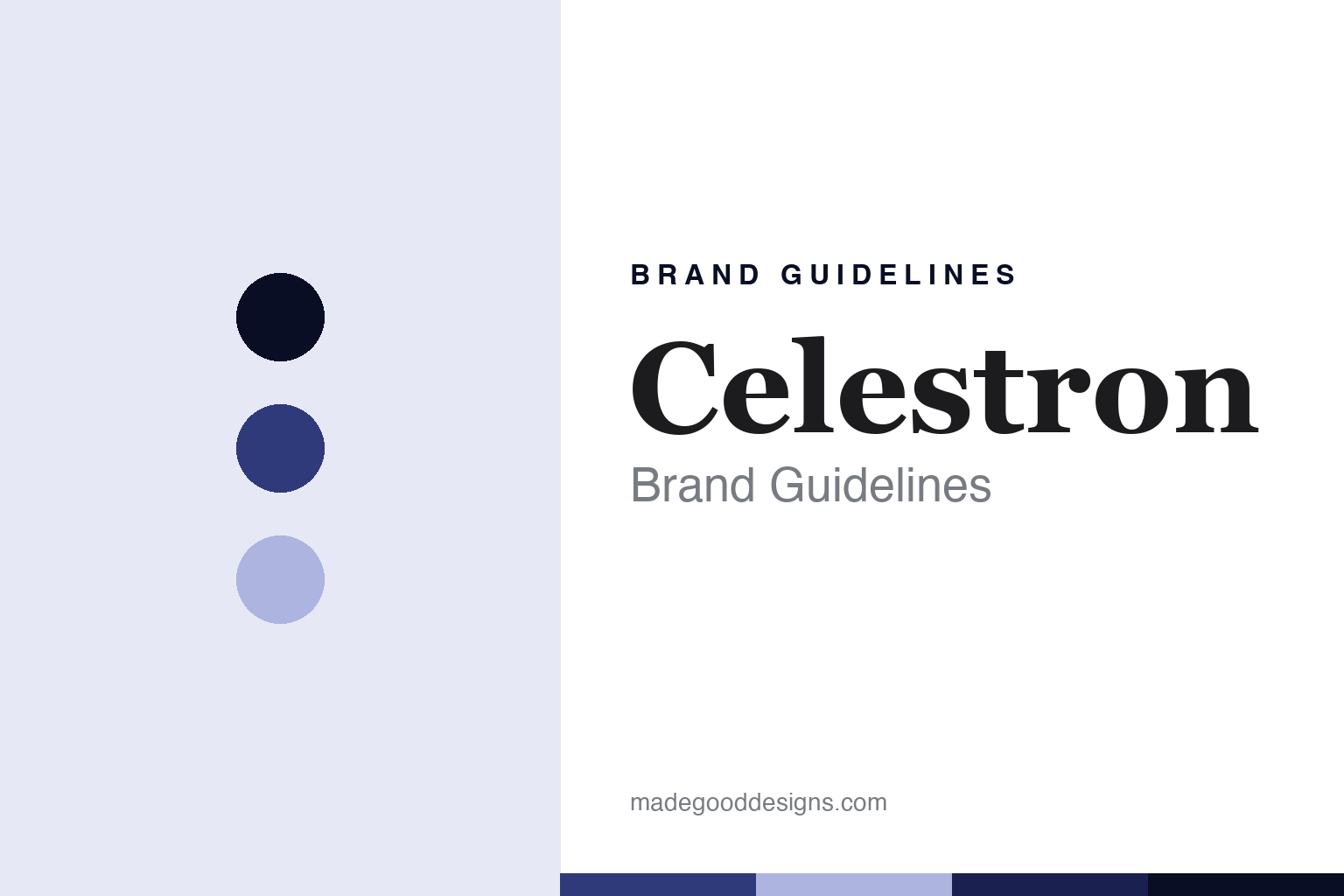
Celestron lives in a cosmos indigo. Click a swatch to copy the hex.
Celestron’s identity is storied, mass-market and familiar — a cosmos indigo, an ink, a pale periwinkle, a deep indigo, and a paper. The palette leans cosmos indigo and pale periwinkle: a night-sky register chosen deliberately instead of the brand’s trademarked orange, so the maker is honoured without reproducing its trade dress. It signals a consumer-telescope giant — familiar, storied and everywhere. The honest caveat: with no published brand hex, and with the brand’s orange treated as trade dress, these values are an original, unofficial interpretation, not first-party colours.
The lesson is a cosmos indigo signals a storied, mass-market identity. Celestron’s world is a backyard telescope pointed at the planets. For designers, it is a reminder that a deep cosmos indigo and a soft pale periwinkle can carry a maker brand — a night-sky tone held as colour, never the iconic orange tube. Because these tones can fail as small text, keep type dark and let the colour live in the accents, palette and band. The takeaways: credit Tom Johnson; date it to 1964; name the Synta ownership; and treat any single hex as unofficial.
Typography
The register is a heritage serif — storied, familiar, established.
Celestron’s identity carries a storied, familiar, established spirit — a household astronomy name, not a start-up. A heritage serif captures the mood: classic, confident and warm, the register of a brand that has been in backyards for decades. Set in a cosmos-indigo palette, the heritage serif feels storied and familiar — exactly the personality Celestron carries. It behaves like an established name rather than a modern logo, mirroring the night sky and ground glass. (Celestron’s real telescopes, the orange tube and the logo are things we describe but do not reproduce, and the exact typeface is not ours to use.) Because it is not ours to use, the honest description is “a heritage-serif brand,” shown here in a stand-in. The type behaves like the brand: storied, familiar and established.
Aa
A heritage-serif brand — storied and familiar. (Specimen set in Playfair Display, a heritage-serif STAND-IN; NOT the Celestron logo, and not its orange tube.)
The telescope
Celestron stands for the consumer-telescope giant.
Celestron opens the telescope round as its consumer anchor. A cosmos-indigo palette, a heritage serif and a 1964 founding make one thing — the consumer-telescope giant — the whole identity: storied, mass-market and familiar. The category-defining reach is the pitch, and the Synta ownership is the honest twist. The point is the most familiar name in amateur astronomy, and the brand that reveals who owns the field, opening a round about where telescopes are made.
Put to work, the identity is the brand told straight, ownership named and founding corrected. A maker in this spirit would credit Tom Johnson, date it to 1964, and name the Synta ownership. A reader in this spirit would keep the facts right: Celestron sells telescopes as its heroes, led by the orange-tube C8 Schmidt-Cassegrain and the NexStar range; it was founded in 1964 in California by Tom Johnson; it has been owned by Synta since 2005, the same parent that owns Sky-Watcher, with both built in China; and it is a US-founded brand built abroad. Celestron opens the round, before Sky-Watcher. The honest editorial moves are to date it to 1964, to name the Synta hidden-giant, to keep the where-made claim honest, and to protect the orange tube as trade dress.
For designers and brand-builders, Celestron opens the telescope: name who owns a household brand now — and honour a trademarked colour without reproducing it. The lessons: state a conglomerate owner plainly; date a heritage brand precisely; distinguish a US brand from where it is built; respect a signature colour as trade dress; and never reproduce a logo. It is also a reminder to stay precise: Celestron is the California-founded consumer-telescope giant behind the orange-tube Schmidt-Cassegrain, now owned by Synta and built in China — with the palette here an unofficial interpretation that pointedly is not its orange. The hidden-giant story is the hook: Synta secretly made Celestron’s optics for about fifteen years before buying the American household name outright in 2005, and it owns Sky-Watcher too — so two brands that look like rivals on the shelf are corporate siblings. Read that way, Celestron is less a telescope than a household astronomy name, absorbed: storied, familiar, established. The lesson for a brand is that reach and honest ownership can coexist, and naming the parent keeps the story earned. Celestron made the-consumer-telescope-giant the identity — proof that a household name can open a round.
Explore & save
Keep Celestron’s identity on hand — save it to a board in the Made Good inspiration library.
Celestron identity set
Pin the cosmos-indigo palette and the heritage-serif register to your own board.