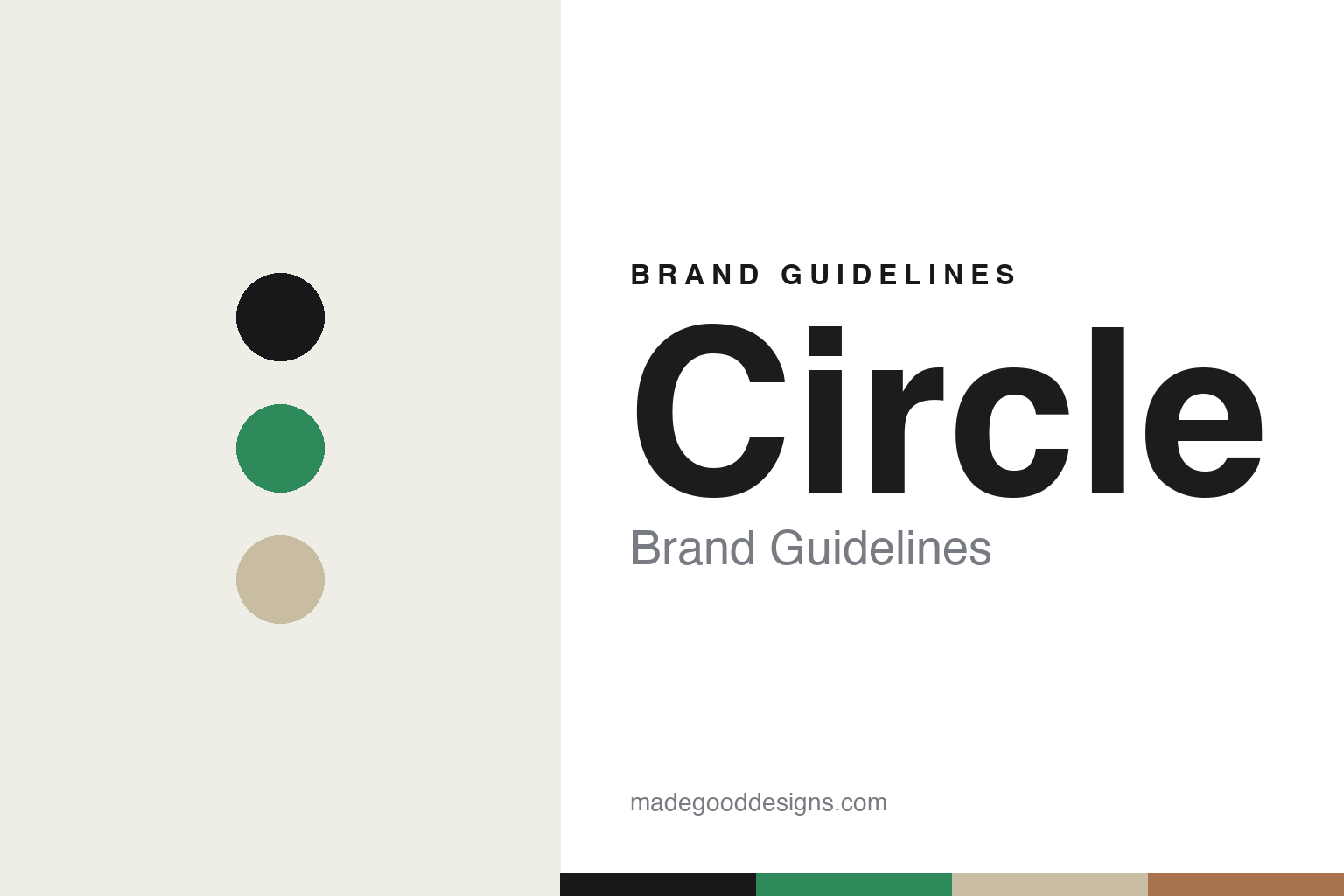
Circle Sportswear Brand Guidelines
Circular running.
Aa
Two constants: a circular, eco palette and a modern grotesque register. Abstract homage — not the Circle wordmark or logo.
Circular running
Circle designs running gear to be remade.
Circle Sportswear is a lesson in circularity as a design language. Founded in 2020 by Romain Trébuil and Alex Auroux in Paris, the founder-led brand positions itself as (in its words) the first running brand designed around the circular economy — “le running sans compromis.”
Its brand identity is circular, bio-based and considered — made in Portugal and Poland from recycled and bio-based materials, including its PLNT-FOAM castor-oil bio-foam (developed with Arkema) and merino-plus-TENCEL wood-fibre; its SNR shoe is around 75% bio-sourced and designed for disassembly. A take-back and recycling program, B Corp certification and a lowercase “circle™” wordmark round out the identity.
(Honest notes: Circle’s green claims are its own — we attribute them (“Circle says…”). It’s founder-led but venture-backed (not bootstrapped), founded in 2020, and made in Portugal and Poland. There’s no official brand hex, so the tones here are an unofficial interpretation.)
Colour
Circle lives in a circular, eco palette. Click a swatch to copy the hex.
Circle’s identity is clean, natural and circular — an onyx, a circular green, a bio beige, a clay, and an off-white. The palette pairs an onyx base with a circular green and a bio beige — the register of recycled materials, castor-oil foam and a low-impact loop. It signals sustainability, design and circular responsibility rather than loud performance branding. The honest caveat: with no published brand hex, these tones are an original, unofficial interpretation, not first-party values.
The lesson is a circular, eco palette signals sustainable design. Circle’s world is a running shoe designed to be remade. For designers, it is a reminder that an onyx base with a circular green and a bio beige reads as natural and considered — right for a circular-economy brand. The takeaways: anchor with onyx; add a circular green and a bio neutral; and treat any single hex as unofficial — using onyx for small text so the green stays a signal.
Typography
The register is a modern grotesque — clean and considered.
Circle’s identity carries a clean, considered, circular spirit — recycled materials and low-impact design. A modern European grotesque captures the mood: it is clean and precise, the register of a considered, design-led brand. Set in a circular palette, the modern grotesque feels clean and considered — exactly the personality Circle carries. It is precise rather than loud, mirroring a low-impact product. (Circle’s real wordmark is a trademark we describe but do not reproduce, and the exact brand typeface is not ours to use.) Because the mark is not ours to use, the honest description is “a modern grotesque spirit,” shown here in a stand-in. The type behaves like the brand: clean, considered and circular.
Aa
A modern grotesque spirit — clean and considered. (Specimen set in Familjen Grotesk, a modern grotesque STAND-IN; NOT the Circle wordmark, which is a trademark.)
Circularity as identity
Circle stands for circular running.
Circle Sportswear is a lesson in making circularity the identity. A circular palette, bio-based materials and a take-back model make circular design the whole brand — clean, considered, low-impact. The circularity is the differentiator. The differentiator is a circular, bio-based, design-led identity.
For designers and brand-builders, Circle offers a clear takeaway: a circular model can be a brand. The lessons: design for the loop (recycled, bio-based, disassembly); build take-back into the model; and back it with certification (B Corp). It is also a reminder to report carefully: attribute green claims to the brand, note it’s VC-backed and founded in 2020, and treat the palette as an unofficial interpretation. Circle made circularity the brand — proof that a model can be the difference.
Explore & save
Keep Circle Sportswear’s identity on hand — save it to a board in the Made Good inspiration library.
Circle identity set
Pin the circular palette and the modern-grotesque register to your own board.


