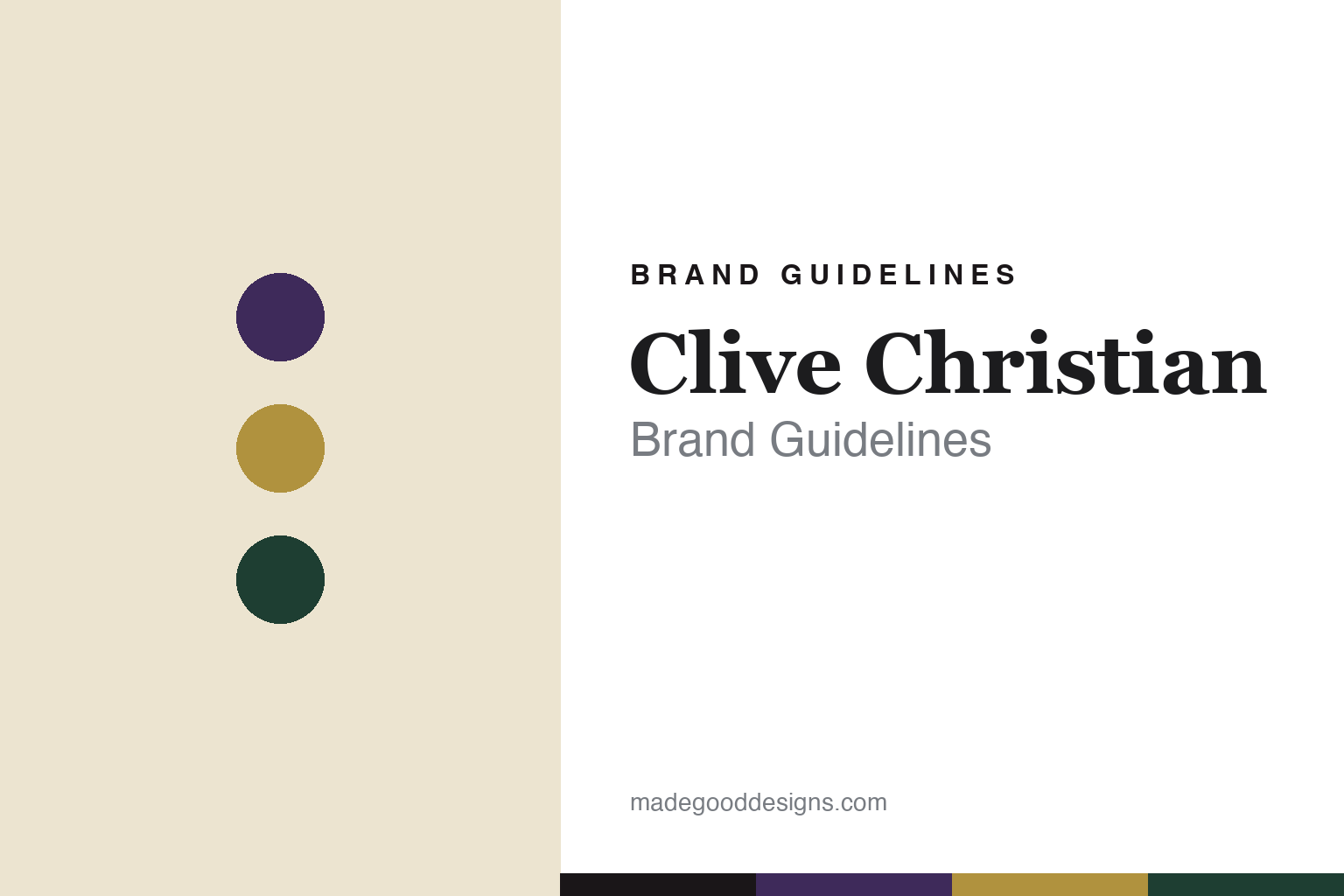
Clive Christian Brand Guidelines
By royal appointment.
Aa
Two constants: a regal purple-and-gold palette and a heritage serif wordmark. Abstract homage — not the Clive Christian crown or bottle.
By royal appointment
Clive Christian crowned its bottles.
Clive Christian is a lesson in heritage plus a crown. The house traces its story to The Crown Perfumery Company (London, 1872), which British designer Clive Christian — famous for ultra-luxury kitchens, not perfumery — acquired in 1999 and relaunched under his own name. Its hero, “No. 1”, was recorded by Guinness as “the world’s most expensive perfume.”
The signature is regal: heavy crystal bottles topped with a gold-and-crystal crown stopper (top editions set with diamonds), an ultra-high concentration, and a story that the Crown Perfumery was granted permission to use Queen Victoria’s crown. The palette is deep, jewel-toned, royal.
(Honest notes: the fragrance line as we know it dates to Clive Christian’s 1999 relaunch, not a continuously operating 1872 house — the “1872” is the acquired Crown Perfumery name. And the founder no longer owns it: he sold his majority stake in 2015, and the perfume brand was acquired by Nichebox in 2019. The “world’s most expensive” line is a marketing and Guinness claim on jewelled editions. No official brand hex is published.)
Colour
Clive Christian lives in regal purple and gold. Click a swatch to copy the hex.
Clive Christian’s identity is regal, jewel-toned and opulent — a royal purple, a gold, a deep green, a cream, and an ink. The palette is regal purple and gold with deep jewel tones, the register of British royal-heritage luxury. It signals crowns, warrants and old-world opulence rather than modern minimalism. The honest caveat: with no published brand hex, these tones are an original, unofficial interpretation, not first-party values.
The lesson is royal purple plus gold and a crown signal regal luxury. Clive Christian’s world is a coronation. For designers, it is a reminder that a jewel-toned palette anchored by a genuine crown motif can conjure royal heritage and justify extreme prices (real or claimed). The takeaways: use royal purple and gold for regality; anchor with a crown/heritage icon; and treat any single hex as unofficial — using a deep purple for small text so the gold stays regal.
Typography
The wordmark spirit is a heritage serif — regal and opulent.
Clive Christian’s identity carries a regal, heritage, opulent spirit — a crown-topped crystal bottle in jewel tones. A refined heritage serif captures the mood: it is stately and old-world, the register of a house that sells British royal luxury. Set against purple and gold, the serif feels regal and opulent — exactly the crown personality Clive Christian carries. It is ceremonial rather than modern, mirroring a coronation crest. (Clive Christian’s real crown stopper and bottles are trade dress we describe but do not reproduce, and the exact typeface is not published, so we don’t assert it.) Because the specific mark is not ours to use, the honest description is “a heritage serif spirit,” not the Clive Christian logo. The type behaves like the brand: regal, heritage and opulent.
Aa
A heritage serif spirit — regal and opulent. (Specimen set in Cormorant Garamond, a refined serif; NOT the Clive Christian crown, which is a trademark.)
Selling a crown
Clive Christian stands for regal luxury.
Clive Christian is a lesson in a single icon carrying a brand. The crown — as stopper, emblem and heritage story — makes a 1999 relaunch feel like centuries of royal warrant, and justifies “world’s most expensive” pricing. The crown is the brand. The differentiator is a fully-committed regal, crown-led identity.
For designers and brand-builders, Clive Christian offers a two-sided takeaway: a heritage icon is powerful — and worth using honestly. The lessons: a crown, jewel palette and heritage serif can conjure royal lineage and premium pricing; but heritage claims invite scrutiny. It is also a reminder to report fairly: the fragrance line dates to 1999 (not a continuous 1872 house), the founder no longer owns it (Nichebox, 2019), and the crown/Queen Victoria story is the brand’s own narrative — with the palette here an unofficial interpretation. Clive Christian sold a crown — proof that one icon can be the difference.
Explore & save
Keep Clive Christian’s identity on hand — save it to a board in the Made Good inspiration library.
Clive Christian identity set
Pin the regal purple-and-gold palette and the heritage-serif spirit to your own board.