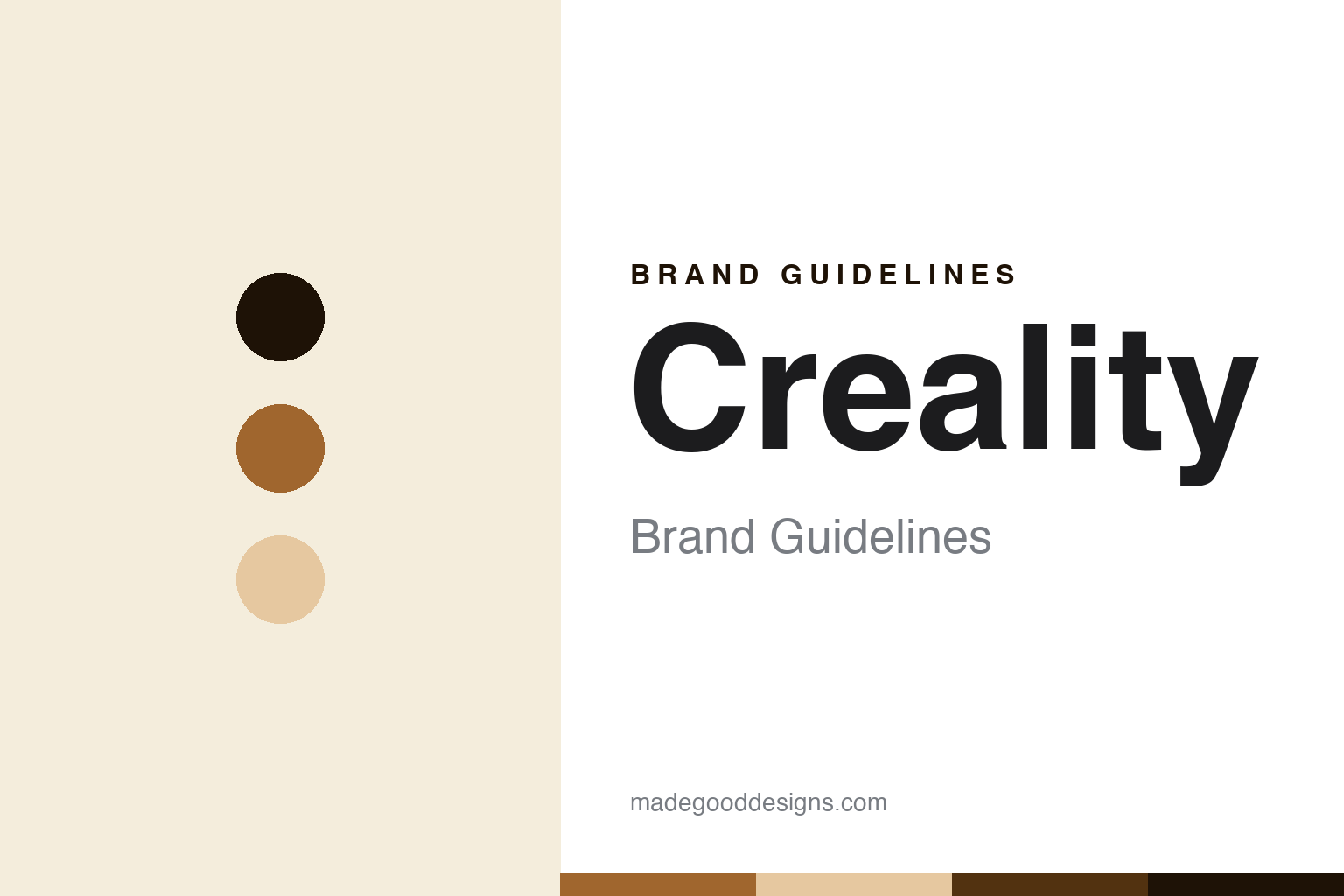
Creality Brand Guidelines
The printer that went mainstream.
Aa
Two constants: a volume-bronze palette and a volume-sans register. Abstract homage — not a Creality product or mark; no printer, gantry or logo is reproduced.
The printer that went mainstream
Creality is the Shenzhen value leader whose Ender-3 democratized desktop 3D printing, now a newly public company.
Creality brings the 3D-printer round its value-leader node — the brand that, more than any other, put a 3D printer on an ordinary hobbyist’s desk by making it cheap. It was founded in 2014 in Shenzhen by four college-graduate co-founders. Creality makes and sells the printers, and its answer to a round about who owns 3D printing and where it is made has just changed: a Shenzhen manufacturer that has recently gone public.
Its identity is the printer that went mainstream. The landmark Ender-3, the value leadership and the recent public listing are the story here. A brand, mainstream. The printer that went mainstream.
(Honest notes, so the founding, the ownership and the flagship are framed accurately. Creality sells the printers as its heroes — above all the Ender-3, plus the large CR-series and the newer high-speed CoreXY K1 line — and we report its language as the brand’s own. On founding: it was founded in 2014 in Shenzhen by four co-founders who met at a 3D-printing exhibition, whose English name spellings vary. On ownership, an important correction: Creality was long founder-controlled and private, took a pre-IPO round around 2021 with backers including Tencent’s venture arm, and has recently gone public via a Hong Kong listing, so we describe it as recently listed rather than private, noting the exact date should be confirmed. On the flagship: the Ender-3, from 2018, is widely described as the best-selling consumer 3D-printer range, with hundreds of thousands of units, and it democratized desktop FDM as a cheap, open, hackable machine with a huge modding community. On the newer line: the K1 CoreXY printers answer Bambu Lab on speed while competing on price. On where it is made: China, in Creality’s own Shenzhen factory. Its designs, the Creality name and the Ender name are IP we describe but do not reproduce; there is no official brand hex; these tones are an unofficial interpretation.)
Colour
Creality lives in a volume bronze. Click a swatch to copy the hex.
Creality’s identity is value, high-volume and hackable — a volume bronze, an ink, a pale sand, a deep umber, and a paper. The palette leans volume bronze and pale sand: a warm, workmanlike register that nods to accessible, tinkerable hardware rather than a loud logo colour. It signals the printer that went mainstream — accessible, high-volume and hackable. The honest caveat: with no published brand hex, these values are an original, unofficial interpretation, not first-party colours.
The lesson is a volume bronze signals a value, hackable identity. Creality’s world is a cheap printer on countless desks, modded by its owners. For designers, it is a reminder that a warm volume bronze and a soft pale sand can carry a hardware brand — a workmanlike tone held as colour, not a product shot. Because these tones can fail as small text, keep type dark and let the colour live in the accents, palette and band. The takeaways: date it to 2014; correct the ownership to recently public; anchor on the Ender-3; note the K1 answer to Bambu; and place manufacturing in Shenzhen.
Typography
The register is a volume sans — accessible, high-volume, hackable.
Creality’s identity carries an accessible, high-volume, hackable spirit — a value leader, not a premium boutique. A volume sans captures the mood: clean, plain and practical, the register of a printer made for everyone to tinker with. Set in a volume-bronze palette, the volume sans feels accessible and hackable — exactly the personality Creality carries. It behaves like a made, functional thing rather than a loud logo, mirroring a gantry grid and a layer-line stria. (Creality’s real printers and the Ender name are things we describe but do not reproduce, and the exact typeface is not ours to use.) Because it is not ours to use, the honest description is “a volume-sans brand,” shown here in a stand-in. The type behaves like the brand: accessible, high-volume and hackable.
Aa
A volume-sans brand — accessible and hackable. (Specimen set in Archivo, a volume-sans STAND-IN; NOT the Creality logo or any product.)
The 3D printer
Creality stands for the printer that went mainstream.
Creality brings the round its value-leader node. A volume-bronze palette, a volume sans and a 2014 founding make one thing — the printer that went mainstream — the whole identity: value, high-volume and hackable. The landmark Ender-3 is the pitch, and the value leadership is the proof. The point is the brand that made 3D printing cheap enough for everyone, in a round about who owns 3D printing and where it is made.
Put to work, the identity is the brand told straight, the ownership corrected and the flagship anchored. A maker in this spirit would date it to 2014, correct the ownership to recently public, and anchor on the Ender-3. A reader in this spirit would keep the facts right: Creality sells the Ender-3, CR-series and K1 line as its heroes; it was founded in 2014 in Shenzhen; it has recently gone public via a Hong Kong listing; the Ender-3 from 2018 democratized budget FDM; and it is made in its own Shenzhen factory. Creality sits third in the round, after Prusa. The honest editorial moves are to date it to 2014, to correct the listing, to anchor on the Ender-3, to note the K1 answer to Bambu, and to place manufacturing in Shenzhen.
For designers and brand-builders, Creality continues the 3D printer: democratize a category with price — and keep the ownership status current. The lessons: win a market by making it affordable and hackable; anchor a brand on one landmark product; keep an ownership story up to date, since a “private” brand can go public; answer a premium disruptor on price; and never reproduce a logo. It is also a reminder to stay precise: Creality is the Shenzhen value leader whose Ender-3 democratized desktop 3D printing, now a newly public company — with the palette here an unofficial interpretation. The hook is that democratization: while others chased premium features, Creality made a printer cheap and open enough that a student could buy one and mod it, sold hundreds of thousands of Ender-3s, and turned a niche hobby into a mainstream one — a value leader that has now graduated to a public listing. Read that way, Creality is less a single printer than a category it opened up: accessible, high-volume, hackable. The lesson for a brand is that affordability and honest currency reinforce each other, and updating the ownership keeps the story earned. Creality made the-printer-that-went-mainstream the identity — proof that value carries a round.
Explore & save
Keep Creality’s identity on hand — save it to a board in the Made Good inspiration library.
Creality identity set
Pin the volume-bronze palette and the volume-sans register to your own board.