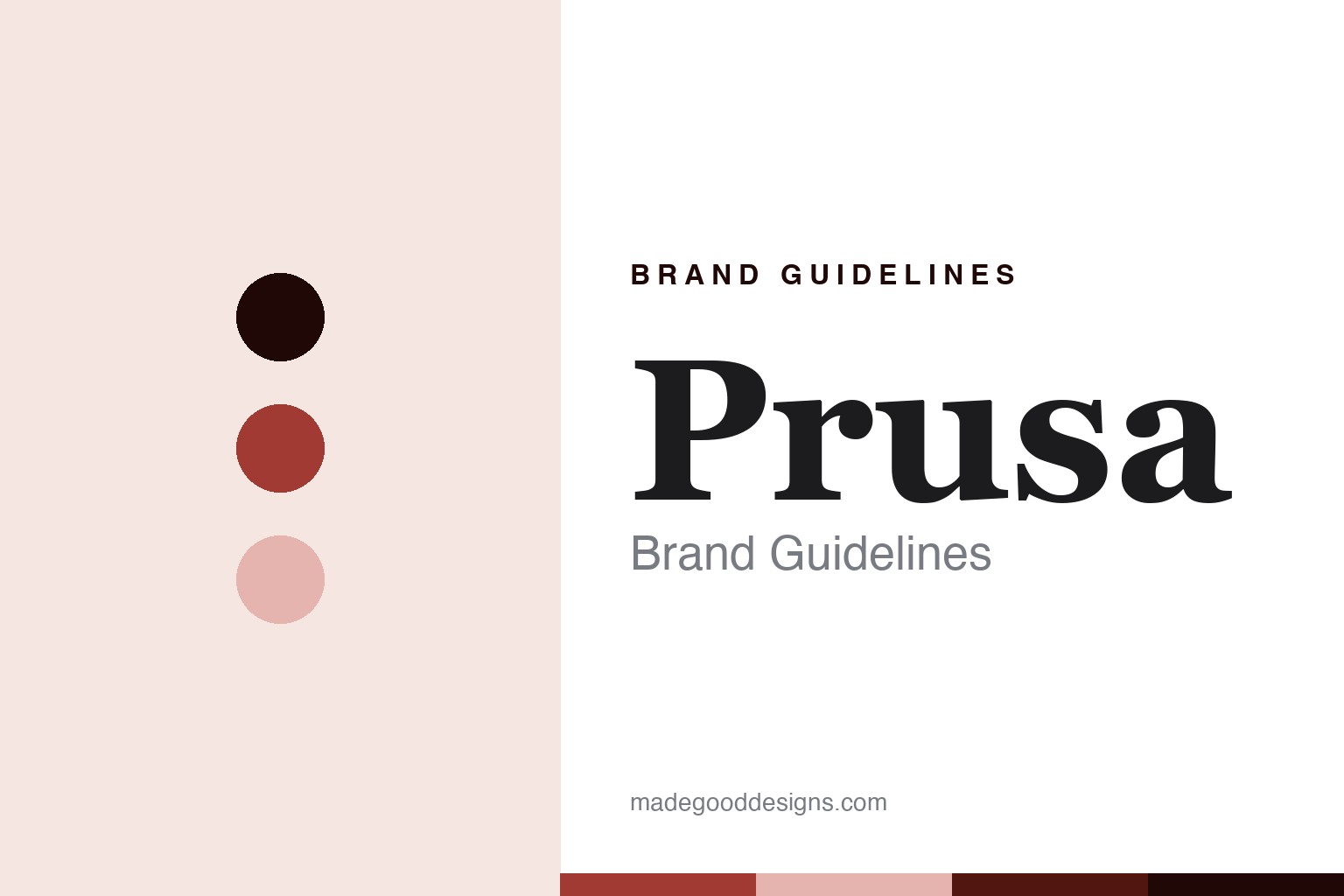
Prusa Brand Guidelines
The open-source printer from Prague.
Aa
Two constants: a heritage-crimson palette and an open-source-serif register. Abstract homage — not a Prusa product or mark; no printer, gantry or logo is reproduced, and the iconic Prusa orange is deliberately not used.
The open-source printer from Prague
Prusa is the RepRap-rooted Czech maker that prints its own printers in Prague, navigating open-source ideals against Bambu-era pressure.
Prusa brings the 3D-printer round its open-source node — the European maker whose whole identity grew from the open RepRap movement, and whose ideals are now being tested by competition. Prusa Research was founded in 2012 by Josef Průša in Prague, and it makes and sells the printers itself. Its answer to a round about who owns 3D printing and where it is made is unusual and proud: founder-led, and manufactured in-house in Prague, on a farm of its own printers.
Its identity is the open-source printer from Prague. The RepRap open-source heritage, the in-house Czech manufacturing and the pressure on those ideals are the story here. A maker, open. The open-source printer from Prague.
(Honest notes, so the heritage, the manufacturing and the open-source tension are framed fairly. Prusa sells the printers as its heroes — the Original Prusa i3 line, now the MK4S, the compact MINI, the multi-toolhead XL, and the newer enclosed CoreXY CORE One, alongside the open PrusaSlicer software — and we report its language as the brand’s own. On heritage: Josef Průša was a developer in the open-source RepRap movement, and his Prusa i3 is one of the most copied and forked printer designs in the world, so openness is genuinely in the brand’s DNA. On ownership: it is private and founder-led. On the tension, which we frame neutrally: the CORE One did not release its full hardware design files, marking a move away from fully open hardware, while its firmware and slicer remain open, and Josef Průša has linked the shift to competitive pressure, especially from Bambu Lab benefiting from Prusa’s openness — so we say its open-source commitment has evolved, not that it abandoned it. On where it is made: in-house in Prague, notably against Asia-based competitors, and Prusa even 3D-prints many of its own parts on a farm of hundreds of its own printers. Its designs, the Prusa name and the iconic Prusa orange are IP we describe but do not reproduce; there is no official brand hex; these tones are an unofficial interpretation.)
Colour
Prusa lives in a heritage crimson. Click a swatch to copy the hex.
Prusa’s identity is open, European and self-made — a heritage crimson, an ink, a pale rose, a deep maroon, and a paper. The palette leans heritage crimson and pale rose: a warm, principled register that nods to a community-rooted maker rather than a loud logo colour, and deliberately not to the iconic Prusa orange. It signals the open-source printer from Prague — open, principled and self-made. The honest caveat: with no published brand hex, and with Prusa orange treated as trade dress, these values are an original, unofficial interpretation, not first-party colours.
The lesson is a heritage crimson signals an open, self-made identity. Prusa’s world is a Prague workshop where printers build printers. For designers, it is a reminder that a warm heritage crimson and a soft pale rose can carry a maker brand — a principled tone held as colour, never the signature orange. Because these tones can fail as small text, keep type dark and let the colour live in the accents, palette and band. The takeaways: date it to 2012; credit the RepRap heritage; frame the open-source shift neutrally; stress the in-house Prague manufacturing; and treat Prusa orange as trade dress.
Typography
The register is an open-source serif — open, principled, self-made.
Prusa’s identity carries an open, principled, self-made spirit — a community-rooted maker, not a closed consumer brand. An open-source serif captures the mood: warm, considered and confident, the register of a company built on shared designs. Set in a heritage-crimson palette, the open-source serif feels open and principled — exactly the personality Prusa carries. It behaves like an established maker rather than a loud logo, mirroring a layer-line stria and a build-plate lattice. (Prusa’s real printers, the orange and the name are things we describe but do not reproduce, and the exact typeface is not ours to use.) Because it is not ours to use, the honest description is “an open-source-serif brand,” shown here in a stand-in. The type behaves like the brand: open, principled and self-made.
Aa
An open-source-serif brand — open and principled. (Specimen set in Cormorant Garamond, an open-source-serif STAND-IN; NOT the Prusa logo or its iconic orange.)
The 3D printer
Prusa stands for the open-source printer from Prague.
Prusa brings the round its open-source node. A heritage-crimson palette, an open-source serif and a 2012 founding make one thing — the open-source printer from Prague — the whole identity: open, European and self-made. The RepRap heritage is the pitch, and the in-house Prague manufacturing is the proof. The point is a maker whose openness built it and is now being tested, in a round about who owns 3D printing and where it is made.
Put to work, the identity is the brand told straight, the heritage credited and the tension framed fairly. A maker in this spirit would date it to 2012, credit the RepRap heritage, and frame the open-source shift neutrally. A reader in this spirit would keep the facts right: Prusa sells the i3 line, the XL and the CORE One as its heroes; it was founded in 2012 by Josef Průša in Prague; its Prusa i3 is among the most-forked open-source designs; it manufactures in-house in Prague and prints its own parts; and its open-source commitment has evolved under competitive pressure, not vanished. Prusa sits second in the round, after Bambu Lab. The honest editorial moves are to date it to 2012, to credit RepRap, to frame the open-source shift neutrally, to stress in-house Prague manufacturing, and to treat Prusa orange as trade dress.
For designers and brand-builders, Prusa continues the 3D printer: let open-source heritage and self-made manufacturing be the identity — and frame the evolution of those ideals honestly. The lessons: build a brand on genuinely shared, open designs; manufacture in-house as a point of pride and difference; frame a shift away from full openness as an honest evolution under pressure, not a betrayal or a denial; keep firmware and software open even as hardware tightens; and never reproduce a logo or a signature colour. It is also a reminder to stay precise: Prusa is the RepRap-rooted Czech maker that prints its own printers in Prague, navigating open-source ideals against Bambu-era pressure — with the palette here an unofficial interpretation. The hook is that principle under pressure: Prusa grew from the open RepRap movement — its i3 the design everyone copied — and built a Prague factory where printers print printers, but the arrival of a polished, closed competitor forced it to hold some hardware back, an open-source ideal quietly evolving in real time. Read that way, Prusa is less a printer than a principle: open, principled, self-made. The lesson for a brand is that open heritage and honest evolution reinforce each other, and framing the shift fairly keeps the story earned. Prusa made the-open-source-printer-from-Prague the identity — proof that principle carries a round.
Explore & save
Keep Prusa’s identity on hand — save it to a board in the Made Good inspiration library.
Prusa identity set
Pin the heritage-crimson palette and the open-source-serif register to your own board.


