Culture Vélo Brand Guidelines
A French shop sign that gives independent bicycle shops one national face.
Aa
Two constants: a green, cream and orange palette and a condensed sans register. Abstract homage — not a Culture Vélo product or mark; no sign, logo or shopfront is reproduced.
From Bouticycle to Culture Vélo
A shop sign born out of a buying group.
Culture Vélo was created in January 2000 by Denis Briscadieu. In a 2018 interview with the franchise-trade site Toute la Franchise, the network’s development manager gave the date as 1 January 2000; the company’s own profile on the same site gives 3 January. Either way, the sign is a little more than a quarter of a century old, and it was built by someone who already knew the trade from the supply side.
Before Culture Vélo, the interview says, Briscadieu had been a product manager at Look and then joined Alvarez, in Auch in the Gers, as sales director. Alvarez was at the time, according to the interview, the largest French buying group in the cycle trade. There he saw that independent bicycle dealers needed to come together under one shop sign, and he launched a sign called Bouticycle, which he developed for Alvarez until 1999.
He wanted to separate the shop sign from the buying group, the interview says, and when that was refused he left Alvarez to found Culture Vélo. The idea was a service centre: a head office that would develop tools and services for its member shops, rather than a sign attached to a wholesaler. Bouticycle was later bought back, at the end of 2008, and now sits beside Culture Vélo in the same group.
That group is Cyclelab, based at L’Isle-Jourdain in the Gers, west of Toulouse; it is a French company with no link to the South African bicycle chain Cycle Lab. In January 2024 Le Journal des Entreprises described it as founded 24 years earlier, with Briscadieu as its founder and president, and as running a distribution network of 135 shops under four signs: Culture Vélo, Bouticycle, Vélo Station and Foulées, a sign for running shops. The group also sells services such as IT and communication to its shops through a central office, the paper said.
Colour
A brand licence, not a chain of owned shops.
Culture Vélo is not a chain of company-owned shops. The 2018 interview describes it as developed under a brand licence (licence de marque). At first the licence mostly attracted independent shops that were already trading; later, more of its candidates were people opening or taking over a bicycle shop. The company’s profile on Toute la Franchise gives the contract as a five-year brand licence and an average shop of about 500 square metres.
In 2018 the network had 72 shops and put the ideal coverage of France at about a hundred, the interview said. A head-office team of 35 people covered nine areas: network development, network support, buying, IT, communication, e-commerce, training, events and shop design. New licensees were given three weeks of training, one week of theory and two inside an experienced member’s shop, and the group runs its own school that trains cycle technicians. The company’s timeline names that school Sup de Vélo and dates it to 2010; it also says Briscadieu set up an IT company, 5IVE, in 2003 to supply software to Culture Vélo shops. Each order placed on the Culture Vélo website is assigned to a physical shop, the interview added.
The network kept growing. Toute la Franchise reported in May 2023 four openings that year, in La Rochelle, Lille, Saint-Quentin and Toulon La Garde, with a 79th shop due at Vendenheim and a target of more than 80 by the end of the year. The company’s own timeline says it passed 80 shops in 2023 and had 84 in 2024; its website listed 83 shops in November 2026, from Brest to Nice.
The shops are given over entirely to cycling, the 2023 report said: city, mountain, road, gravel, folding, cargo and electric bicycles, with parts, clothing and accessories. They offer workshops that service all brands, postural studies, used bikes, click and collect and a loyalty programme. The company also offers financing and leasing.
Typography
Bicycle shop chains.
Bicycle shop chains present themselves in a few recognisable ways. Some run very large stores on retail parks, with test tracks, workshops and thousands of bikes under one roof; Fahrrad XXL in Germany, for example, describes branches of up to 11,000 square metres with test tracks beside them. Others keep to city-centre shops and neighbourhood workshops, or began as websites and added a small number of shops later, as Tredz did in South Wales.
Structure shapes how the names look. A chain may own every branch itself, or a shared name may sit above independent businesses: Fahrrad XXL says its stores are run by seven family firms, and several of its branch names add the family name of the firm behind them. In the Netherlands and France, formulas and networks of independent bicycle shops work in a similar way, giving each shop one sign, one website and shared buying while the owner keeps the business, as the companies describe their own structure.
Workshops are part of the offer almost everywhere. The companies in this group describe repair and servicing in their own words, from in-store workshops for bicycles and e-bikes to trade-in schemes for used bikes; logos, shop signs and colour schemes are shown as the companies publish them on their own sites and storefronts. Their corporate pages usually tell a founding story and name the current owner, whether a family, a founder or a listed retail group.
These guides, covering chains in Germany, the Netherlands, France, the United Kingdom, Australia, South Africa and Japan, set out what can be checked about each one: who founded it, who owns it now, how its stores and workshops are described, and which descriptions rest only on the company’s own word. Each suggests an unofficial palette and a stand-in typeface for designers studying the category.
Aa
A condensed sans for a national shop sign. (Specimen set in Barlow Condensed, a sans STAND-IN; NOT the Culture Vélo logo.)
Culture Vélo
A sign, a school and an assembly line.
The group has also moved into assembly. Le Journal des Entreprises reported that the Vélo Factory, a Cyclelab subsidiary at L’Isle-Jourdain, began work in December 2023 and was inaugurated on 19 January 2024. It assembles bicycles and components under other companies’ names, for local authorities, retailers, start-ups and larger brands. The plant sits in the Vélo Vallée, a cluster of cycle businesses around the town, and the group also organises ProDays, a trade event for the French cycle industry, the paper said.
The company’s timeline traces how the sign has presented itself. It created its own communication agency in 2002, adopted the signature “Des Vélos et des Hommes” (roughly, “Of bikes and people”) in 2008, became a Tour de France partner the same year, and ran its first television campaign in 2012, broadcast during Paris-Roubaix. The website today calls Culture Vélo a cycling specialist since 2000, and its about page describes both an online shop and a network of physical shops across France.
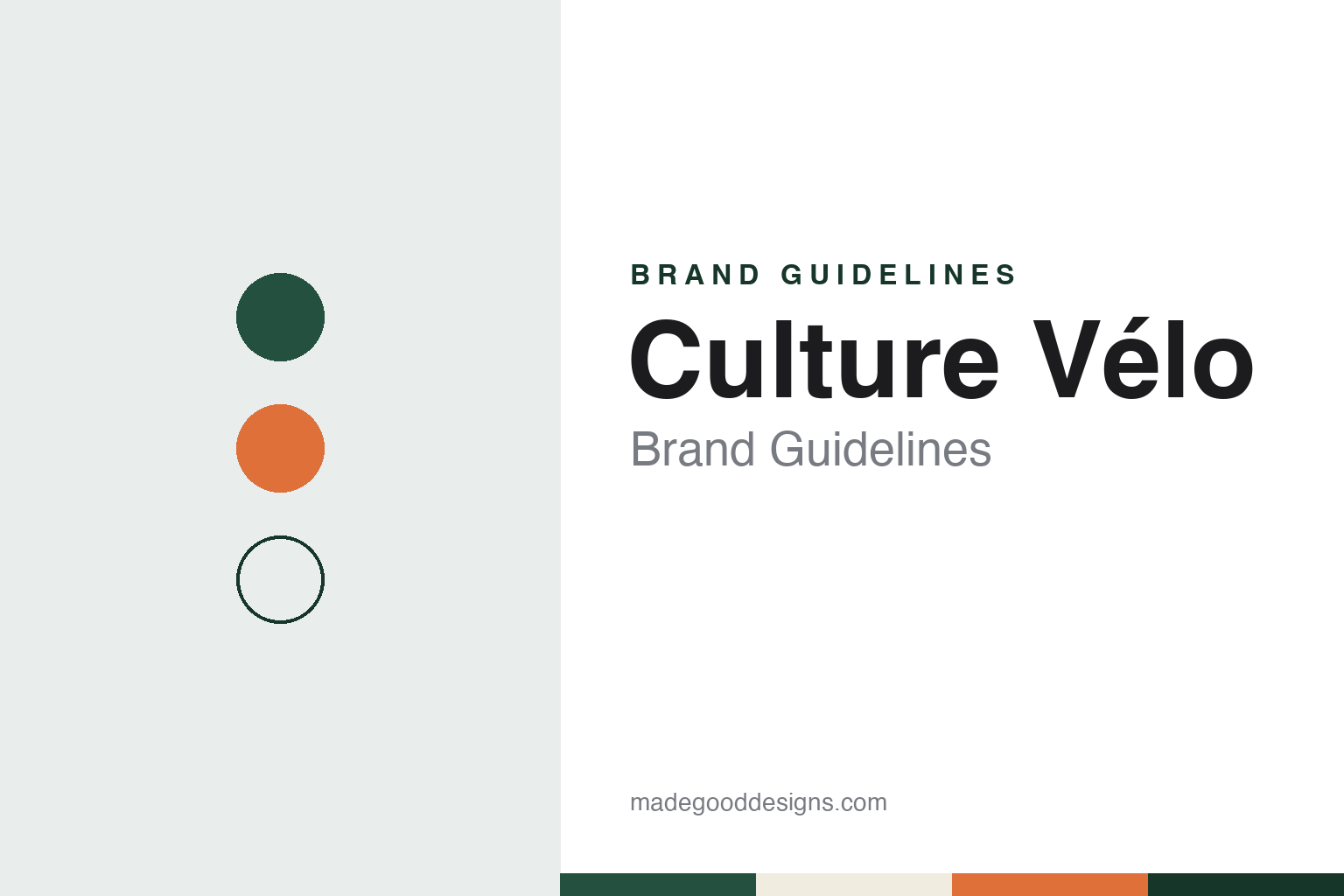
For a design guide, Culture Vélo shows how a shared sign can give independent shops one national face while each keeps its own owner. Compare Bike Totaal in the Netherlands and Decathlon, also from France. For this guide we use a deep green, a chalk cream and a signal orange with a condensed sans, an unofficial interpretation; no product or logo is reproduced.
Explore & save
Keep Culture Vélo’s identity on hand — save it to a board in the Made Good inspiration library.
Culture Vélo identity set
Pin the Culture Vélo green, cream and orange palette and the condensed sans register to your own board.
Source & notes
Frequently Asked Questions
What font can I use to match the Culture Vélo look?
This guide describes Culture Vélo’s type as “A condensed sans for a national shop sign”. Its type specimen is set in Barlow Condensed from Google Fonts as a stand-in; Barlow Condensed is not Culture Vélo’s own lettering.
What colours are in the Culture Vélo palette?
This guide’s Culture Vélo palette is Peloton green #24513F, Deep pine #17362A, Chalk cream #F1ECE0, Signal orange #E0703A and Paper #F9F7F2. The tones are the guide’s own unofficial interpretation, not official Culture Vélo hex codes.
When was Culture Vélo founded?
Culture Vélo was founded in January 2000, in France.
Who founded Culture Vélo?
Culture Vélo was founded by Denis Briscadieu in January 2000.