El Fogoncito Brand Guidelines
A 1968 Mixcoac taquería, the gringa and Mr Taco! in China.
Aa
Two constants: an ember, charcoal and corn palette and a slab serif register. Abstract homage — not an El Fogoncito product or mark; no menu, logo or sign is reproduced.
Avenida Revolución, 1968
A small taquería in Mixcoac.
El Fogoncito opened on 22 August 1968 on Avenida Revolución in Mexico City, in the Mixcoac area near the Colegio Williams, Alto Nivel reported in April 2018. Its founder was Martha Ávalos. El Economista, writing in March 2007, gave the same opening date and described the original taquería as a family business run by her, serving tacos al pastor at a time when they were not yet widely known. The unit was small: Alto Nivel put it at eight square metres, with metal tables and chairs lent by a soft-drink company, and El Financiero, in February 2023, described an opening with only four tables.
Accounts of the second branch differ. Alto Nivel dated it to 1970 and placed it at the corner of Shakespeare and Víctor Hugo streets, which it described as Polanco; El Financiero said it opened two years after the first, in colonia Anzures, behind the Camino Real hotel. Both reports tie that branch to the dish the chain is most associated with.
The taquería also reached a football crowd early. Alto Nivel reported that El Fogoncito ran two points of sale in the Estadio Azteca for the 1970 World Cup and for some years afterwards. The founder’s son, Carlos Roberts, took charge of the business at 19, the same report said, and his main contribution was to systematise how it ran. He was named as director general by El Economista in 2007 and 2009 and by Alto Nivel in 2018, when he described the chain as the restaurant his mother founded.
Colour
Flour tortilla, cheese and al pastor.
The gringa is the product the brand puts first: a flour tortilla with cheese and al pastor pork. El Fogoncito presents itself as “los creadores de las gringas de México”, the creators of Mexico’s gringas, El Financiero reported in 2023. According to the company’s website, as quoted in that article, the first gringa was made in 1970 at the Anzures branch, which faced a student area where many residents were from the United States. They asked for their al pastor in the white flour tortillas used for quesadillas, with cheese added, and other customers began to order “lo de la gringa”. Chilango, in a 2020 feature on Mexico City al pastor taquerías, also noted that El Fogoncito claims the gringa.
Outside the company, the origin is treated as open. El Financiero pointed out that the book Tacopedia calls the gringa’s origin unknown, and that the researcher Domingo García Garza describes gringas as a variant of northern Mexican tacos. The same article quoted the Diccionario enciclopédico de la gastronomía mexicana, which describes the dish as two tortillas of maize or wheat filled with al pastor meat and manchego and Oaxaca cheeses, sometimes with pineapple. El Fogoncito has since added variants such as a shrimp gringa, El Financiero noted.
The menu travels with the name. When a franchise opened in Vila Madalena, São Paulo, in February 2019, the Brazilian trade title Turismo & Eventos listed guacamole, sopecitos, the taco al pastor and the gringa, with the al pastor cooked in an oven brought from Mexico. The franchisee, Paulo Ramos, had lived in Mexico for 18 years, the same report said.
For a designer, the gringa is a gift: a short, memorable word with a story attached, which the chain repeats in its own description of itself. The brand’s visual identity has also been updated. For its fiftieth anniversary in August 2018, Alto Nivel reported, the chain introduced a renewed image, shown at a new restaurant in Lomas de Tecamachalco, in the State of Mexico.
Typography
How Latin American chains present themselves.
Latin American restaurant chains tend to present themselves through a small set of public surfaces: the shopfront, the menu, the delivery box and the corporate page. The shopfront carries the name and colours to the street, often on a corner unit or inside a shopping centre. Many chains refresh it on a cycle, and anniversaries are a common moment for a new look across dining rooms and signs.
Menus do much of the brand work. A chain is often remembered for one or two named dishes, such as a taco, a pizza or a breakfast plate, and the company repeats those names in its signs, its menus and its own telling of its history. Where a chain says it created a dish, the claim belongs to the company, and independent food writers do not always agree; a careful guide keeps the two apart. Mascots, packaging and delivery boxes extend the same vocabulary to takeaway and app orders.
Ownership is often a group matter. Several chains in Mexico, Brazil, Peru and Colombia sit inside larger restaurant or retail groups that run national brands next to international franchises, and some, like Toks within Grupo Gigante, began as a sideline of a supermarket business. Groups buy, convert and rename chains, so the same dining room can carry two names in a decade. Dated reports and stock-exchange filings are the plain record of who owns what, and when.
Franchising is the other common thread. Corporate pages describe founders, owners and franchise networks, and the business press counts units at a stated date, at home and abroad. Those counts change quickly, and openings in new countries do not always last, so each figure in these guides is tied to the report and the date that gave it.
Aa
A sturdy slab serif for a grill counter. (Specimen set in Roboto Slab, a serif STAND-IN; NOT the El Fogoncito logo.)
El Fogoncito
From Beijing to Costa Rica.
Growth came through franchising. Alto Nivel wrote in 2018 that the franchise model had taken the chain beyond Mexico City and abroad, and counted 38 units, its own and those in partners’ hands. The Asian venture began in Beijing: El Economista reported in March 2007 that the first franchise there had opened after market studies by the consultancy Latin Asia, with the taco al pastor as the lead dish because dairy plays a smaller part in local diets.
China produced the brand’s clearest naming lesson. In July 2009, El Economista reported that after two and a half years in China the franchise would trade as “Mr Taco!” for two new units in Guangzhou. Carlos Roberts explained that the original Chinese name used four characters chosen to sound like “fogoncito” in Mandarin, but they meant roughly “palace of fortune and much joy” and said nothing about the food, while company research showed that Chinese diners knew the word “taco” well. The menu in China had changed by about half since opening, he said. By April 2018 the China operation had closed, Alto Nivel reported, and the chain was present in Costa Rica, Honduras and Nicaragua.
The network has since contracted abroad. El Economista reported in March 2024 that El Fogoncito had 32 units in Mexico City and a franchise in Costa Rica, and that after 2020 it had closed some outlets, later recovered, as well as its units in Brazil and Bolivia. Carlos Mendoza was its director of operations at the time.
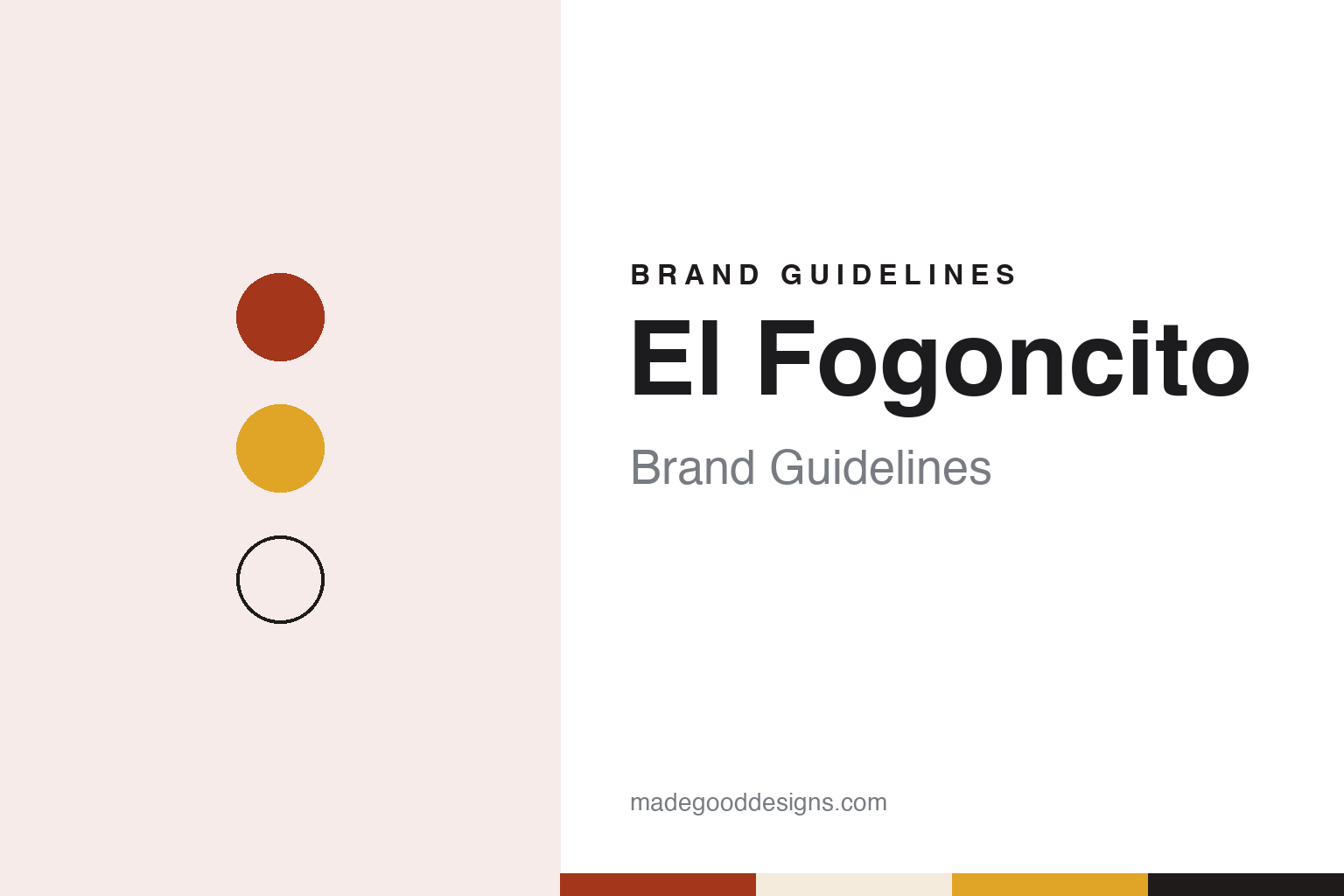
For a design guide, El Fogoncito shows how a single dish can carry a brand story, and how a name that works in Spanish may need rethinking in another script. Compare Toks, another Mexico City restaurant chain, and Sanborns. For this guide we use ember, charcoal and corn yellow with a slab serif, an unofficial interpretation; no product or logo is reproduced.
Explore & save
Keep El Fogoncito’s identity on hand — save it to a board in the Made Good inspiration library.
El Fogoncito identity set
Pin the El Fogoncito ember, charcoal and corn palette and the slab serif register to your own board.
Source & notes
Frequently Asked Questions
What font can I use to match the El Fogoncito look?
This guide describes El Fogoncito’s type as “A sturdy slab serif for a grill counter”. Its type specimen is set in Roboto Slab from Google Fonts as a stand-in; Roboto Slab is not El Fogoncito’s own lettering.
What colours are in the El Fogoncito palette?
This guide’s El Fogoncito palette is Ember #A3361B, Charcoal #1E1B1A, Corn yellow #E0A526, Lime leaf #5E7A3A and Masa #FAF4EA. The tones are the guide’s own unofficial interpretation, not official El Fogoncito hex codes.
When was El Fogoncito founded?
El Fogoncito was founded in 22 August 1968, in Mexico City.
Who founded El Fogoncito?
El Fogoncito was founded by Martha Ávalos in 22 August 1968.