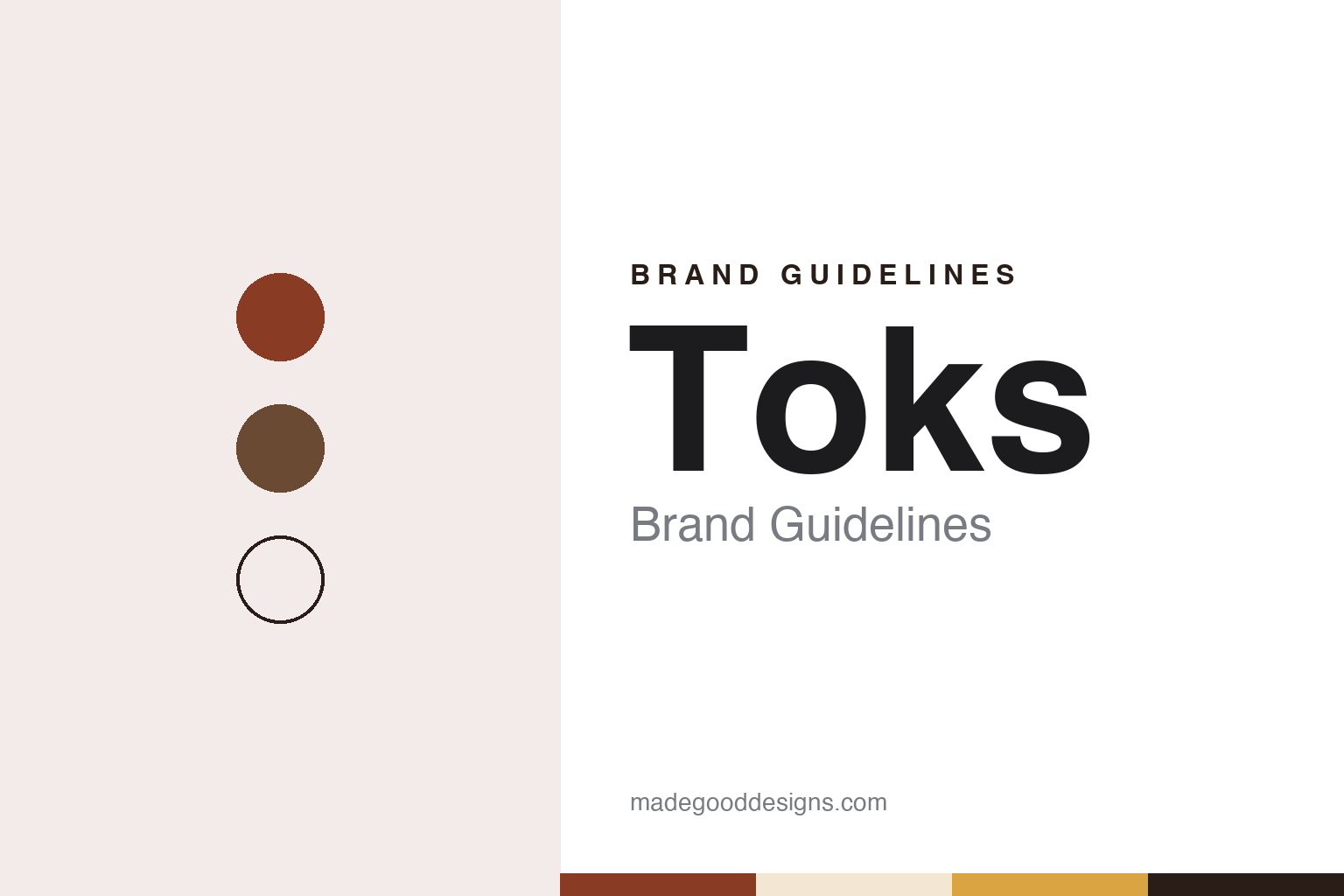
Toks Brand Guidelines
Grupo Gigante’s 1971 cafetería and the California conversions.
Aa
Two constants: a coffee, tomato and cream palette and a rounded sans register. Abstract homage — not a Toks product or mark; no menu, logo or sign is reproduced.
A Gigante cafetería
A supermarket group opens a family restaurant.
Toks began as a sideline of a supermarket business. Grupo Gigante, the Mexico City group founded by the Spanish-born merchant Ángel Losada Gómez, opened its first Gigante store in Mixcoac in 1962, Spanish Wikipedia says. In 1971 the company diversified by opening a family cafetería in Mexico City under the trade name “Tok’s Restaurantes”. English Wikipedia places that first restaurant in the north of the city, close to the Basilica of Our Lady of Guadalupe, and says the chain has belonged to Grupo Gigante since it was created. In a fiftieth-anniversary statement reported by SDP Noticias in July 2021, the company gave the opening date as 16 July 1971 and the district as La Villa, the neighbourhood around the basilica.
The name has two spellings that matter to a designer. Spanish Wikipedia keeps the apostrophe of the older trade name, Tok’s, while the business press of the last decade, from Forbes México in 2015 to El Economista in 2026, writes it as one word, Toks. The later form is the one used in this guide.
For most of its life Toks sat beside a much larger grocery chain. Gigante reached its hundredth store in 1991, both the English and Spanish Wikipedia histories say, and opened its first specialty restaurants in 1982. In 2007 the group agreed to sell its supermarkets to Organización Soriana, in a deal cleared by the federal competition authority, El CEO reported in February 2023; Spanish Wikipedia says Gigante kept the store properties, its joint ventures and its Súper Precio mini-markets. After the sale, El CEO wrote, the group concentrated on restaurants, real estate and specialist retail, including Office Depot and RadioShack in Mexico, and it brought Petco, The Home Store, Panda Express and Shake Shack to the Mexican market.
Colour
California becomes Toks.
The restaurant arm grew by adding brands around Toks. Spanish Wikipedia says that in 2011 Tok’s Restaurantes brought the Panda Express chain to Mexico. The biggest single step came in 2015. Forbes México reported on 12 March 2015 that Restaurantes Toks, part of Grupo Gigante, had completed its purchase of Restaurantes California from Comercial Mexicana, taking on 46 California restaurants and seven Beer Factory units. The company said it would decide which businesses and brands it would convert and which it would keep.
Conversion followed. In an interview with Excélsior, published by Dinero en Imagen on 30 March 2015, Toks’ director general Federico Bernaldo de Quirós said the company estimated that about 35 of the California units could become Toks and that the remaining sites might take another of its formats. He added that staff from the acquired restaurants were attending Toks training centres, because the two chains worked in different ways. Two years later, Forbes México reported in April 2017 that the remodelling of the California cafeterías converted to the Toks brand was almost finished, quoting Ángel Losada Moreno, then chairman and chief executive of Grupo Gigante.
For a brand, a conversion programme of this kind is a design exercise as much as a property one: dozens of existing dining rooms, signs and menus had to be brought under one name. The press reports describe the work only as remodelling and training, and they do not describe the interiors themselves.
Grupo Gigante added a taquería brand in 2020. On 29 April that year, Spanish Wikipedia says, its subsidiary Beer Factory de México bought the El Farolito taquerías, including the brand and the rights under its contracts. By February 2023, El CEO counted five restaurant brands in the group: Toks in the restaurant-cafetería segment, plus Panda Express, Beer Factory, Shake Shack and the El Farolito taquerías. Grupo Restaurantero Gigante, the food division, was present in 22 states and had more than 10,200 employees, the same report said, and its own website dated its start to the founding of Toks in 1971.
Typography
How Latin American chains present themselves.
Latin American restaurant chains tend to present themselves through a small set of public surfaces: the shopfront, the menu, the delivery box and the corporate page. The shopfront carries the name and colours to the street, often on a corner unit or inside a shopping centre. Many chains refresh it on a cycle, and anniversaries are a common moment for a new look across dining rooms and signs.
Menus do much of the brand work. A chain is often remembered for one or two named dishes, such as a taco, a pizza or a breakfast plate, and the company repeats those names in its signs, its menus and its own telling of its history. Where a chain says it created a dish, the claim belongs to the company, and independent food writers do not always agree; a careful guide keeps the two apart. Mascots, packaging and delivery boxes extend the same vocabulary to takeaway and app orders.
Ownership is often a group matter. Several chains in Mexico, Brazil, Peru and Colombia sit inside larger restaurant or retail groups that run national brands next to international franchises, and some, like Toks within Grupo Gigante, began as a sideline of a supermarket business. Groups buy, convert and rename chains, so the same dining room can carry two names in a decade. Dated reports and stock-exchange filings are the plain record of who owns what, and when.
Franchising is the other common thread. Corporate pages describe founders, owners and franchise networks, and the business press counts units at a stated date, at home and abroad. Those counts change quickly, and openings in new countries do not always last, so each figure in these guides is tied to the report and the date that gave it.
Aa
A rounded sans for a family cafetería. (Specimen set in Nunito, a sans STAND-IN; NOT the Toks logo.)
Toks
About 195 restaurants and a group in transition.
Restaurant counts for Toks come from dated reports. Infobae wrote in January 2024 that the chain had more than 192 restaurants across Mexico, under Grupo Gigante, whose board was chaired by Ángel Losada Moreno. El Economista reported in July 2026 that at 31 March 2026 the group operated 195 Toks restaurants, alongside 27 Panda Express, 21 Shake Shack and 13 El Farolito units; Panda Express and Shake Shack were run under franchise agreements, while Toks was the main pillar of the restaurant division. Merca2.0 reported in November 2026 that Grupo Gigante opened three Toks restaurants and closed one in the third quarter of 2026, and placed Toks among full-service restaurants.
The group’s next restaurant move is not settled. The same report named Federico Bernaldo de Quirós, who ran Toks in 2015, as director general of Grupo Gigante.
The palette here is our own reading of a family cafetería rather than a published specification: a coffee brown and an espresso dark for the counter, a tomato brick that holds up as small text, a honey yellow and a warm cream. The rounded sans is a stand-in chosen for the same plain, friendly register.
For a design guide, Toks shows how a restaurant brand can grow inside a retail group and then absorb another chain’s dining rooms under its own name. Compare Sanborns, another Mexico City restaurant name with a long history, and El Fogoncito, a Mexico City taquería chain founded in 1968. For this guide we use coffee brown, tomato brick and cream with a rounded sans, an unofficial interpretation; no product or logo is reproduced.
Explore & save
Keep Toks’s identity on hand — save it to a board in the Made Good inspiration library.
Toks identity set
Pin the Toks coffee, tomato and cream palette and the rounded sans register to your own board.
Source & notes
Frequently Asked Questions
What font can I use to match the Toks look?
This guide describes Toks’ type as “A rounded sans for a family cafetería”. Its type specimen is set in Nunito from Google Fonts as a stand-in; Nunito is not Toks’ own lettering.
What colours are in the Toks palette?
This guide’s Toks palette is Tomato brick #8A3B24, Espresso #2A1D17, Coffee #6B4A33, Honey #D9A441 and Cream #FAF3E8. The tones are the guide’s own unofficial interpretation, not official Toks hex codes.
When was Toks founded?
Toks was founded in 1971, in Mexico City. Toks is known for Family cafeterías, the California conversions.
Who founded Toks?
Toks was founded by Grupo Gigante in 1971. Toks is known for Family cafeterías, the California conversions.