Emart Brand Guidelines
The Seoul hypermarket chain that wrote its name in lowercase.
Aa
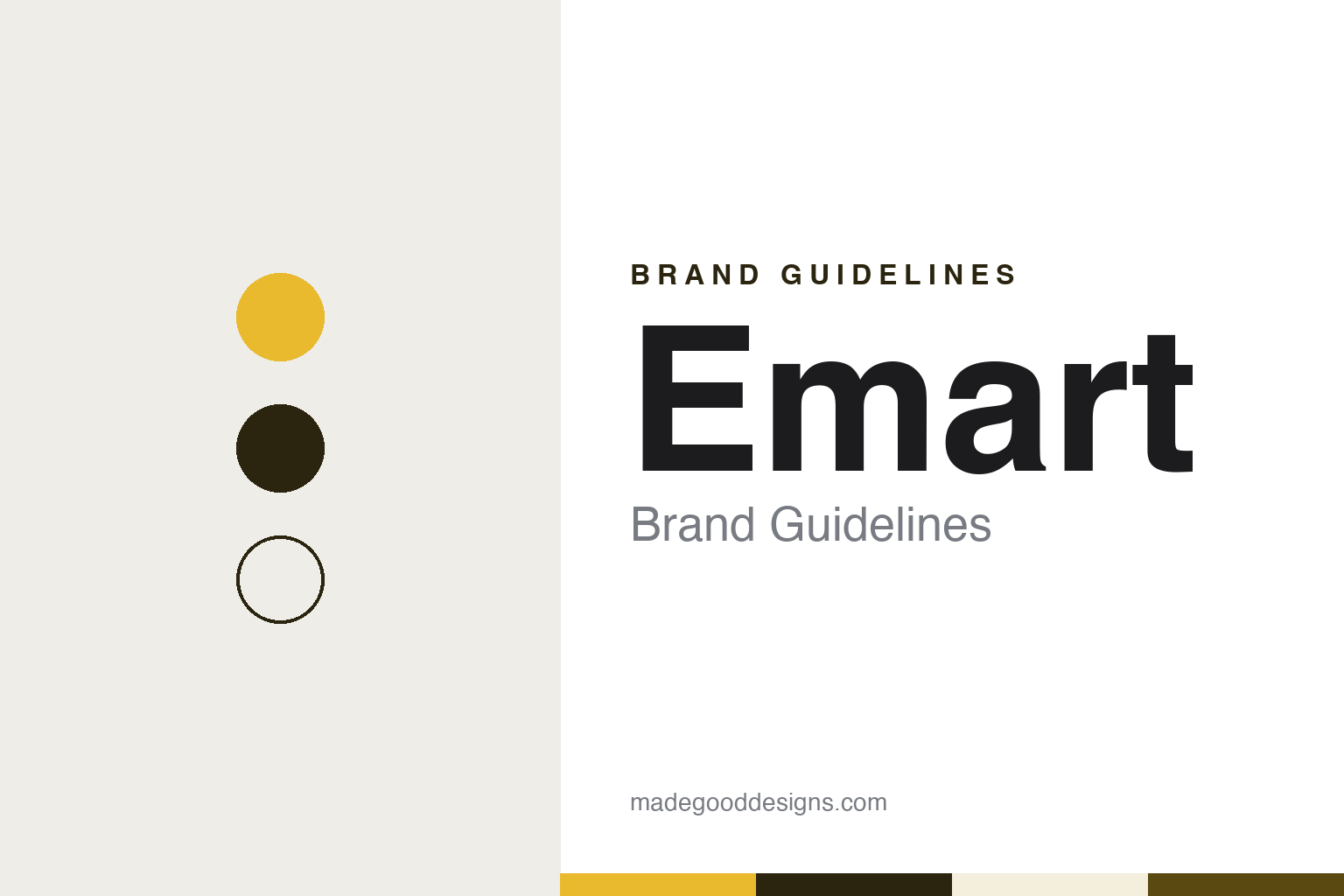
Two constants: an Emart yellow and charcoal palette and a rounded sans register. Abstract homage — not an Emart asset; no logo, fascia or pack is reproduced.
Changdong, 1993
A department-store group opens a hypermarket.
Emart began as a division of Shinsegae, the Seoul department-store group. English Wikipedia says the first store opened on 12 November 1993 in Chang-dong, in Seoul’s Dobong district, and that a second followed in Ilsan New Town in September 1994. The company’s own history page lists the Changdong branch as its starting point, adds a logistics centre in December 1996, and puts the opening of an online shopping mall in August 2004.
Growth at home came partly through purchases. In May 2006 Emart bought Walmart Korea and its 16 stores, according to both the company and English Wikipedia, which says the stores first traded as Shinsegae Mart before being merged fully into Emart in 2008. In 2011 it acquired the Kim’s Club Mart branches. The company’s timeline marks its 101st branch, in Iksan, in October 2006, and its 150th, at Byeollae in Gyeonggi province, in August 2013.
The business also tried other countries. English Wikipedia says Emart opened a store in Shanghai in February 1997, went on to open 27 stores in China and left the country in 2017. A store in Ho Chi Minh City followed in December 2015; in late 2021 THISO Retail, part of the Vietnamese group THACO, agreed to take over Emart Vietnam together with a franchise licence for the name. In Mongolia, Emart opened in Ulaanbaatar in July 2016 with Altai Holding, and English Wikipedia counts six stores there as of December 2025.
Emart became a company in its own right in 2011. Shinsegae spun off its hypermarket business that year and Emart was launched as a separate corporation, The Asia Business Daily reported in August 2026; the company dates the completed spin-off to May 2011. Its legal name today is EMART Inc., with its head office in Seoul’s Jung district, and its shares trade on the Korea Exchange.
Colour
Big boxes, warehouse stores and own labels.
The core format is the hypermarket: a large store that sells groceries alongside household goods, clothing and electronics. Around it Emart has built a family of formats. Emart Traders, a warehouse store, opened at Guseong in Gyeonggi province in November 2010, according to the company, and celebrated its tenth year in December 2020. The Korea Times described the format in October 2026: a limited range bought in large quantities, large packs, goods shown in boxes or on pallets, and an own brand, T Standard, developed with manufacturers from planning to launch.
Own labels carry much of the visible branding inside the stores. The Korea Herald described three in June 2026: Peacock, Emart’s premium ready-meal brand; No Brand, its value-focused private label; and 5K Price, a low-price line launched in August 2025. The company’s timeline records the first No Brand cooperative store in August 2016, and in 2015 the launch of Peacock Kitchen, a food store, alongside The Life, a lifestyle store, and Electromart, an electronics store. The same year it opened its first Emarttown, at Kintex in Gyeonggi province. Other specialist names on the timeline include Molly’s Pet Shop, launched with the first Traders store in November 2010, and Pierrot Shopping, whose first store opened in Seoul in June 2018.
Emart also sits inside a wider group of businesses. The Asia Business Daily reported in August 2026 that the Emart side of the former Shinsegae Group includes SCK Company, Shinsegae Property and the Emart24 convenience-store chain, and that Emart holds about 65 percent of the online retailer SSG.com. Shinsegae Group announced in 2024 that the Emart and Shinsegae groups would separate, the same paper reported.
Typography
How Korean retailers present themselves.
South Korea’s large retailers tend to present themselves through formats before slogans. A single group may run hypermarkets, warehouse stores, supermarkets, convenience stores and online malls side by side, each with its own name on the fascia, and corporate pages usually open with a timeline: the first branch, the district it stood in, the year it opened, and then each new format as it was added.
The big-box stores carry much of their identity on the shelf. Hypermarkets sell groceries alongside clothing, household goods and electronics under one roof, and own labels give them names to point to in the aisle, from value ranges to premium ready meals. Warehouse formats lean on large packs and goods shown in boxes or on pallets, so that the display itself signals the way the store sells.
Department stores and convenience chains work at opposite scales. Department-store groups put their weight into the building, the façade and the flagship in a city centre, while convenience chains rely on a short name and a bright fascia that has to read from a street corner and repeat across a large network of small shops. Beauty and lifestyle chains, and the apps that sit alongside all of these stores, carry the same names into a much smaller frame.
Behind the shop fronts sit corporate structures that the companies set out in plain terms: founding groups, spin-offs, joint ventures with foreign retailers, private-equity owners and listings on the Korea Exchange. Names have changed as partners arrived or left, and some chains have gone through court-supervised rehabilitation. For a designer, that history explains why a fascia, a logotype or an own-label pack looks the way it does today.
Aa
A rounded, friendly sans, in the spirit of a lowercase logotype. (Specimen set in Nunito, a rounded sans STAND-IN; NOT the Emart logo.)
Emart
Capitals traded for lowercase in 2011.
The visual identity changed with the spin-off. The company says that in May 2011 every letter of its logo, once written in capitals, moved to lowercase, and links the change to an idea of serving customers. It describes a run of curved lines it calls the “Emart Curves,” bold lettering, and a softer, friendlier line than the earlier, more rigid design. Those are the company’s own descriptions of its mark.
Online, the picture has shifted more than once. English Wikipedia says Emart took an 80.01 percent stake in eBay Korea in January 2022 and renamed it Gmarket Global, with eBay keeping the rest; the company’s timeline records the share transfer contract in June 2021. The Korea Herald reported in August 2026 that the board of SSG.com, the online business formed in 2019 by combining the e-commerce operations of Emart and Shinsegae, had approved a plan to split its fashion, beauty and lifestyle business into a new company tentatively named Shinsegae Mall; the split was approved in August 2026 and not completed at the time of writing. English Wikipedia also records a move into American grocery retail through Good Food Holdings, the parent of Bristol Farms, bought in 2018, which went on to acquire New Seasons Market in a sale finalised in early 2020.
The stores themselves remain the main stage for the brand. Chosun Biz reported in November 2026 that Emart had stretched its autumn “SSG Day” promotion from four days the previous year to ten, while its rival Homeplus was operating only part of its network under court-supervised rehabilitation.
For a design guide, Emart shows how a retailer can shift its tone by changing letter case and line rather than its name. Compare Lotte Mart, the hypermarket chain of the Lotte group, and Homeplus. For this guide we use a warm yellow, a deep charcoal and a cream with a rounded sans, an unofficial interpretation; no product or logo is reproduced.
Explore & save
Keep Emart’s identity on hand — save it to a board in the Made Good inspiration library.
Emart identity set
Pin the Emart yellow and charcoal palette and the rounded sans register to your own board.