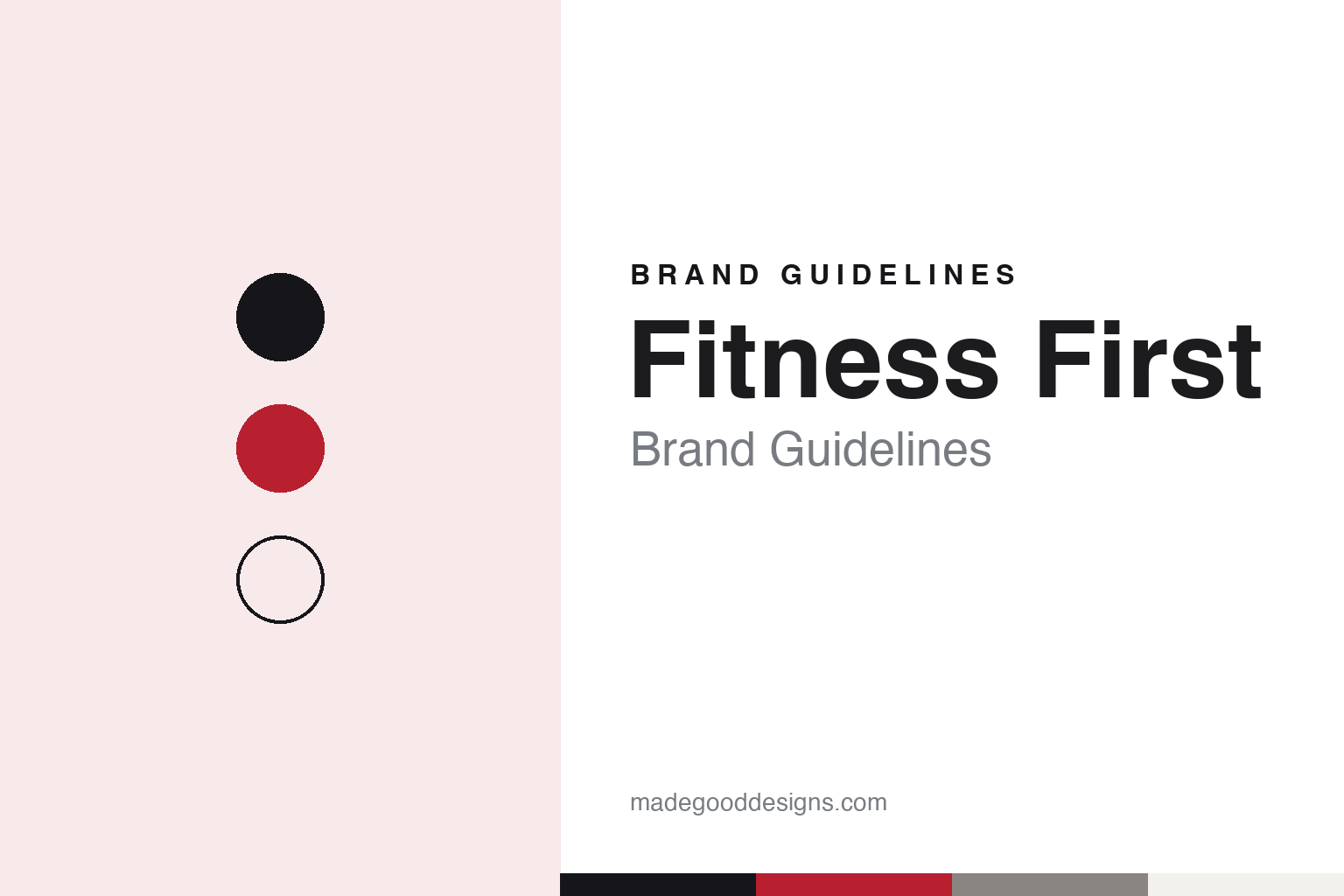
Fitness First Brand Guidelines
A Bournemouth club brand that became several businesses under one name.
Aa
Two constants: a red, black and warm-grey palette and a condensed sans register. Abstract homage — not a Fitness First product or mark; no logo, club or sign is reproduced.
Bournemouth
One club on the south coast, then a global chain.
Fitness First began on England’s south coast. English Wikipedia says the first club was opened in Bournemouth in 1993 by Mike Balfour, and describes the company as an international fitness-centre brand that owned and ran its own clubs around the world until financial pressure led to parts of it being sold to different owners in different regions.
The name soon became familiar in the town where it started. When Bournemouth’s football ground, Dean Court, reopened after rebuilding in November 2001, it took its first sponsored name, the Fitness First Stadium, English Wikipedia says.
Growth abroad followed. English Wikipedia says the company entered Australia in 2000 by buying assets of the collapsed Healthland chain, added Living Well Lady clubs there in 2006 and opened its first clubs in India in 2008. Ownership passed between private-equity firms along the way: it names Cinven as the buyer in 2003, when the company was taken private, and BC Partners in 2005.
By 2012 the group was under strain. English Wikipedia lists high debt, a failed stock-market listing and competition from low-cost chains, and says clubs in Spain, Italy and the Benelux countries were sold before Oaktree Capital Management and Marathon Asset Management took control through a debt-for-equity swap. In Australia, ABC News reported on 1 June 2012 that Fitness First would sell 24 of its 97 clubs there as part of a restructuring of its UK parent, and that members would be able to choose whether to move to a new owner.
Colour
One name, several owners.
Since then the name has been held by separate businesses in different regions, each with its own owner. English Wikipedia sets out the split. In 2016 the Australian arm was sold to the Fitness and Lifestyle Group, and in the same year DW Sports Fitness bought all 62 UK clubs, sold 14 of them and kept 48 under the Fitness First name.
In Asia, the clubs were combined with another chain. Marketing-Interactive reported on 24 February 2017 that Celebrity Fitness and Fitness First Asia had come under one parent, Evolution Wellness Holdings, with 152 wholly owned clubs across Asia, Oaktree and Navis holding equal shares, and both brands kept. It gave the club counts at the merger as 21 in Singapore, 35 in Malaysia, 46 in Indonesia and 28 in Thailand. English Wikipedia’s list of countries says the Hong Kong business has been in voluntary liquidation since 2022.
In Germany the business became the core of a new group. In an interview published by the German trade magazine BODYMEDIA on 29 August 2019, the chief executive of the newly founded LifeFit Group said it brought together Fitness First, the Hamburg chain elbgym, added in December 2018, and Barry’s, the interval-training studio brand, and that Fitness First then ran about 70 studios in Germany. German Wikipedia says the Frankfurt-based group grew out of Fitness First’s German business in 2019 with Oaktree as investor, and that Oaktree sold it to the Dutch private-equity firm Waterland in September 2024.
LifeFit has since used Fitness First as the name for most of its clubs. BODYMEDIA reported on 7 August 2023 that the group had begun a “soft rebranding” of its FitnessLOFT, smile X and In Shape studios, adding “powered by Fitness First” to their names, and counted 112 Fitness First studios in all. The accounting firm BDO, which advised on the deal, said on 13 March 2025 that LifeFit had taken over FIT/One, whose 33 studios in Germany and 12 in Austria are run under the Fitness First name; LifeFit announced completion on 1 April 2025. On 31 March 2026 LifeFit said it had completed the purchase of 21 Just Fit studios around Cologne, taking it to more than 230 clubs.
Typography
Clubs, tiers and owners.
Gym and health-club chains sell a place, so much of their visual identity lives in photographs of the clubs themselves: the equipment floor, the class studios, the changing areas and, increasingly, the details of a refit. The companies publish this imagery in their own press rooms and on club pages, and when a chain modernises, the new interior often becomes the story; RSG Group’s 2024 release on McFit described steel, concrete and wood rather than a new logo.
Many chains split one name into tiers and sub-brands. A club brand may run a premium line and a value line under separate colours, give its class formats their own names, or sell a training programme through its member app. Fitness First’s German owner, for example, separates BLACK and RED clubs, and the UK business launched a training service called “able” inside its app in 2025.
Campaign identities change faster than logos. Slogans, ambassadors and sports sponsorships give a chain public visibility for a few years, while a wordmark and its colours may last a decade or more. Where a rebrand is documented, it is usually in trade or marketing press at the time of the launch, and that is where the guides in this set look for it.
Ownership is often the least visible layer. Corporate websites, press releases and trade magazines record which investor owns a chain, how many clubs it counts and in which countries, and those figures change with each purchase or sale. The guides in this set give club, member and country counts only as a dated source states them, and name the owner as of that source.
Aa
A condensed sans for club signage and campaign lines. (Specimen set in Barlow Condensed, a sans STAND-IN; NOT the Fitness First logo.)
Fitness First
A red letter, and two coloured tiers.
The brand’s look has been set region by region. Mumbrella reported on 21 January 2014 that Fitness First Australia had replaced its blue logo with a red “F”, which the company said stood for “passion, energy and strength,” and was launching its first Australian brand campaign alongside changes to its clubs and service. English Wikipedia adds that the actor Jane Fonda was brand ambassador for that relaunch, and that in 2014, as part of a global rebrand, the company opened BEAT, a heart-rate-based training studio, in London.
In Germany the colours have become a product line. LifeFit’s website describes Fitness First BLACK as its upscale clubs, many with swimming pools, Fitness First BLACK Performance as a more intense format, and Fitness First RED as clubs with defined training zones and modular pricing; BODYMEDIA counted 79 RED and 33 BLACK studios in August 2023. LifeFit says it works with HYROX, Les Mills and EGYM in its clubs, and the German website sorts memberships by the two tiers.
In the UK, the brand runs under its own management. Its press releases say it closed 11 loss-making sites in the year to March 2024, reopened its Marylebone club in London in February 2025 after a refurbishment, and in April 2025 launched “able,” a personalised training service built with the fitness-technology company EGYM and delivered through the Fitness First app. A new chief executive took over in July 2025, the company said. In November 2026 its website listed 25 clubs, 17 of them in London.
For a design guide, Fitness First shows how one name can be held by several owners, each setting its own look: a red letter in Australia, red and black tiers in Germany. Compare David Lloyd Clubs, another British club brand, and McFit, another chain with clubs in Germany and Austria. For this guide we use a signal red, a club black and warm greys with a condensed sans, an unofficial interpretation; no product or logo is reproduced.
Explore & save
Keep Fitness First’s identity on hand — save it to a board in the Made Good inspiration library.
Fitness First identity set
Keep the Fitness First red, black and warm-grey palette and the condensed sans register for your own reference board.