International House Brand Guidelines
A Córdoba school that became a network of independently owned schools.
Aa
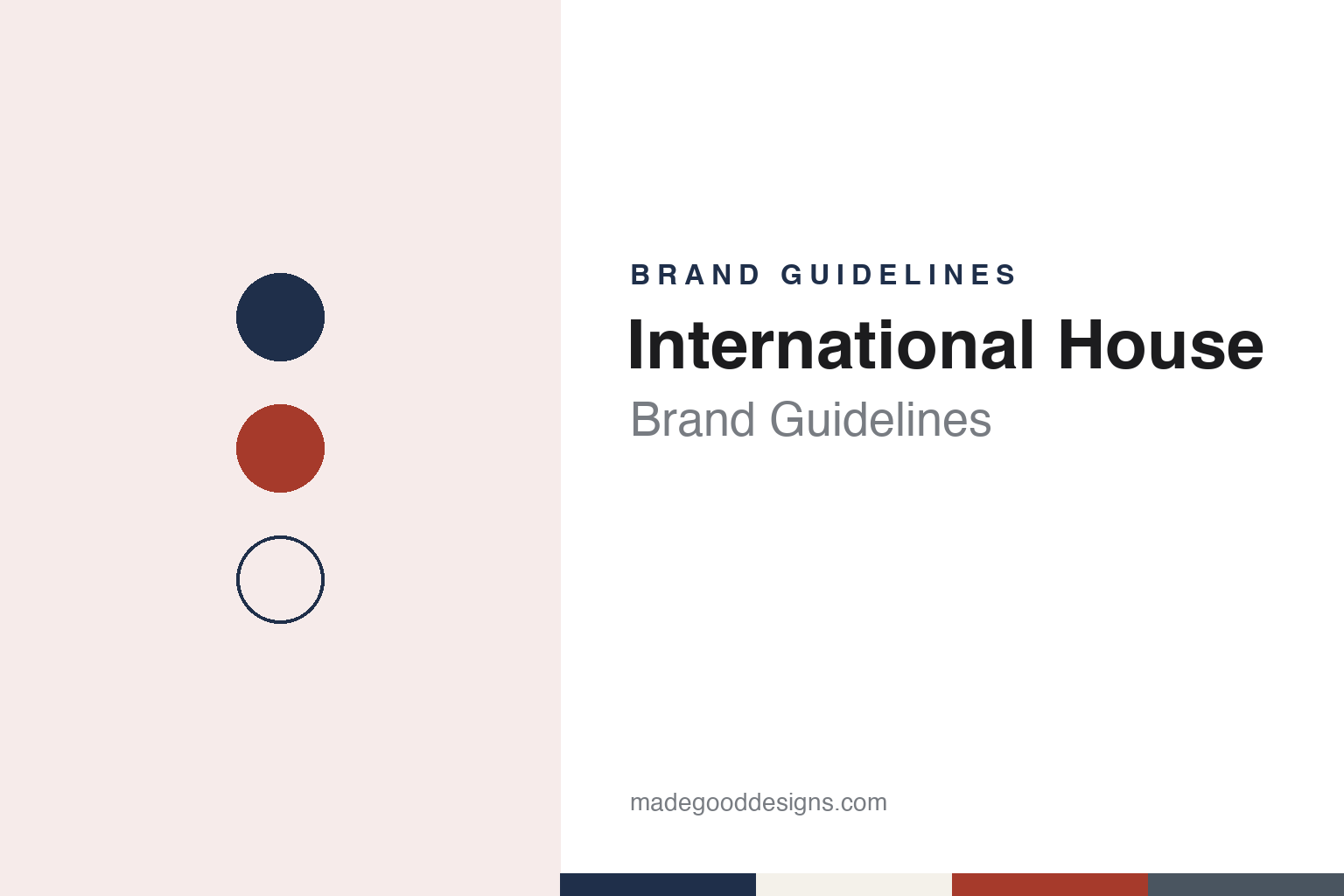
Two constants: an ink blue, brick red and chalk palette and a humanist sans register. Abstract homage — not an International House asset or mark; no logo, sign or school photograph is reproduced.
Córdoba to Covent Garden
A couple, a school in Spain and a book about it.
International House began in 1953 in Córdoba, in southern Spain, where John Haycraft and his wife Brita Haycraft opened a language school, according to the organisation and English Wikipedia. English Wikipedia says the pair taught and wrote there until 1959. John Haycraft told that story in Babel in Spain, published by Hamish Hamilton in 1958, and followed it with Babel in London in 1965, the organisation says; its IH Journal keeps a history section compiled by Brita Haycraft, with chapters on Córdoba and on the Shaftesbury Avenue years of 1961 to 1966.
The London chapter followed. English Wikipedia says International House London opened in 1957 in Endell Street, moved to Shaftesbury Avenue in 1961, to Piccadilly in 1977 and to purpose-built premises in Covent Garden in 2007. It added teacher training in 1962, courses for business executives in 1986 and foreign-language courses in 1989. In 1974 the couple set up a non-profit educational trust; English Wikipedia says International House Trust trades today as International House London, and the trust’s own page says it funds free or low-cost lessons in English and in modern languages for people in London who could not otherwise afford the full cost.
The teacher-training course is the thread most often tied to the name. IH London says its founders started a teacher-training qualification in 1962 that is now known as the CELTA, assessed by Cambridge. English Wikipedia traces the same line: a course developed at International House in the 1960s and 1970s became the Royal Society of Arts certificate in teaching English and then the CELTA. John Haycraft was appointed CBE in 1982 and retired from International House in 1990, English Wikipedia says.
Colour
One name, many owners.
International House is not one company with branches. The International House World Organisation (IHWO), based in London, describes itself as the central membership office for a network of independently owned schools: it manages the IH brand, takes schools through affiliation, runs a quality scheme with regular inspections, and handles network communications, publicity and news. On its own figures the network counts 130+ affiliated schools in 45+ countries, teaching English, Spanish, German, French, Italian and other languages, with well over 200,000 students and more than 5,800 teachers. IH London’s page gives a larger round figure of over 150 schools in over 50 countries, so the count varies with the source and the date.
The trade press shows how the model works. In September 2022 The PIE News reported that five France Langue schools, in Paris, Bordeaux, Biarritz, Lyon and Nice, had joined the network after an affiliation process begun in 2018/19. The report said France Langue had worked in France for more than 40 years and taught 8,000 students a year, while International House brought nearly 70 years of language teaching and teacher training; France Langue’s general manager spoke of putting “the beautiful IH logo” in Paris once again. In November 2024 the same publication reported that International House Edinburgh, a member since the end of 2022, had closed and entered liquidation; the school had opened in 2005 and gained British Council accreditation five years later. The report quoted IHWO as saying that, because every IH school is independently owned and managed, no other affiliate was directly affected. In May 2024 The PIE News also reported on the IH Directors Conference, held that year in Split, Croatia.
That structure shapes the identity. One shared name and mark is carried by many owners, each adding a city, as in IH Paris or IH Lyon. The IH World website is arranged by audience — students, teachers, agents and schools that want to join — with an IH English level test, an Online Teacher Training Institute and the IH Journal. Its stated vision is “Bringing the world together through language.”
Typography
How language schools present themselves.
Language schools sell something that is hard to photograph: progress in a language. Their websites tend to show the setting instead. ELS, for example, describes its centres as sitting on American college campuses and points to shared lounges, cafeterias and computer labs, while inlingua’s international site sorts its courses for adults, companies and children and names the local centre, such as inlingua Berlin or inlingua Utah, beside each student quote.
Course and level names do much of the identity work. The Common European Framework of Reference for Languages offers a shared scale of six levels, from A1 to C2, and inlingua organises its own course books by those codes. Others number their own ladders: ELS teaches in 12 class levels and says more than 600 colleges recognise its level 109 or 112.
Much of the booking and some of the teaching happen online. Schools such as inlingua and ELS carry placement tests, application pages and branded learning platforms on their sites: inlingua runs a family of “my.” products for e-learning and virtual classrooms, and ELS offers a free online English test and a WhatsApp chat with admissions staff.
Owners, networks and accreditations appear on the schools’ corporate pages. inlingua licenses its name to independently owned centres, a franchise model the Swiss newspaper 20 Minuten described in 2024. ELS names its accreditation by ACCET, and since 2022 has belonged with ILSC and Berlitz to Language Education Holdings, The PIE News reported. This guide sets out what can be checked about each brand, and marks clearly what rests on the company’s own word.
Aa
A humanist sans for a network name. (Specimen set in Work Sans, a sans STAND-IN; NOT the International House logo.)
International House
A flagship in London, a federation worldwide.
Today the name has two faces. IH London teaches from a nine-floor school in Covent Garden with, by its own count, 53 classrooms, a large library and a café; English Wikipedia gives 56 classrooms. IH London lists courses for adults and for young learners aged 8 to 17, a Professional English Centre, teacher training, foreign languages and evening courses, and says it is an exam centre. It also says it works with IHWO to protect the International House brand worldwide. English Wikipedia lists its accreditation by the British Council and Eaquals and its membership of English UK.
The world organisation runs the network side. IH World says schools in its membership train about half of all CELTA graduates worldwide; that is the organisation’s own figure. Its mission statement speaks of ensuring quality language education and training, and its listed values begin with “Commit to Quality.” It offers online teacher-development courses, a jobs service for affiliates and annual academic and management conferences, and English Wikipedia says affiliates are inspected by approved inspectors for quality control. The site also states that it is not associated with International House-New York, a residence that shares the name; several other unrelated institutions called International House exist, so the IH World and IH London sites are the places to check.
For a design guide, International House shows how a single short mark can hold together a federation of independently owned schools, each adding its own city to the shared name. Compare Eurocentres, another long-running language-school network with a London chapter, and Berlitz, another long-running language-school name. For this guide we use ink blue, brick red and chalk with a sans, an unofficial interpretation; no product or logo is reproduced.
Explore & save
Keep International House’s identity on hand — save it to a board in the Made Good inspiration library.
International House identity set
Pin the International House ink blue, brick red and chalk palette and the humanist sans register to your own board.