Format Brand Guidelines
A Toronto portfolio builder that started as 4ormat and kept its rules in black, white and yellow.
Aa
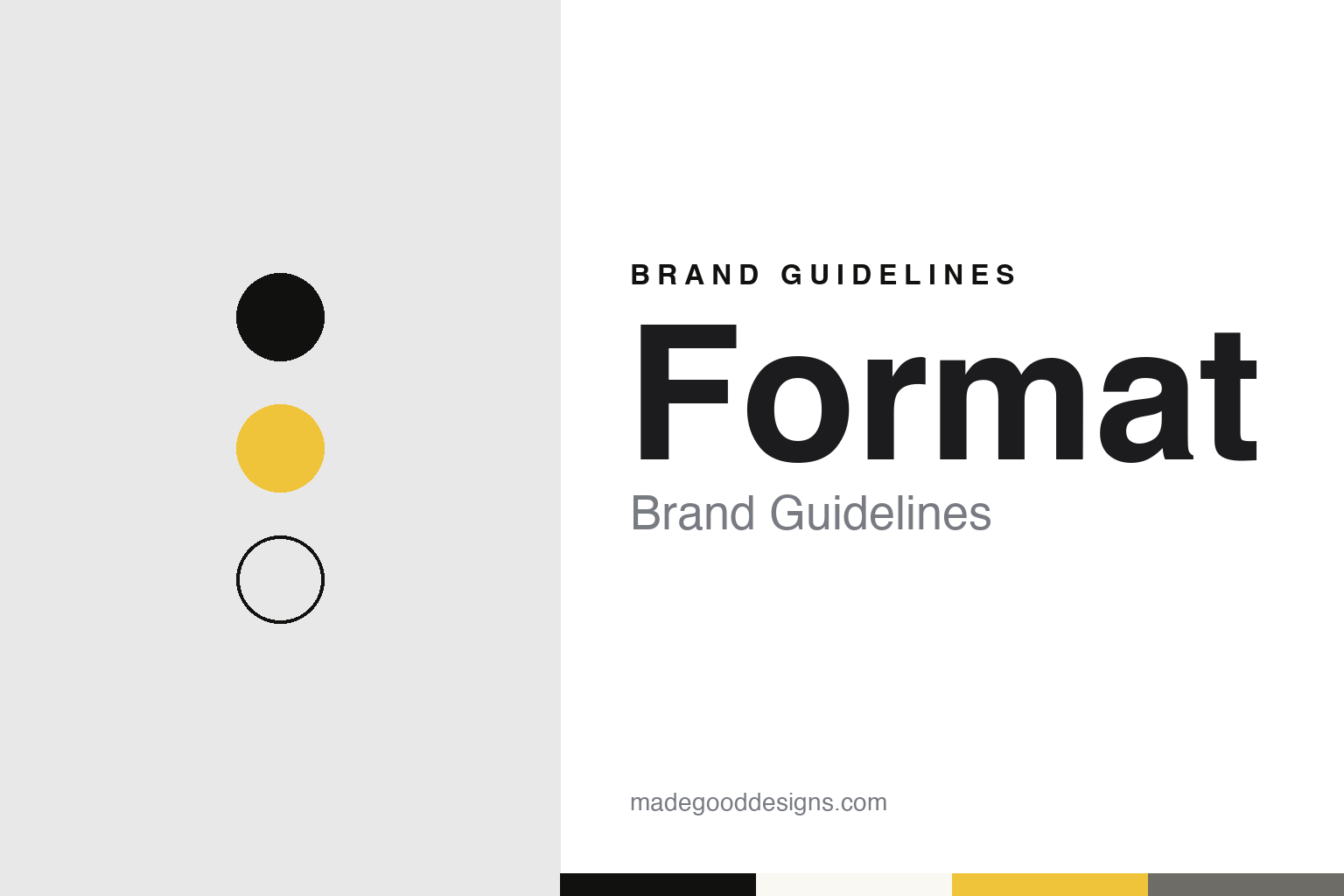
Two constants: a black, white and yellow palette and a grotesque sans register. Abstract homage — not a Format asset or mark; no logo or wordmark is reproduced.
4ormat
A portfolio tool built in spare hours.
Format began life with a number in its name. In a guest post for TechCrunch published on 1 April 2012, co-founder Tyler Rooney described the company as the online portfolio start-up 4ormat and wrote that the team started it in 2008, building it in their spare time while working full-time as consultants. By the time of that post, he wrote, the service had been running for almost three years.
The post is remembered for one decision. Rooney explained that 4ormat’s portfolio-building interface had never supported Internet Explorer in any version, even though that browser held most of the desktop market when the company started. The finished portfolio sites displayed in every browser, he wrote, but the editor itself asked people using Internet Explorer to switch. He presented the choice as a way for a small, self-funded team to ship features faster, and wrote that no customer had asked for Internet Explorer support since launch.
The company’s Toronto roots are documented by BetaKit, the Canadian technology news site. On 17 September 2013 it reported that the Ontario College of Art and Design, OCAD University, had formed a partnership with the “Toronto-based online portfolio solution startup 4ormat.” The deal gave OCAD students and faculty free access to the paid tools, with students keeping that access for six months after graduation, and followed a year-long pilot at the university. BetaKit named Lukas Dryja as 4ormat’s founder and noted that he holds a bachelor’s degree from OCAD’s graphic design programme; it described Rooney as a co-founder.
The same report quoted the company’s own description of its reach at the time: a platform “used by tens of thousands of creative professionals in over 120 countries,” built on drag-and-drop site editing and professionally designed themes. Those figures are the company’s, as BetaKit printed them in 2013.
Colour
Portfolios, galleries and a studio back office.
Today the service trades as Format, at format.com, and its website footer names the operator as Ideaform Inc. The company’s About page describes a single purpose — “to help photographers succeed and thrive” — and lists its values as impact, trust, care, simplicity and hard work. The same page says the business has been “bootstrapped since day one,” echoing the self-funded start Rooney described in 2012.
The product is organised around a handful of named areas. Online Portfolio is the website builder itself, sold on professionally designed themes for photographers, artists, designers, illustrators and filmmakers. Workflow covers the business side of a photography studio: proofing, client management, contracts and file transfers, alongside client galleries. Selling lets members sell products, services and digital downloads, which Format describes as commission free. Flex Block lets users build custom layouts by snapping elements into place, and a Weglot integration translates sites for international visitors.
Format also sells advice and publishes editorial. Its Format Experts offer one-to-one consultations to build or review a member’s site, and Format Magazine runs features, galleries, resources and video, together with member stories about people who use the platform. The website itself is offered in English, French, Spanish, Portuguese, German and Italian.
Education has stayed close to the brand since the OCAD partnership. Format’s Educational Outreach page describes a Student Program that gives students a free year on the platform, a library of onboarding and professional-practice videos, and resources and webinars for teachers and institutions. The page carries a quotation attributed to OCAD University praising the partnership’s effect on students’ careers.
Typography
Design and documentation.
Website and portfolio builders present themselves first through their templates. Ucraft’s home page offers more than 120 “designer-made” templates sorted into categories such as business, photography, restaurants and art, and credits each one to a designer on its team; Readymag’s templates, Website Planet reported in May 2026, are grouped into company websites, landing pages, presentations, portfolios, editorials and online stores, and include designs submitted by users.
The editor is the second part of the pitch, and the products differ. Ucraft’s editor works with blocks and elements that snap into a page grid, according to reviews in TechRadar in 2021 and PCMag in 2026, with a separate page of typography, button and layout settings that the company calls Designer Tools. Readymag’s editor is freeform, with elements placed without a rigid grid and detailed type controls such as ligatures, stylistic sets and variable fonts, according to English Wikipedia; Website Planet describes it as layer-based.
Showcase sites made by users do much of the brand’s work. Ucraft keeps a gallery called “Made with U,” and Readymag runs an annual Website of the Year award for projects built on its platform, judged by a jury of designers and art directors, according to English Wikipedia. Plan and feature names follow a similar logic, pairing plain tiers with branded tools: TechRadar listed Ucraft’s paid plans in 2021 as Pro Website, Pro Shop and Unlimited, alongside features such as a logo maker.
Corporate pages on founders and owners vary widely. Ucraft’s about page gives a dated timeline and names its investor, SoftConstruct, but not its founders, while Readymag’s founders and chief executive are named in English Wikipedia and in design-press interviews. This guide sets out what each company says about itself, and what independent dated sources add.
Aa
A grotesque sans in black and white. (Specimen set in Archivo, a sans STAND-IN; NOT the Format logo or wordmark.)
Format
A wordmark with two permitted colourways.
Format publishes basic identity rules on its own press page. The wordmark may be used only white on a black background or black on a white background, and the page asks users not to alter its opacity, shape, colour or proportions. The separate logo is supplied in three versions: black on a yellow background, white on black and black on white, with the same instruction not to change it. The page adds that Format uses fonts from Type Network, the type foundry and distributor, without naming a particular family. Downloadable media images sit alongside the marks for press use.
Those rules suit a service whose customers are mostly showing their own pictures. A strict black-and-white wordmark stays out of the way of the photographs, and the yellow version of the logo gives the brand one recognisable colour without competing with the work on screen. The company’s About page makes the same point in words, describing a design standard that “honors the quality of our members’ work.”
The ownership story moved on in 2021. Format’s About page says that on November 11, 2021, Format announced it was “joining forces with Zenfolio,” the photography website and client-gallery company, and calls the combination “a significant shift in direction for the industry.” The site still runs under its own name and its own operator, Ideaform Inc., and its pages continue to speak about Format’s team, values and careers as a business in its own right.
The 4ormat name has gone, but the spelling is easy to trace: the company appears as 4ormat in TechCrunch in 2012 and BetaKit in 2013, and as Format on its website today.
For a design guide, Format shows how a portfolio platform can keep its identity quiet so the members’ work stays in front. Compare Zenfolio, the photography platform Format joined forces with, and Pixpa, another portfolio builder for photographers. For this guide we use black, white and a warm yellow with a grotesque sans, an unofficial interpretation; no product or logo is reproduced.
Explore & save
Keep Format’s identity on hand — save it to a board in the Made Good inspiration library.
Format identity set
Save the Format black, white and yellow palette and the grotesque sans register for your own reference.