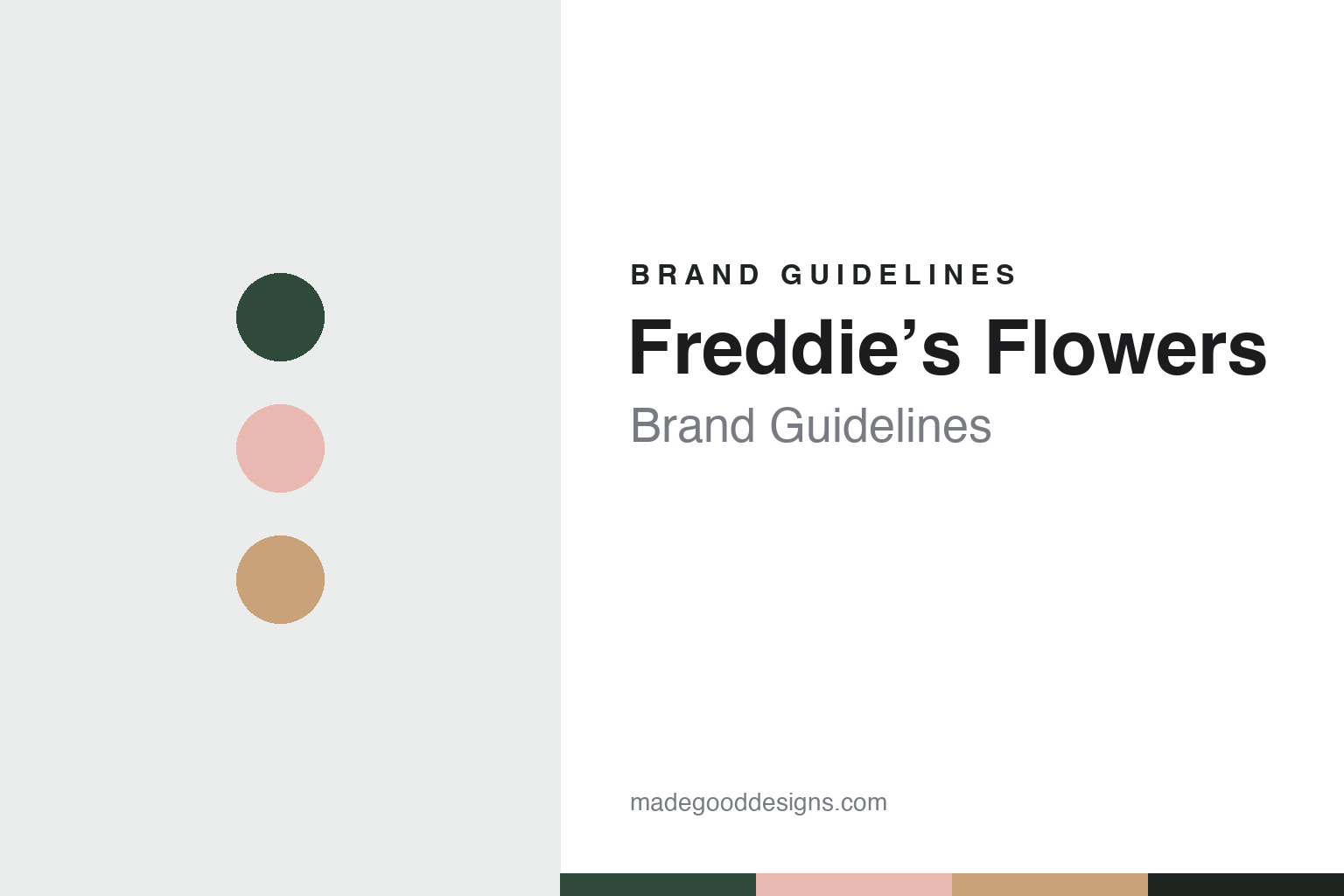
Freddie’s Flowers Brand Guidelines
A London flower subscription that began with a milk float and a gazebo.
Aa
Two constants: a stem green, petal pink and kraft palette and a garden serif register. Abstract homage — not a Freddie’s Flowers product or mark; no box, card or logo is reproduced.
A gazebo and a milk float
A florists’ son takes the shop to the doorstep.
Freddie’s Flowers is a London flower-subscription business. The UK company register lists Freddie’s Flowers Ltd as incorporated on 29 August 2014, and City AM, reporting in June 2026, described the firm as established “a little over a decade ago” by its founder, Freddie Garland, whose parents ran a flower shop. The company tells its origin story in the founder’s own voice. He grew up in his parents’ shop, moved back home, got a milk float for deliveries and set up a gazebo for packing boxes; the early days meant mornings at the flower market, packing and delivering, then evenings on the streets looking for customers. City AM repeats the detail, saying the business began operations in a gazebo in the garden of a house on a residential street.
The model has stayed at the centre of the brand. Customers sign up for a box of seasonal stems delivered on a set day, weekly, fortnightly or every three weeks, and can pause, skip or cancel online. The stems arrive in bud and unarranged: the company says each box holds five to seven varieties, a sachet of flower food and an illustrated arranging guide, so the customer does the arranging at home. There are two sizes, called Classic and Showstopper, and the company says the larger box carries some varieties kept only for that size. Alongside subscriptions it sells one-off gift boxes, letterbox flowers, vases and corporate gifting, and its blog is called The Flower Press. The phrase it uses for all of this is “living flowerfully.”
The company says it works with its growers on a “grow-to-order” basis. Because subscriptions tell it roughly how many stems it will need each week, growers only grow what has been ordered, which the company presents as a way to cut floral waste; anything left over, it says, is composted. It also says it is a member of the FSI, which it describes as an international body for sustainability in floriculture.
Colour
Boxes, bikes and a B Corp.
Packaging and delivery carry much of the brand. The company says its standard customer packaging is recyclable or biodegradable, and that boxes travel by low-carbon delivery: a team of bikes in London, and electric vans and couriers elsewhere. In many areas it collects the empty box at the next delivery so it can be used again. It names DPD and Abel & Cole as courier partners. It has also introduced greeting cards made from flower waste, and it publishes a yearly sustainability report; the most recent listed on its site covers 2025.
Freddie’s Flowers is a certified B Corp. It says so on its own site, and the point is confirmed from outside. When Retail Gazette reported in May 2026 on a Chelsea Flower Show week partnership with the lingerie brand Stripe & Stare, under which fifteen shoppers a day at Stripe & Stare’s King’s Road boutique received a posy from Freddie’s Flowers between 18 and 24 May, Stripe & Stare’s co-founder described Freddie’s Flowers as “a fellow B Corp.” The tie-in was timed for Chelsea in Bloom, the floral art show that runs alongside the flower show.
Growth brought a wider map and then a narrower one. In 2020, City AM recalled, the company drew attention in the City with an unusual bond offer in which investors could take their interest in flowers rather than in cash, following the chocolate chain Hotel Chocolat, which had paid investors in chocolate; the company register lists a separate bond company incorporated in September 2020. In August 2021 the business closed a funding round. It expanded to Germany, the Netherlands and California, aiming to become a global flower business, but later pulled out of the Netherlands and California. By 2026, City AM reported, overseas sales made up around a sixth of the total, and a German-language site still sells subscription boxes as Blumen-Abos.
Typography
Design and documentation.
Flower delivery brands sell something that changes with every order. The bouquet a customer sees on screen is a photograph of one arrangement, made up again by a florist or a packing team when the order arrives, so the photograph does much of the work of the brand. A bouquet is often given a name and sold in more than one size: in 2019, for example, House Beautiful reported Serenata Flowers bouquets offered in standard, deluxe and grande versions.
Packaging is the other visible surface. Some online florists send flowers in boxes made to fit through a letterbox, and that packaging has become part of how they are described: House Beautiful noted in 2019 that one Bloom & Wild bouquet came “delivered through your door” in the company’s letterbox packaging. Others work through networks of local shops, where the arrangement is made by an independent florist and the brand lives mainly on the website and the order confirmation.
Naming carries much of the rest. Seasonal launches, bouquets named after a month or a festival, gift ranges and, at some companies, subscription schemes can give a brand a calendar to talk about, and the trade revolves around a few peak days; Valentine’s Day is the clearest, which the Swedish trade site Ehandel.se called the most intense day of the year for flower delivery in February 2026.
Behind the shop fronts, ownership is often more concentrated than the brand names suggest. Groups such as Euroflorist run several national web shops and keep separate corporate and investor pages that list the brands they own. This guide sets out what can be checked about each brand — who founded it, who owns it and how it sells — and attributes to the company any claim that rests on its own word alone.
Aa
A warm garden serif for a founder-voiced flower box. (Specimen set in Fraunces, a serif STAND-IN; NOT the Freddie’s Flowers logo.)
Freddie’s Flowers
From expansion to a leaner London business.
The years after 2022 brought cost-cutting. City AM reported in June 2026 that the business cut around a quarter of its staff in 2024, and that headcount had fallen by around 60 per cent from its 2022 peak. In the year to August 2025 the company closed its warehouse in Hounslow, west London, and moved flower packing to a third party, saying in its accounts that the change would pay back within twelve months. The same accounts, City AM said, showed demand for gifts and vases up by a third, and the company described its aim as “profitable growth.” In November 2026 its UK site sells subscriptions and gift boxes for delivery across mainland Britain.
The way the brand talks is part of its identity. The About page opens in the founder’s own voice, “Hi, I’m Freddie,” and the copy stays informal throughout: boxes are “a bunch of joy,” sizes are Classic and Showstopper, and the stems are shown through a seasonal Lookbook on the site. Each box arrives with an illustrated card that explains the stems and how to arrange them, with styling tips and flower facts, and the care tips are printed inside the box itself.
For a design guide, Freddie’s Flowers shows how a subscription brand can be built around a box, a printed card and a friendly voice rather than a single hero product. Compare it with the London letterbox brand Bloom & Wild and the florists’ relay network Interflora. For this guide we use a deep stem green, a soft petal pink and a warm kraft tone with a serif, an unofficial interpretation; no product or logo is reproduced.
Explore & save
Keep Freddie’s Flowers’s identity on hand — save it to a board in the Made Good inspiration library.
Freddie’s Flowers identity set
Save the stem green, petal pink and kraft palette and the garden serif register for your own moodboard.