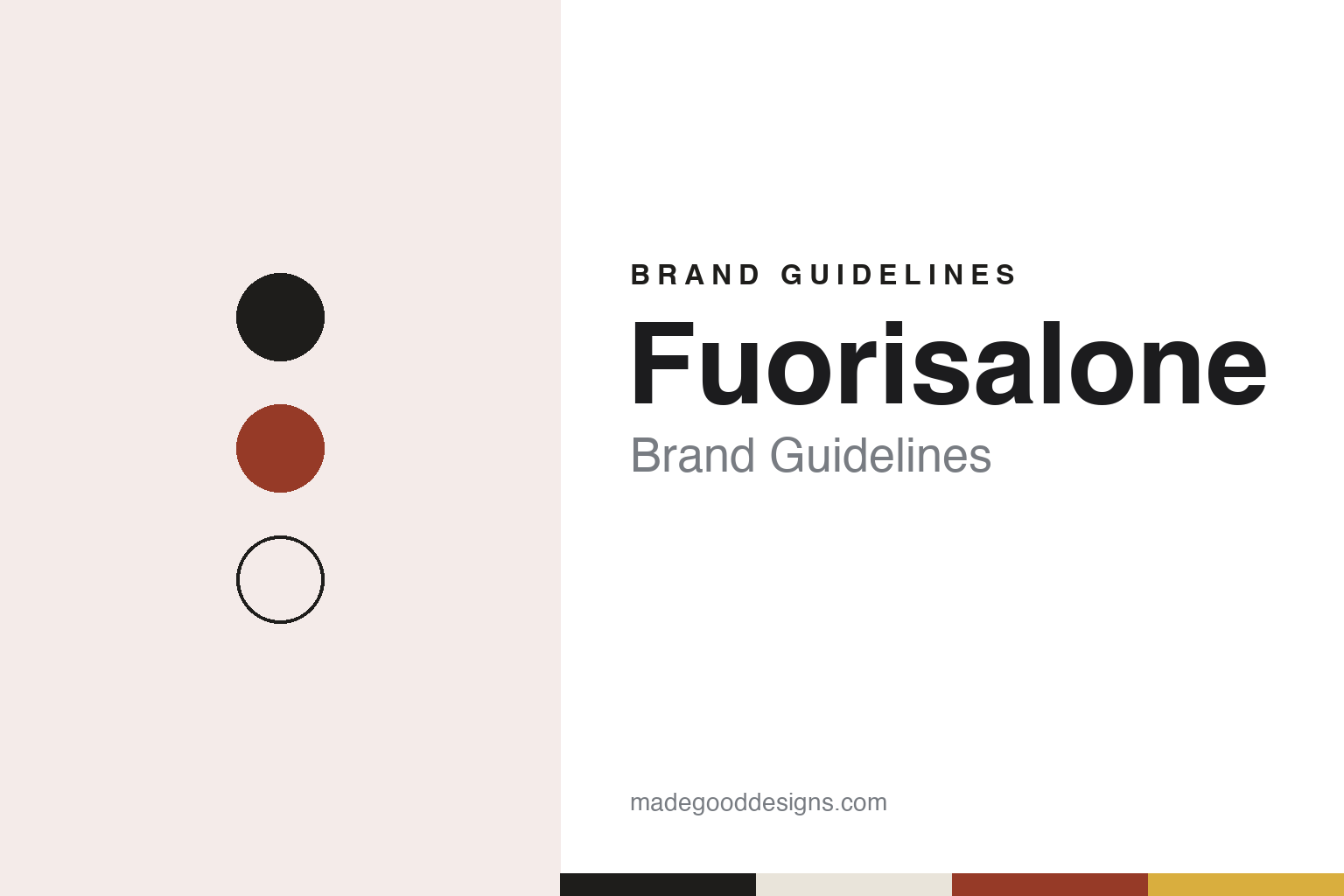
Fuorisalone Brand Guidelines
Milan Design Week’s city-wide programme outside the Salone.
Aa
Two constants: a brick, stone and ink palette and a grotesque sans register. Abstract homage — not a Fuorisalone mark; no logo, flag or key visual is reproduced.
Off-Salone
A name for everything outside the fair.
Fuorisalone, Italian for “outside the Salone,” is the name used for the events held across Milan each April during the week of the Salone del Mobile.Milano, the furniture fair held in the exhibition halls at Rho Fiera Milano. Together the fair and the city programme make up the Milano Design Week, known in English as Milan Design Week. Unlike the Salone, the Fuorisalone has no single organiser: brands, galleries, schools, magazines and district associations each put on their own shows, and a series of guides and platforms has grown up to list them.
The history published by the fuorisalone.it platform traces the pattern back to the late 1970s, when, it says, the furniture maker Cassina used its own showroom in the city as an extension of its stand at the fair. In the 1980s more companies set up displays in showrooms and other venues in the city centre, and the same account says that in 1983 the magazine Abitare gave a section of its pages to the events outside the fair, followed a year later by a video feature.
The calendar changed at the start of the 1990s. According to the fuorisalone.it history, the Salone’s organiser, Cosmit, moved the fair’s 30th edition from September to April in 1991, and Gilda Bojardi of the interiors magazine Interni organised a “Designer’s Week,” a network of city showrooms that the platform describes as the starting point of the official guides that followed. That format lasted two editions, the same account says, but small printed guides to the week multiplied in the years after it.
Monocle, in an interview published on 25 April 2026, said Bojardi has published a guide to the Fuorisalone’s events since 1990 and has edited Interni, a Mondadori title, since 1994. In the same interview she said she coined the word herself: the Salone did not want its name used for outside events, and, thinking of New York theatre, she reasoned “Off-Broadway, off-Salone: Fuorisalone.” Since 1998, the magazine reported, Interni has staged its own events under its own banner; in 2026 its showcase was called Materiae, with events at Milan’s State University and in Brera’s botanical garden.
The fair itself left the city centre in 2006, when Fiera Milano and the Salone moved to the new pavilions at Rho, the fuorisalone.it history says, while the events outside it stayed in Milan’s neighbourhoods.
Colour
A platform and its districts.
The most widely used listing today is fuorisalone.it, run by Studiolabo, a Milan agency for communication and concept design. The platform says it has been the reference guide to the Fuorisalone since 2003, and that Fuorisalone.it is a trademark registered by Studiolabo, with extensions for China and Japan. Studiolabo says it devised both Fuorisalone.it and Brera Design District, and that since 2014 the platform has also been the reference point for Interzone, a City of Milan project within its “Milano Creativa” programme that gathers the requests of the many operators involved in the design week.
In 2020 the physical event did not take place, and Studiolabo says it ran a fully digital communication plan for the Fuorisalone instead. In 2021, by the company’s account, the platform became a design guide active all year in physical, digital and hybrid form; since 2022 it has run projects through the year, with an events guide that switches on during the design week itself.
The programme is spread across neighbourhoods rather than gathered in one hall. The fuorisalone.it history dates Zona Tortona to 2001, after the Superstudio venue opened its spaces to design as well as fashion in 2000, and calls it a project of territorial branding for the Fuorisalone. In its report on the 2026 edition, the platform says Brera Design District remained the main point of reference, with 320 events across 217 permanent showrooms and other venues, and names Tortona, Durini, 5VIE, Isola and Porta Venezia among the districts, alongside independent programmes such as Alcova.
The same report gives the dates of the 2026 Fuorisalone as 20 to 26 April. The organiser says its official guide listed more than 1,100 events that year, with more than 1,300 events in the city as a whole and more than 500,000 visitors. It also describes a widening range of hosts: furniture design remains a pillar, it says, but technology, fashion, automotive, food and art brands now take part, with installations in historic palazzi, courtyards and temporary spaces across the city.
Typography
Design weeks and biennials.
Design weeks and design biennials usually take their names from the place that holds them. Most combine a city with the words “design week,” “design festival” or “biennale,” sometimes in the local language and sometimes shortened to an acronym or a single coined word, so that the name works as a date in the calendar as much as a title.
The bodies behind them vary. Some are run by national or regional design councils and city agencies acting in an institutional role; others by cultural foundations, design schools, trade-fair companies or communication agencies. Several are timed to a trade fair in the same city, and grew up as a public programme around it, while others stand alone.
What they share is a programme spread across a city rather than gathered in one hall. Districts, showrooms, shops, galleries, schools, museums and temporary venues open for exhibitions, installations, talks and open studios, and the organisers publish maps, guides and listings to hold the pieces together. Biennials tend to work with a curator and a smaller set of venues; design weeks often depend on many independent hosts.
Visual identity follows the same pattern. A steady wordmark or name carries from year to year, while each edition adds its own theme, key visual or poster, often by a different designer or studio. This guide describes each event from its own first edition, using dated sources for organisers, venues, dates and themes, and sets an unofficial palette and type stand-in beside it; no logo or key visual is reproduced.
Aa
A grotesque sans for a name that belongs to a whole city. (Specimen set in Archivo, a sans STAND-IN; NOT the Fuorisalone logo.)
Fuorisalone
A yearly theme over a steady name.
The Fuorisalone has no single wordmark owned by an organiser of the whole week; the identity that visitors meet is the name itself, the platform that lists the events and the districts that brand their own streets. Fuorisalone.it presents the name with the registered-trademark sign and states that it belongs to Studiolabo, while districts such as Brera Design District run their own guides, calendars and communication.
Fuorisalone.it also gives each edition a theme, with its own page and visual material; its theme pages run from 2022. It lists “Materia Natura” for 2024, a theme it tied to sustainability as a guiding principle in the design process; “Mondi Connessi,” or “connected worlds,” for 2025, about links between physical and digital worlds, between cultures, and between people and the environment; and “Essere Progetto,” roughly “being project,” for 2026, which the platform says covers both people as active subjects of change and design as a process that keeps evolving, including the relationship with artificial intelligence.
The platform’s 2026 report describes the Fuorisalone as a dual system with the fair: the Salone as a trade event aimed at business and product presentation, and the Fuorisalone as a spread-out urban system of events, installations and cultural activities across Milan.
For a design guide, Fuorisalone shows how a single coined word, owned by no one hall, can hold together a week of events run by many separate hosts. Compare Salone del Mobile, the fair the word was made to stand apart from, and Paris Design Week, another city programme timed to a furnishing fair. For this guide we use a brick red, a warm stone and a deep ink with a sans, an unofficial interpretation; no product or logo is reproduced.
Explore & save
Keep Fuorisalone’s identity on hand — save it to a board in the Made Good inspiration library.
Fuorisalone identity set
Pin the Fuorisalone brick, stone and ink palette and the grotesque sans register to your own board.
Source & notes
Frequently Asked Questions
What font can I use to match the Fuorisalone look?
This guide describes Fuorisalone’s type as “A grotesque sans for a name that belongs to a whole city”. Its type specimen is set in Archivo from Google Fonts as a stand-in; Archivo is not Fuorisalone’s own lettering.
What colours are in the Fuorisalone palette?
This guide’s Fuorisalone palette is Courtyard brick #963A27, Ink #1E1D1B, Stone #E9E4DA, Tram yellow #D9AE3E and Paper #F8F6F1. The tones are the guide’s own unofficial interpretation, not official Fuorisalone hex codes.
What does the name Fuorisalone mean?
According to this guide, the name Fuorisalone comes from “Outside the Salone” (coined by Gilda Bojardi of Interni).