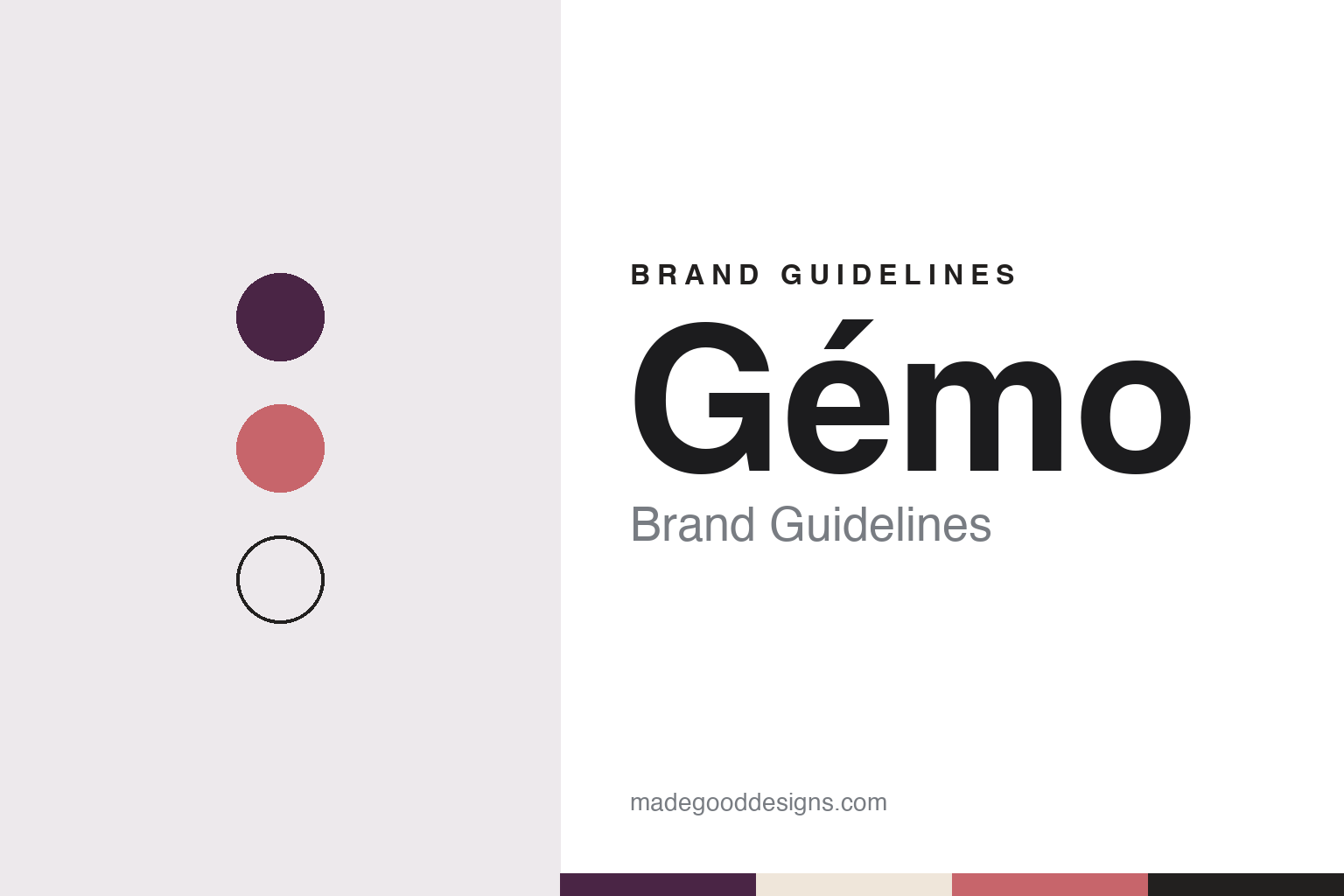
Gémo Brand Guidelines
Shoes and clothes for the whole family under one roof, since 1991.
Aa
Two constants: a deep plum, rose clay and linen palette and a friendly humanist sans register. Abstract homage — not a Gémo asset; no logo, shop fascia, shoe or garment is reproduced.
Gérard and Monette
A 1991 chain built from three Éram formats.
Gémo was created in 1991 inside the Éram group, the shoe and clothing retailer whose historic head office is at Saint-Pierre-Montlimart in Maine-et-Loire, now part of the commune of Montrevault-sur-Èvre. French Wikipedia names its founders as Xavier Biotteau and his wife Catherine, and says the chain brought together several formats the group had developed in the 1980s: Hyper aux vêtements, Hyper aux chaussures and Tandem. Le Journal des Entreprises also dates Gémo to 1991, describing it in March 2023 as a subsidiary of the Éram group based at Montrevault-sur-Èvre.
The name is a family one. According to French Wikipedia, “Gémo” joins the first names of the couple then at the head of Éram, Gérard Biotteau and his wife Simone, known as Monette. The idea from the outset, the same source says, was shoes and clothing for the whole family under one roof, in stores placed on the edges of towns rather than in their centres; its first slogan promised customers that the chain would keep making life simpler for them.
Footwear and clothing have stayed side by side. In August 2021, Le Journal des Entreprises reported that own-label products made up 85 to 90 per cent of what Gémo sold, and that not every store yet carried both shoes and clothing, something the chain was working to change as it renovated its shops. French Wikipedia names house labels including Camps for clothing and Tanéo, 5 Miles and Follow Me for shoes, sold alongside sportswear brands and licensed children’s ranges.
In December 2020, as the chain approached its thirtieth year, the same paper put the Gémo catalogue at about 15,000 references, supplied from three warehouses in western France that serve the whole country.
Colour
Four hundred stores and a network from Tahiti to Abidjan.
Most of Gémo’s stores are in France. French Wikipedia gives 411 stores in France in 2016, with an average size of about 1,500 square metres, and 393 in France in 2023. Le Journal des Entreprises counted 440 Gémo stores in December 2020, 412 of them in France, with openings that year in Saint-Étienne, in Sallanches in Haute-Savoie and in Abidjan; in August 2021 it gave about 400 stores in France, and in March 2023 it gave 430 stores in France and abroad.
The network outside mainland France grew from overseas France and French-speaking Africa. In August 2021 the paper reported that Gémo had had stores in Tahiti and New Caledonia since 2020 and was opening a fourth store in Switzerland. In March 2023 it reported four stores in Africa, two in Côte d’Ivoire, one in Cameroon and one in Gabon, after openings from November 2022, and the chain’s first two stores in the Middle East, in Saudi Arabia, opened at the end of 2022. French Wikipedia counts more than 34 stores outside mainland France in 2025, in overseas territories and in twelve countries including Senegal, Madagascar, Malta and Mauritius.
The chain has also sold through other people’s shops and to businesses. In August 2021 Le Journal des Entreprises reported that Gémo was present in thirteen Intermarché supermarkets. In December 2020 the paper described Gémo Pro, a service launched that year for professional buyers; companies, local authorities and vocational schools had already been buying from the ordinary ranges in store, and the new service gave them a dedicated offer in every shop, with stores acting as collection points for orders prepared in the warehouses.
The head office has stayed in the Mauges countryside. The same 2020 report said Gémo employed about 380 people at Saint-Pierre-Montlimart, the historic seat of the group as well.
Typography
How the chains present themselves.
France’s mass-market fashion and childrenswear chains grew up mostly in retail parks and shopping centres rather than on high streets. Kiabi opened its first store at Roncq, outside Lille, in 1978, and Gémo was created by the Éram group in 1991 to sell shoes and clothing for the whole family in stores on the edges of towns. For these chains the shop fascia, the logo on the bag and the label inside the garment are often the same name, because most of what they sell is their own.
Own-label ranges carry much of the identity. The International Directory of Company Histories traces Kiabi’s house brands back to its first store, with Winch and Decade, and later children’s labels; Le Journal des Entreprises reported in 2021 that own-label products made up 85 to 90 per cent of Gémo’s offer. Catalogues, websites, apps and seasonal campaigns present those ranges, and logos are redrawn from time to time: Kiabi unveiled a new single-letter K in December 2025, CB News reported.
Many of the chains belong to family-owned groups, and their corporate pages say so plainly. Kiabi sits in the Mulliez family’s retail group alongside Auchan and Decathlon; Gémo belongs to Éram, based at Saint-Pierre-Montlimart in Maine-et-Loire; French Wikipedia describes Groupe Beaumanoir as a family group founded in 1981 by Roland Beaumanoir. Founders, owners and changes of control are part of each brand’s story, and receiverships and sales have reshaped several of these names in recent years.
This guide sets out what can be checked about each brand: who founded it, who owns it, how its stores, labels and logos have changed, and what has happened to it. Company statements are marked as such, and counts of stores and countries are given with the date of the source.
Aa
A friendly humanist sans for a family chain. (Specimen set in Figtree, a sans STAND-IN; NOT the Gémo logo.)
Gémo
Prêt-à-vivre, second-hand corners and family slogans.
Gémo went online in 2010, when it opened its e-commerce site, according to French Wikipedia. In December 2020 Le Journal des Entreprises reported that its online sales had doubled during the spring closures of that year, and that a drive-through collection service started then had been kept afterwards.
The same December 2020 report described a test of second-hand corners in three stores from the summer of 2020, with about 1,000 references of women’s and baby clothing, half of them from Gémo’s own labels, collected and sorted by a partner, Patatam.
The brand’s voice has been written into its slogans. French Wikipedia lists “Le prêt-à-vivre”, a play on prêt-à-porter, as the chain’s slogan from 2021 to 2024 and gives its signature since 2024 as “Taillé(e)s pour la vie de famille”, roughly “cut out for family life”. French Wikipedia also records a 2024 collection called “Produits malins”, designed with families to answer everyday problems parents face with clothes and shoes.
Gémo’s owner remains the Éram group, which French Wikipedia describes as a French distributor of shoes, clothing and accessories made up of ten brands.
For a design guide, Gémo shows how a family-owned group can turn its founders’ first names into a retail brand and keep shoes and clothes under one roof. Compare Kiabi, another family clothing chain built on out-of-town stores, and La Halle, another French fashion chain. For this guide we use a deep plum, a rose clay and a linen with a humanist sans, an unofficial interpretation; no product or logo is reproduced.
Explore & save
Keep Gémo’s identity on hand — save it to a board in the Made Good inspiration library.
Gémo identity set
Pin the Gémo deep plum, rose clay and linen palette and the friendly humanist sans register to your own board.
Source & notes
Frequently Asked Questions
What font can I use to match the Gémo look?
This guide describes Gémo’s type as “A friendly humanist sans for a family chain”. Its type specimen is set in Figtree from Google Fonts as a stand-in; Figtree is not Gémo’s own lettering.
What colours are in the Gémo palette?
This guide’s Gémo palette is Deep plum #4A2545, Charcoal #22201F, Rose clay #C7656B, Linen #EFE6DA and Paper #FAF7F2. The tones are the guide’s own unofficial interpretation, not official Gémo hex codes.
When was Gémo founded?
Gémo was founded in 1991, in Saint-Pierre-Montlimart, Maine-et-Loire, France. Gémo is known for Family shoes and clothing in out-of-town stores.
Who founded Gémo?
Gémo was founded in 1991 by Xavier and Catherine Biotteau, within the Éram group.
Who owns Gémo?
Gémo is part of the family-owned Éram group. Gémo is known for Family shoes and clothing in out-of-town stores.


