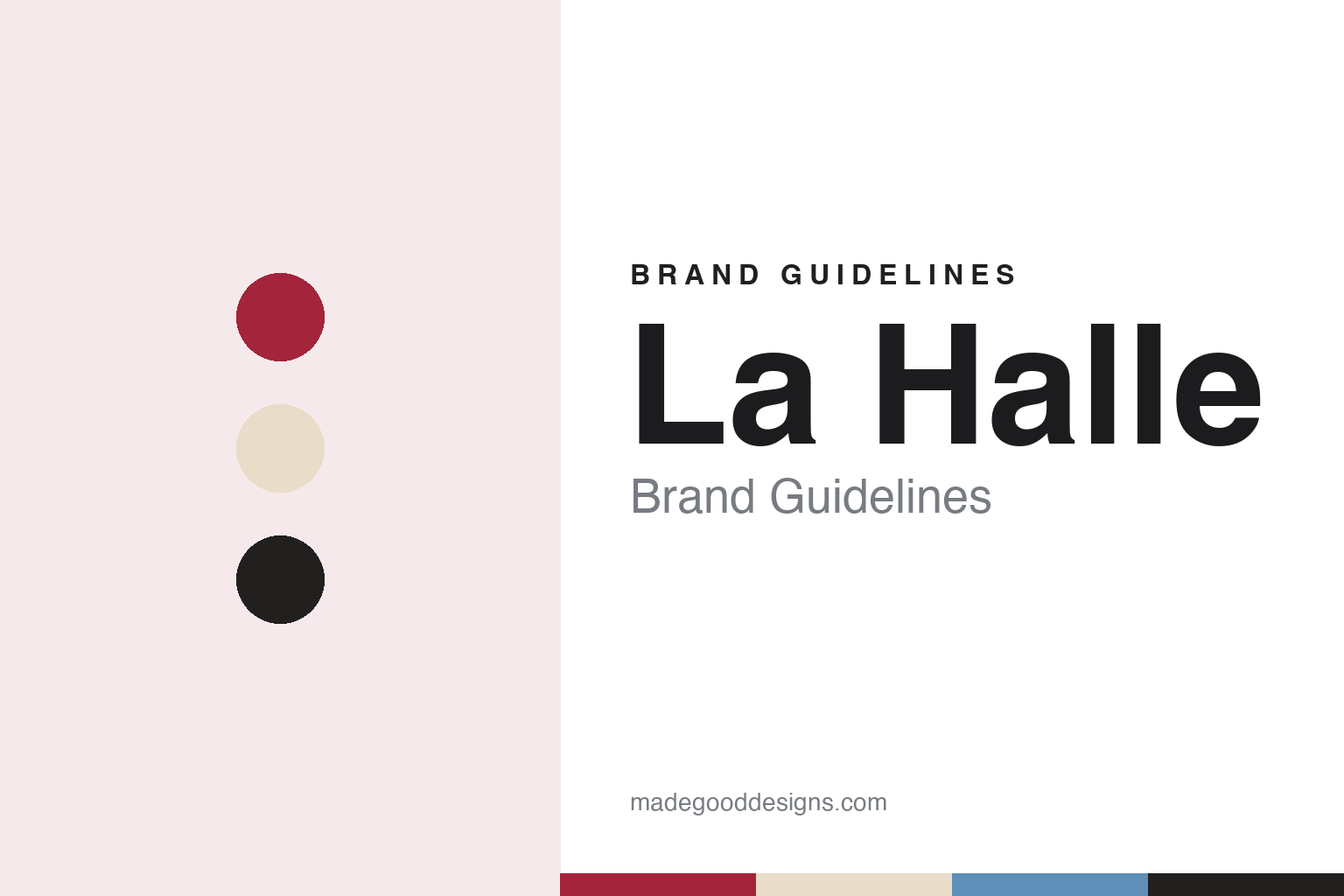
La Halle Brand Guidelines
Vivarte’s family discount chain, taken over by Beaumanoir in 2020.
Aa
Two constants: a berry red, sand and sky blue palette and a rounded family sans register. Abstract homage — not a La Halle product or mark; no logo, fascia or label is reproduced.
Two halls
A shoe hall, then a clothing hall, then one name.
La Halle began as two chains with one idea. French Wikipedia says the shoe group André, later renamed Vivarte, opened discount shoe stores called La Halle aux Chaussures in 1981. In 1984 the same group opened a clothing store, La Halle aux Vêtements, at Fresnes, south of Paris, built on the model of the shoe format: ready-to-wear and fashion accessories at low prices for the whole family. For years the two were separate businesses, each with its own general manager, sharing a name, a family customer and an edge-of-town address.
The format grew in size rather than in style. French Wikipedia says that in 2010 the clothing concept moved into very large stores, and that three years later it added bags and small leather goods. Online shops for the shoe and clothing chains opened around the same time and were merged in 2014 into a single site, lahalle.com. The brand that customers met on a retail park was therefore the same from the car park to the checkout: a large shed, a long fascia, and a mix of womenswear, menswear, childrenswear and shoes under one roof.
In 2013 Vivarte tried to move La Halle upmarket. French Wikipedia says the chain launched lines inspired by other Vivarte brands, such as K by Kookaï, C by Chevignon and N by Naf Naf, and that the two chains were renamed: La Halle aux Vêtements became La Halle Mode & Accessoires, and La Halle aux Chaussures became La Halle Chaussures et Maroquinerie. The move did not last. In April 2015 La Tribune reported that Vivarte’s chief executive had called the 2013 transformation of La Halle aux Vêtements “a total commercial failure,” blaming the opening of flagship stores in city centres while raising both range and prices, and the decision to stop advertising prices. He said that ninety per cent of the chain’s customers shopped on the outskirts of towns, and that children’s clothing was the main reason people came through the door. On 7 April 2015, La Tribune added, Vivarte had announced the closure of 174 of the 618 La Halle stores.
After that, the chain went back to its family customer. French Wikipedia, citing trade press, says that from 2016 La Halle reworked its collections around the young mother who buys for herself, her children and her partner, and that the shoe and clothing chains were merged into one business, simply called La Halle, on 1 January 2019.
Colour
Receivership, a court ruling and a new owner.
The single chain had little time on its own. According to the European Restructuring Monitor of Eurofound, the European Union agency that records large restructuring cases from national press reports, La Halle was placed in receivership on 2 June 2020. On 8 July 2020 the Commercial Court of Paris ruled on the bids. Eurofound’s factsheet, dated the same day, says the court gave 366 stores to the Beaumanoir group, 128 to the shoe chain Chaussea and 14 to SuperChauss’34. Eurofound put the chain’s network in France at about 820 stores, so a large part of it was not taken over.
The legal detail of the Beaumanoir deal is set out in a public decision of the Autorité de la concurrence, France’s competition authority. Its decision of 24 March 2021 describes the operation as the Beaumanoir family taking exclusive control of certain assets of La Halle, based on offers dated 9 June 2020 and the Paris court’s judgment of 8 July 2020. The assets were the 366 clothing and shoe stores for women, men and children, the La Halle trade marks and associated marks such as Liberto and Creeks, and the chain’s domain name. French Wikipedia stresses the same point in plainer words: Beaumanoir did not buy the company La Halle SAS, only a set of its assets.
The decision splits the deal into two linked offers. A Beaumanoir company called Blue Sark took 36 stores, to be turned into Vib’s multi-brand stores, which sell Beaumanoir’s Bonobo, Cache Cache and Bréal brands, or into Cache Cache stores. A second company, Pégase, owned by the Beaumanoir holding company and the family, took 330 stores, of which 328 would keep the La Halle name. The authority described La Halle as an entry-level chain and the Beaumanoir brands as mid-range, examined a number of local areas where the two overlapped, and cleared the deal without conditions. It also noted that part of La Halle’s assets went to Chaussea, which took 128 points of sale.
For the brand, this was the important outcome. La Halle as a company left Vivarte’s hands in a court-supervised sale, but La Halle as a name, a fascia and a family offer carried on, in most of the stores Beaumanoir took, under a new owner from Brittany.
Typography
How French fashion chains present themselves.
France’s mass-market fashion and childrenswear chains grew up mostly in retail parks and shopping centres rather than on high streets. Kiabi opened its first store at Roncq, outside Lille, in 1978, and Gémo was created by the Éram group in 1991 to sell shoes and clothing for the whole family in stores on the edges of towns. For these chains the shop fascia, the logo on the bag and the label inside the garment are often the same name, because most of what they sell is their own.
Own-label ranges carry much of the identity. The International Directory of Company Histories traces Kiabi’s house brands back to its first store, with Winch and Decade, and later children’s labels; Le Journal des Entreprises reported in 2021 that own-label products made up 85 to 90 per cent of Gémo’s offer. Catalogues, websites, apps and seasonal campaigns present those ranges, and logos are redrawn from time to time: Kiabi unveiled a new single-letter K in December 2025, CB News reported.
Many of the chains belong to family-owned groups, and their corporate pages say so plainly. Kiabi sits in the Mulliez family’s retail group alongside Auchan and Decathlon; Gémo belongs to Éram, based at Saint-Pierre-Montlimart in Maine-et-Loire; French Wikipedia describes Groupe Beaumanoir as a family group founded in 1981 by Roland Beaumanoir. Founders, owners and changes of control are part of each brand’s story, and receiverships and sales have reshaped several of these names in recent years.
This guide sets out what can be checked about each brand: who founded it, who owns it, how its stores, labels and logos have changed, and what has happened to it. Company statements are marked as such, and counts of stores and countries are given with the date of the source.
Aa
A rounded, friendly sans for a family chain. (Specimen set in Nunito Sans, a sans STAND-IN; NOT the La Halle logo.)
La Halle
A family offer inside a family group.
La Halle now sits inside one of France’s family-owned fashion groups. Le Figaro reported in 2025 that the Beaumanoir family owns all of its group, which is based in Saint-Malo and runs about 2,100 stores in France, mostly on the outskirts of towns, alongside brands such as Caroll, Bonobo, Morgan and Cache Cache. The Autorité de la concurrence, in its 2021 decision, listed Cache Cache, Bonobo, Bréal, Morgan and Vib’s as the Beaumanoir store names at the time of the La Halle deal.
Inside that portfolio, La Halle keeps the job it was given in 1984. Capital reported in June 2025 that Beaumanoir gives each of its brands a distinct customer: Cache Cache and Jennyfer for young women, Bonobo for denim, Bréal for older shoppers, Morgan and Caroll for a more premium position, and La Halle for families. The magazine described how the group took over La Halle after the collapse of Vivarte and later added other chains, including Caroll, Sarenza and the European business of Boardriders, with brands such as Quiksilver.
That makes La Halle a useful study in how a retail name survives a change of owner. The fascia stayed; the shoe and clothing halves had already become one; and the family offer that the 2015 chief executive described, built around children’s clothing and edge-of-town stores, is still the position its new owner gives it.
For a design guide, La Halle shows how a plain, descriptive name can outlast the group that coined it when the offer behind it stays clear. Compare Kiabi, another French family clothing chain, and Gémo, a French family fashion and shoe chain. For this guide we use a berry red, warm sand, sky blue and charcoal with a rounded sans, an unofficial interpretation; no product or logo is reproduced.
Explore & save
Keep La Halle’s identity on hand — save it to a board in the Made Good inspiration library.
La Halle identity set
Pin the La Halle berry red, sand and sky blue palette and the rounded family sans register to your own board.
Source & notes
Frequently Asked Questions
What font can I use to match the La Halle look?
This guide describes La Halle’s type as “A rounded, friendly sans for a family chain”. Its type specimen is set in Nunito Sans from Google Fonts as a stand-in; Nunito Sans is not La Halle’s own lettering.
What colours are in the La Halle palette?
This guide’s La Halle palette is Berry red #A3243B, Charcoal #22201F, Warm sand #E9DCC8, Sky blue #5E8FB8 and Cream #FAF6EF. The tones are the guide’s own unofficial interpretation, not official La Halle hex codes.
When was La Halle founded?
La Halle was founded in 1981 (La Halle aux Chaussures), in France.


