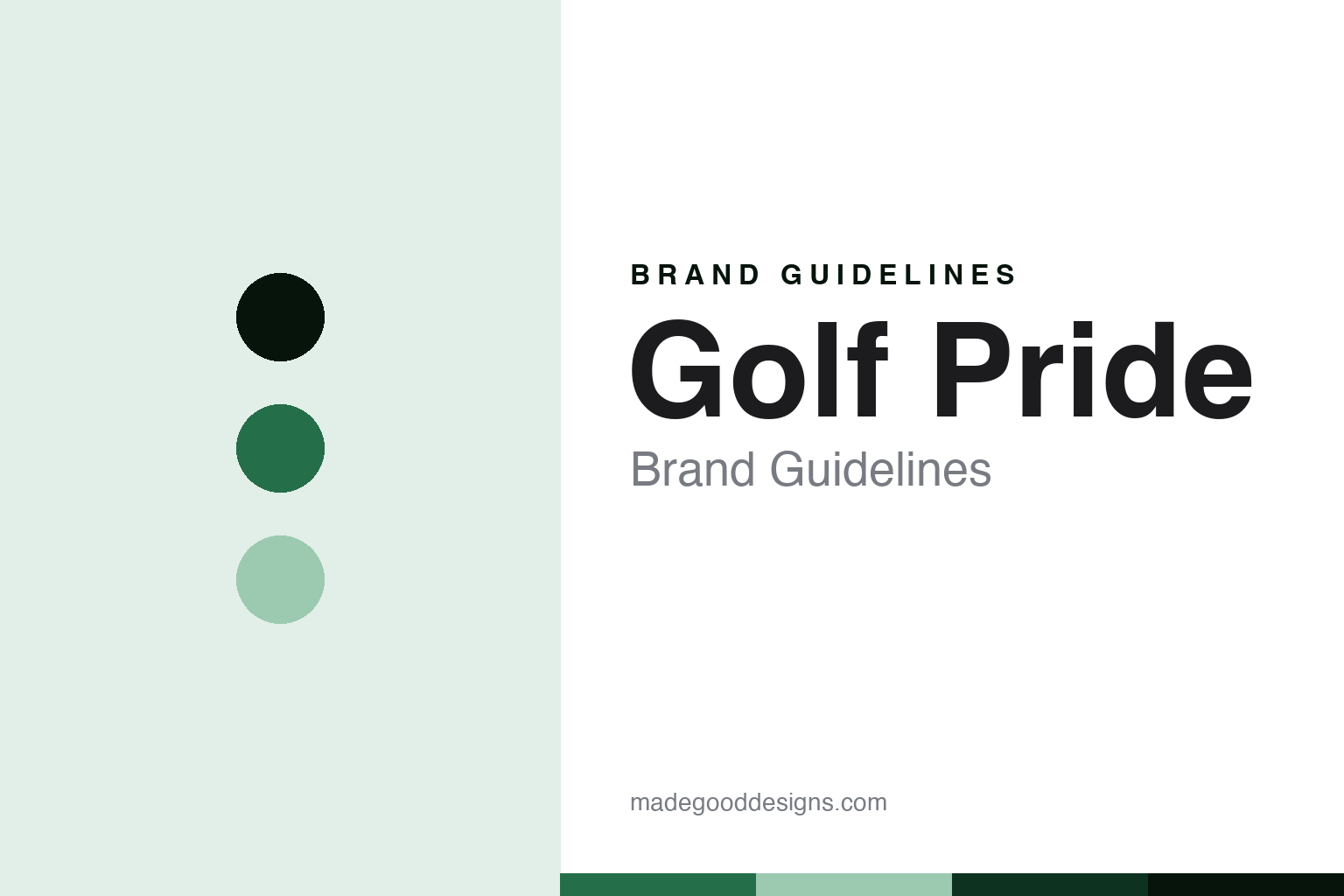
Golf Pride Brand Guidelines
The tour’s grip, owned by a power giant.
Aa
Two constants: a fairway-green palette and a tour-grip-sans register. Abstract homage — not a Golf Pride product or mark.
The tour’s grip, owned by a power giant
Golf Pride is the tour’s No. 1 grip since 1949 — a business of the industrial giant Eaton.
Golf Pride brings the round its dominant grip — the American company that pioneered the rubber golf grip in 1949 and has been, by its own long-running claim, the number-one grip on the professional tours, and which sits, quietly, inside a giant industrial conglomerate. Golf Pride makes golf grips, and its answer to a round about the hidden component makers is scale plus an unlikely owner: the tour’s grip, made by a power-management giant. A grip, from a big company.
Its identity is the tour’s grip, owned by a power giant. Golf Pride’s tour dominance, its 1949 origin and its Eaton ownership are the story here. A grip, on most tour clubs. The tour’s grip, owned by a power giant.
(Honest notes, so the story stays precise. Golf Pride — at golfpride.com — makes golf grips, with the Tour Velvet rubber standard, the MCC and MCC Plus4 cord-hybrid families, CP2, and the ALIGN raised-ridge technology; the “number-one grip on tour” line is the brand’s own long-running claim, historically well supported. It was founded in 1949 by Thomas L. Fawick, a Cleveland, Ohio inventor, who reasoned rubber could beat leather and partnered with a rubber company in Akron; the “Golf Pride” name was inspired by a motor oil of the era. On its milestones, we separate two: it pioneered the rubber golf grip in 1949, and it introduced the first slip-on grip in 1953, so we do not date the slip-on to 1949. On where the grips are made — a theme of this round — the location is not cleanly documented, historically spanning US and offshore operations, so we say undisclosed and reported. On ownership, Golf Pride is a business of Eaton Corporation plc, the American-founded power-management and industrial multinational, domiciled in Ireland with operations in Ohio and listed as ETN. Its marks — Golf Pride, Tour Velvet, ALIGN — are IP we describe but do not reproduce, and there is no official brand hex; these tones are an unofficial interpretation. This is design commentary and does not promote any product.)
Colour
Golf Pride lives in a fairway green. Click a swatch to copy the hex.
Golf Pride’s identity is dominant, standard and conglomerate-owned — a fairway green, an ink, a meadow, a deep green, and a paper. The palette leans fairway green and meadow: a confident, course-side register that nods to the tour’s standard grip rather than a boutique palette. It signals the number-one grip inside a giant company. The honest caveat: with no published brand hex, these values are an original, unofficial interpretation, not first-party colours.
The lesson is a fairway green signals a dominant, standard identity. Golf Pride’s world is a dominant, conglomerate-owned object. For designers, it is a reminder that a confident green and a soft meadow can carry a component brand — the tone of a tour grip. Because these tones can fail as small text, keep type dark and let the colour live in the accents, palette and band. The takeaways: own the standard; be honest that a giant owns it; separate two milestones honestly; and treat any single hex as unofficial.
Typography
The register is a tour-grip sans — confident, standard, made.
Golf Pride’s identity carries a confident, standard, made spirit — the dominant grip, not a fashion. A tour-grip sans captures the mood: assured, established and technical, the register of a grip on most tour clubs. Set in a fairway-green palette, the tour-grip sans feels confident and standard — exactly the personality Golf Pride carries. It is a standard rather than a logo, mirroring a rubber grip. (Golf Pride’s real wordmark, and the Victory arrow, are things we describe but do not reproduce, and the exact typeface is not ours to use.) Because it is not ours to use, the honest description is “a tour-grip-sans spirit,” shown here in a stand-in. The type behaves like the grip: confident, standard and made.
Aa
A tour-grip-sans spirit — confident and standard. (Specimen set in Space Grotesk, a tour-grip-sans STAND-IN; NOT the Golf Pride logo.)
The shaft & grip makers
Golf Pride stands for the tour’s grip, owned by a power giant.
Golf Pride brings the round its dominant grip. A fairway-green palette, a tour-grip sans and a rubber grip make one thing — the tour’s grip, owned by a power giant — the whole identity: dominant, standard and conglomerate-owned. The tour dominance is the differentiator, and the Eaton ownership is the meaning. The point is the grip on most tour clubs, pioneered in 1949, that turns out to be a small consumer sideline of a giant industrial company.
Put to work, the identity is a standard told straight, as design. A maker in this spirit would own the dominant grip, be honest that a giant owns it, and separate its milestones carefully. A reader in this spirit would keep the facts right: it was founded in 1949 by Thomas L. Fawick; it pioneered the rubber grip in 1949 and the first slip-on grip in 1953; the number-one-on-tour line is the brand’s own claim; the making is undisclosed; and it is a business of Eaton Corporation plc, listed as ETN. Golf Pride sits in the round’s owner thread at the industrial-conglomerate end with Nippon Shaft and Fujikura, and its story rhymes with Lamkin: the two biggest grip names are now both owned by larger companies, Golf Pride by an industrial giant and Lamkin by a private-equity-backed rival. Like True Temper for steel, Golf Pride is the invisible grip standard inside the clubs of the first golf round. The honest editorial moves are to treat the tour claim as the brand’s claim, to split the 1949 and 1953 milestones, to hedge the making, and to name Eaton precisely. The lesson Golf Pride teaches is that a dominant standard can hide inside a giant, and honesty about both the claim and the owner keeps the standard credible.
For designers and brand-builders, Golf Pride continues the shaft & grip makers: own the standard — and be honest who owns you. The lessons: build a category-defining component; attribute a market claim as your own; separate milestones honestly; name a corporate parent plainly; and never reproduce a logo. It is also a reminder to stay precise: Golf Pride is the tour’s number-one grip since 1949, a business of the industrial giant Eaton — with the palette here an unofficial interpretation. Read that way, Golf Pride is less a grip than a standard: a rubber grip on most tour clubs, made by a power-management conglomerate. The lesson for a brand is that a dominant component and a surprising owner can coexist, and honesty about both keeps the dominance earned. Golf Pride made the-tour’s-grip-owned-by-a-power-giant the identity — proof that the standard can hide inside a giant.
Explore & save
Keep Golf Pride’s identity on hand — save it to a board in the Made Good inspiration library.
Golf Pride identity set
Pin the fairway-green palette and the tour-grip-sans register to your own board.