Goodwood Festival of Speed Brand Guidelines
The 1993 hillclimb up a Sussex drive.
Aa
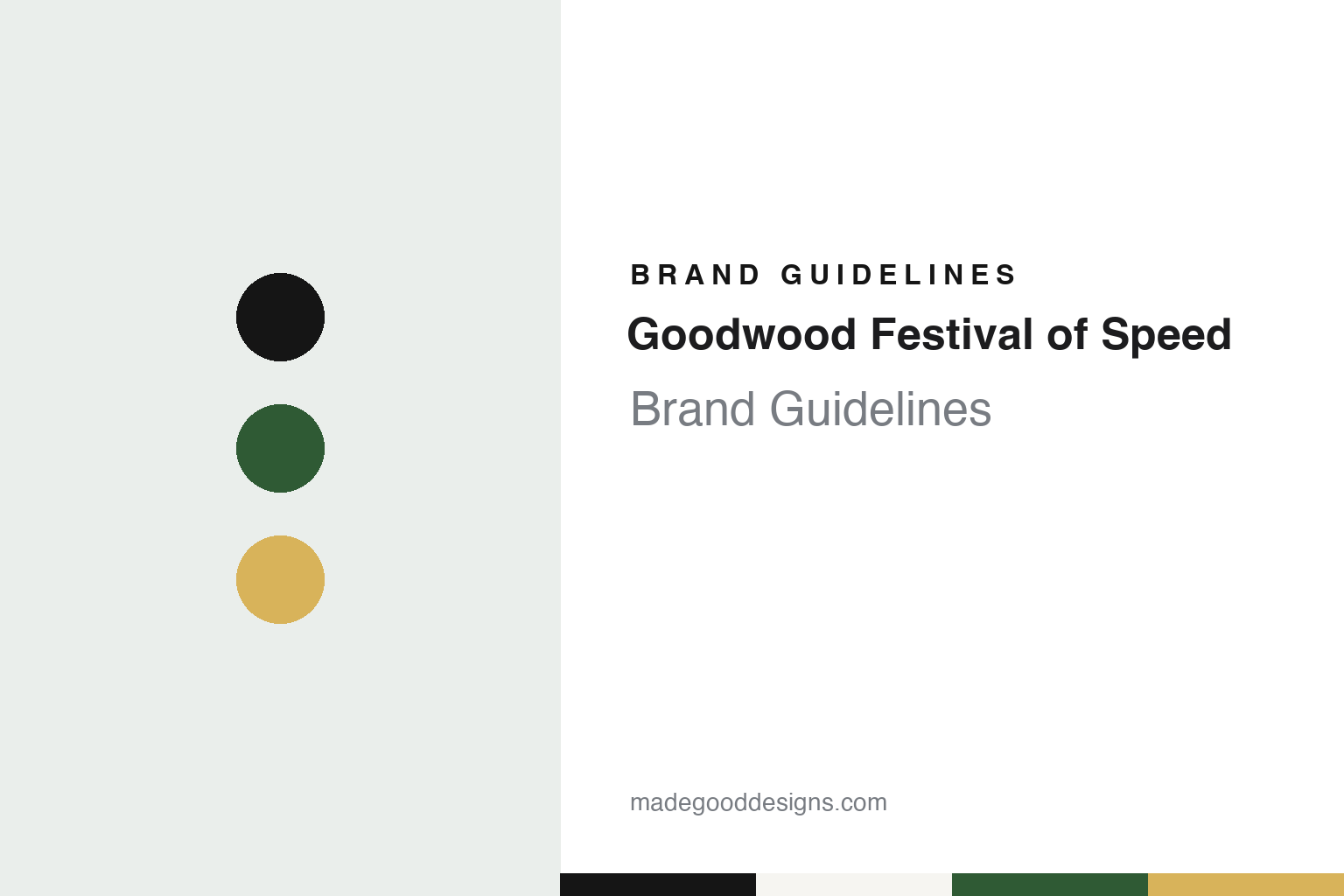
Two constants: a black, white, parkland green and straw palette and a Paddock sans register. Abstract homage — not a Goodwood product or mark; no poster, logo or car is reproduced.
A hillclimb on the drive
One Sunday in June 1993.
The Goodwood Festival of Speed began on Sunday 20 June 1993 in the grounds of Goodwood House, near Chichester in West Sussex. Motor Sport, reporting in August 1993, credited the event to Charles, Earl of March, then president of the British Automobile Racing Club (BARC), and described a hillclimb up the drive in front of the house, with straw bales on the corners and spectators behind tapes and paling fences. English Wikipedia names the founder today as the Duke of Richmond, owner of the estate.
The hill had a precedent. In 1936, Motor Sport recorded, the Earl’s grandfather Freddie March organised a private hillclimb for the Lancia Car Club on the same drive, and won it himself. After the war, as Duke of Richmond and Gordon, he opened the Goodwood motor circuit on the perimeter road of the former Westhampnett airfield; it ran from 1948 until it closed in 1966. Writing in Motor Sport in June 2022, Andrew Frankel said the 1993 hillclimb was conceived as a way of gently reintroducing motor sport to the estate while the long planning process for reopening the circuit went on.
Early estimates were modest. Frankel wrote that the Earl’s own estimate was 2,000 to 3,000 people and that roughly ten times that number came; the 1993 Motor Sport report put the crowd at more than 20,000, and English Wikipedia gives 25,000. The first edition lasted a single day, with 101 cars and 32 motorcycles on the entry, Frankel recorded, and the 1993 report lists a class for 500cc Formula 3 cars and four classes for motorcycles alongside historic grand prix and sports cars.
The format grew from there. English Wikipedia says a Saturday was added in 1994 and a Friday in 1996, and that from 2010 to 2018 a Moving Motor Show ran on the Thursday, giving buyers a chance to drive new cars on the course. Since 2019 the festival has run over four days, in late June or early July, timed to avoid clashes with Formula 1 races and the 24 Hours of Le Mans, which the first two editions shared a weekend with.
Colour
Hill, forest, paddock and lawn.
The festival is built around the hillclimb. English Wikipedia gives the course as about 1.16 miles (1.86 km) with nine turns, climbing past the house; Frankel singles out Molecomb, the corner that appears after a blind brow, lined with hay bales. Around the hill the festival has added set pieces: the Supercar Paddock since 2000; a Forest Rally Stage at the top of the hill since 2005, laid out as a full stage in 2006 to a design by the rally driver Hannu Mikkola and run by the Southern Car Club; and the Future Lab technology pavilion since 2017, according to English Wikipedia. The Cartier Style et Luxe concours, judged by an invited panel on the lawns west of the house, began in 1995.
Manufacturers use the event for unveilings, and most Formula 1 teams attend, Frankel wrote in 2022. On the 1993 lawn in front of the house there was only an Aston Martin DB7 on a plinth. Since 1997, English Wikipedia says, that central display has been designed by the sculptor Gerry Judah: large temporary structures that honoured a car maker each year until 2017, when the subject became a career, that of Bernie Ecclestone.
The calendar has had interruptions. In 2020 the July festival did not take place; English Wikipedia says an event was run instead in October, without spectators, combined with other Goodwood meetings and streamed online. The full festival returned in July 2021. On 14 July 2023, The Race reported, the organisers called off the Saturday, the third day, under a yellow weather warning for high winds, citing the risk to temporary structures on the site; Saturday tickets were refunded and the Sunday went ahead.
English Wikipedia gives a crowd of 158,000 in 2003 as the festival’s record, after which advance-only tickets were introduced and attendance was capped at 150,000. The festival has a sister event at the motor circuit, the Goodwood Revival, held in September.
Typography
Shows, lawns and halls.
Motor shows and concours d’élégance events sell a place and a date as much as the cars on show. Their names usually carry the city, the venue or the estate, and many keep a fixed slot in the calendar: Geneva’s show opened each March, and the Goodwood Festival of Speed runs in late June or early July. Organisers range from dealers’ associations and trade bodies to permanent committees and private estates.
Each event builds its identity from its setting. Indoor shows are defined by halls and stands, where carmakers decide how to present new models; Geneva moved from temporary halls on the Plaine de Plainpalais to Palexpo, beside the airport, in 1982. Outdoor events use lawns, paddocks and routes: at Goodwood a hillclimb up the drive of a country house, with straw bales, tape and a central sculpture on the lawn in front of the house.
Print still matters. Posters, programmes, entry lists and badges are often the most lasting record of a show; Goodwood’s posters were drawn by one motor-racing artist from 1993 to 2015, and the poster for Geneva’s 1905 show survives in its histories. Colour schemes are documented less often; one example is the uniform white and black specified for the first Festival of Speed.
These events also change, pause and end. Shows are renamed, move halls or cities, add days, or lose exhibitors; Geneva’s organisers ended the Swiss show in May 2024 after a single return that February, while its name continued in Doha. This guide sets out each event’s founding, organisers, venues and renamings as dated facts, with no prices, auction results or claims about the cars.
Aa
A plain paddock sans for a black-and-white frame. (Specimen set in Archivo, a sans STAND-IN; NOT the Goodwood Festival of Speed logo.)
Goodwood Festival of Speed
Black, white, green and straw.
The look of the festival was set early. Doug Nye, the motoring historian who helped compile the first invitation list, wrote on Goodwood’s own website in June 2016 that the Earl specified a uniform white and black for the event, so that nothing would distract from the parkland green, the yellow of the straw bales and the cars themselves; Nye put it down to the Earl’s eye as a commercial photographer. Nye also recalled that the name “Goodwood Festival of Speed” was chosen during the weeks of preparation, probably at the suggestion of the press officer Rob Widdows, and that the BARC supported the event as organising club.
Posters carry much of the rest. English Wikipedia says the festival’s poster art was illustrated from the start by the motor-racing artist Peter Hearsey until 2015, and that in 2016 the poster was designed by Klaus Wagger, who had won a competition to design the Mille Miglia poster in 2000. The open paddock, where visitors walk among the cars and the drivers, was part of the idea from the first year, Nye wrote. The event is run by the Goodwood estate, whose website lists it alongside the Goodwood Revival, the Members’ Meeting, horse racing and the hotel.
For a design guide, the Goodwood Festival of Speed shows how a restrained black-and-white frame can let a landscape and its cars carry the colour. Compare Concours of Elegance, another English motoring event staged in historic grounds, and Silverstone, the British circuit. For this guide we use black, white, a parkland green and a straw yellow with a sans, an unofficial interpretation; no product or logo is reproduced.
Explore & save
Keep Goodwood Festival of Speed’s identity on hand — save it to a board in the Made Good inspiration library.
Goodwood Festival of Speed identity set
Pin the black, white, parkland green and straw palette and the Paddock sans register to your own board.
Source & notes
Frequently Asked Questions
What font can I use to match the Goodwood Festival of Speed look?
This guide describes Goodwood Festival of Speed’s type as “A plain paddock sans for a black-and-white frame”. Its type specimen is set in Archivo from Google Fonts as a stand-in; Archivo is not Goodwood Festival of Speed’s own lettering.
What colours are in the Goodwood Festival of Speed palette?
This guide’s Goodwood Festival of Speed palette is Paddock black #151515, Marquee white #F6F5F1, Parkland green #2F5A34, Straw bale #D8B35A and Flint grey #6B6A64. The tones are the guide’s own unofficial interpretation, not official Goodwood Festival of Speed hex codes.
When was Goodwood Festival of Speed founded?
Goodwood Festival of Speed was founded in 1993, in Goodwood House, West Sussex.
Who founded Goodwood Festival of Speed?
Goodwood Festival of Speed was founded by Charles and Earl of March (now Duke of Richmond) in 1993.