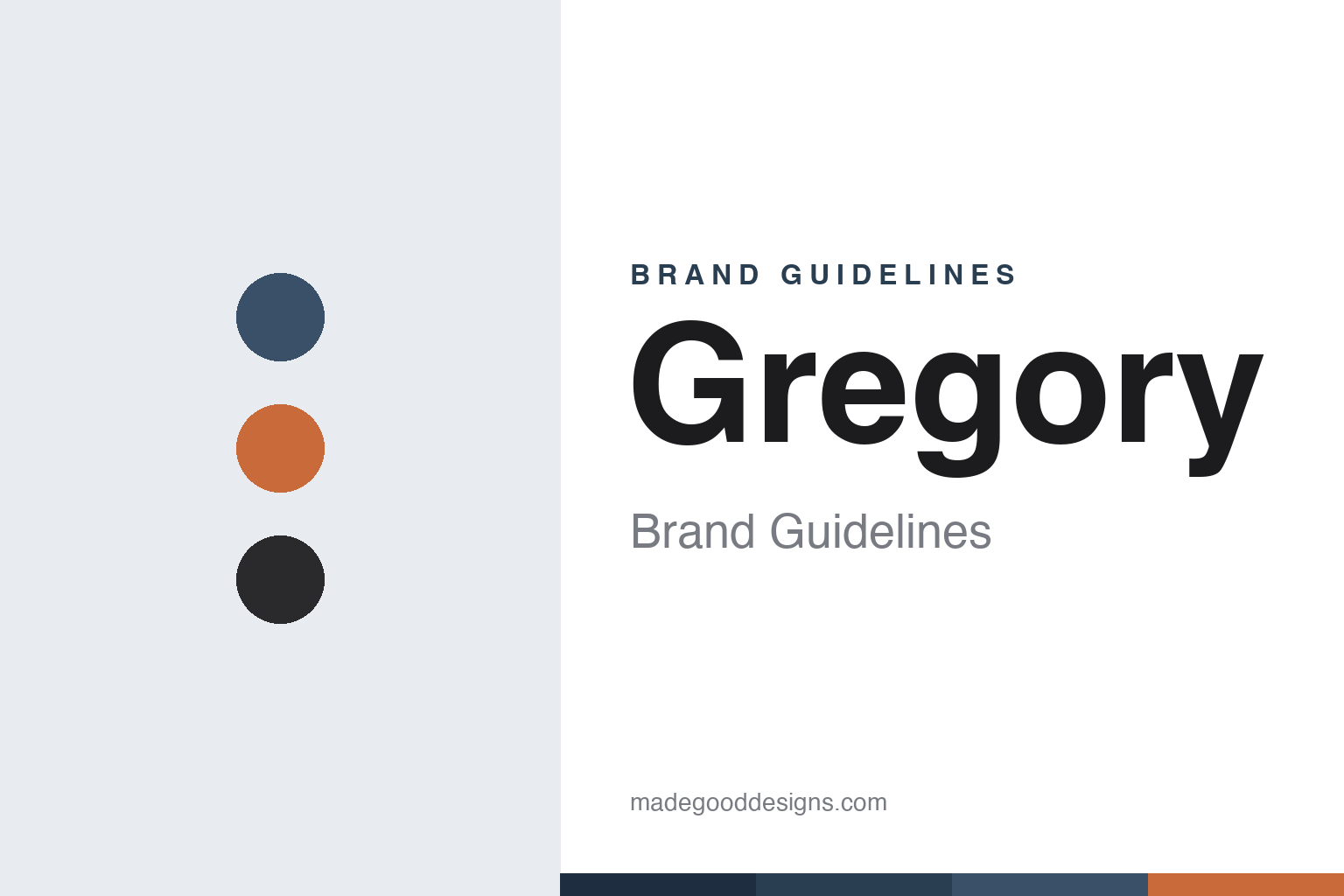
Gregory Brand Guidelines
Fit is everything — anatomical suspension and custom-fit hip belts, from a teenage pack-maker turned pro.
Aa
Two constants: a technical slate-and-orange palette and a sturdy grotesque. Abstract homage — not the Gregory wordmark.
Fit is everything
Gregory obsessed over the fit.
Gregory is a lesson in fit obsession as a brand. Gregory Mountain Products is named for and was founded by pack designer Wayne Gregory, who formally established the company in 1977 in San Diego, California. The origin is a design story: Gregory started building backpacks as a teenager in the 1960s (with an earlier venture, Sunbird, in the mid-1970s) before founding the company. (An honest note: the teenage pack-making is 1960s, but the incorporated company is 1977 — don’t date the company to the ’60s. Two more notes: no official brand hex is published, and the wordmark typeface is undocumented.)
Gregory’s reputation is fit and suspension — it’s long been regarded as making some of the finest-fitting technical backpacking packs, with anatomically-shaped, size-matrixed and heat-moldable custom-fit hip belts and interchangeable components. (The “Rolls-Royce of backpacks” / “finest packs in the world” framing is reputational shorthand — it’s marketing and enthusiast voice, not a verifiable fact.) Its suspension nomenclature includes Response and A3 (Automatic Angle Adjust), and its flagship load-haulers are the Baltoro (men) and Deva (women), alongside families like Zulu/Jade and Miwok/Maya.
Gregory’s corporate history is a winding one. It passed through Armor Holdings (and thus briefly under the defense firm BAE Systems), was bought by Warren Kanders in 2008, and in 2010 was acquired — in the same $135M deal as Black Diamond Equipment — by Clarus Corporation (which later renamed itself Black Diamond, Inc.). Then, in June 2014, Samsonite bought Gregory for $85 million cash, and Gregory is a Samsonite brand today. (An honest correction: Gregory came to Samsonite as a direct purchase from Black Diamond — not “via High Sierra,” which was a separate Samsonite deal.) Designed in the US, manufactured overseas. Fit is everything.
Colour
Gregory lives in a technical slate-and-orange palette. Click a swatch to copy the hex.
Gregory’s identity leans on a technical, mountain palette — slate and steel blues, deep graphite and black, plus warm trail accents (oranges, reds, ambers) that echo model names like Amber. The tones read as capable, engineered and trail-ready rather than fashion-led, while warm accents differentiate the range and signal the outdoors. It’s a functional, gear-first palette that matches a brand built on serious backpacking performance. The honest caveat: Gregory publishes no official brand hex, so the slate, trail-orange and graphite here are an original, unofficial interpretation, not first-party values.
The lesson is a technical palette signals engineered capability. Gregory’s slate-and-orange world reads as capable mountain gear. For designers, it’s a reminder that a functional, gear-first palette can convey engineering and durability. The takeaways: use technical, outdoor tones with warm accents; keep it performance-led; and treat specific hexes as unofficial when there’s no published spec.
Typography
The wordmark is a sturdy grotesque — capable and precise.
Gregory’s identity carries a sturdy, capable, precise spirit — a clean all-caps “GREGORY” wordmark (historically with a small summit mark in some eras) whose solid, grounded letterforms read as engineered, dependable and performance-focused. The sturdy type matches a brand built on fit engineering and technical suspension, and its clarity signals capability over decoration. Set against a technical slate-and-orange palette, the type feels capable and precise — exactly the serious-backpacking personality Gregory cultivates. It’s sturdy and grounded rather than delicate, mirroring the load-hauling packs. Because the exact wordmark face isn’t publicly documented, the honest description is “a sturdy grotesque spirit,” not a named font. The type behaves like the brand: sturdy, capable and precise.
Aa
A sturdy grotesque spirit — capable and precise. (Specimen set in Archivo, a sturdy grotesque in the spirit of the Gregory identity; the real face is undocumented.)
Fit as the difference
Gregory sold the carry.
Gregory is a lesson in owning one attribute completely. In technical backpacks, many brands compete on features and materials; Gregory built its whole reputation on the single thing that matters most when a pack is heavy — fit. Anatomically-shaped, size-matrixed, heat-moldable hip belts; adjustable, interchangeable suspension; a founder who’d been obsessing over how a pack rides on the body since he was a teenager. That relentless focus on comfort-under-load made Gregory a byword for the best-fitting packs, and it’s a durable, ownable position because fit is felt directly by the user on every mile. The corporate ownership changed hands repeatedly — through a defense conglomerate, alongside a rival, and finally to Samsonite — but the fit reputation is what actually carried the brand across all of it. The lesson is that owning one attribute that genuinely matters to users — and being demonstrably the best at it — can be a more durable differentiator than a long feature list. Nail the carry, and the brand rides on it.
For designers and brand-builders, Gregory offers a clear takeaway: owning the single attribute users feel most can define a brand. The lessons: pick the attribute that matters most (fit under load); engineer it deeply (anatomical, adjustable, custom-fit suspension); and let genuine performance carry the reputation through ownership changes. It’s also a reminder to keep the facts precise — Gregory was founded in 1977 in San Diego by Wayne Gregory, is famous for fit and suspension and the Baltoro/Deva packs, and has been a Samsonite brand since 2014 (a direct purchase from Black Diamond). Gregory sold the carry — proof that owning one attribute can be the brand.
Explore & save
Keep Gregory’s identity on hand — save it to a board in the Made Good inspiration library.
Gregory identity set
Pin the technical palette and the sturdy-grotesque spirit to your own board.