Hagebau Brand Guidelines
A merchants’ co-operative from Soltau with one roof over many names.
Aa
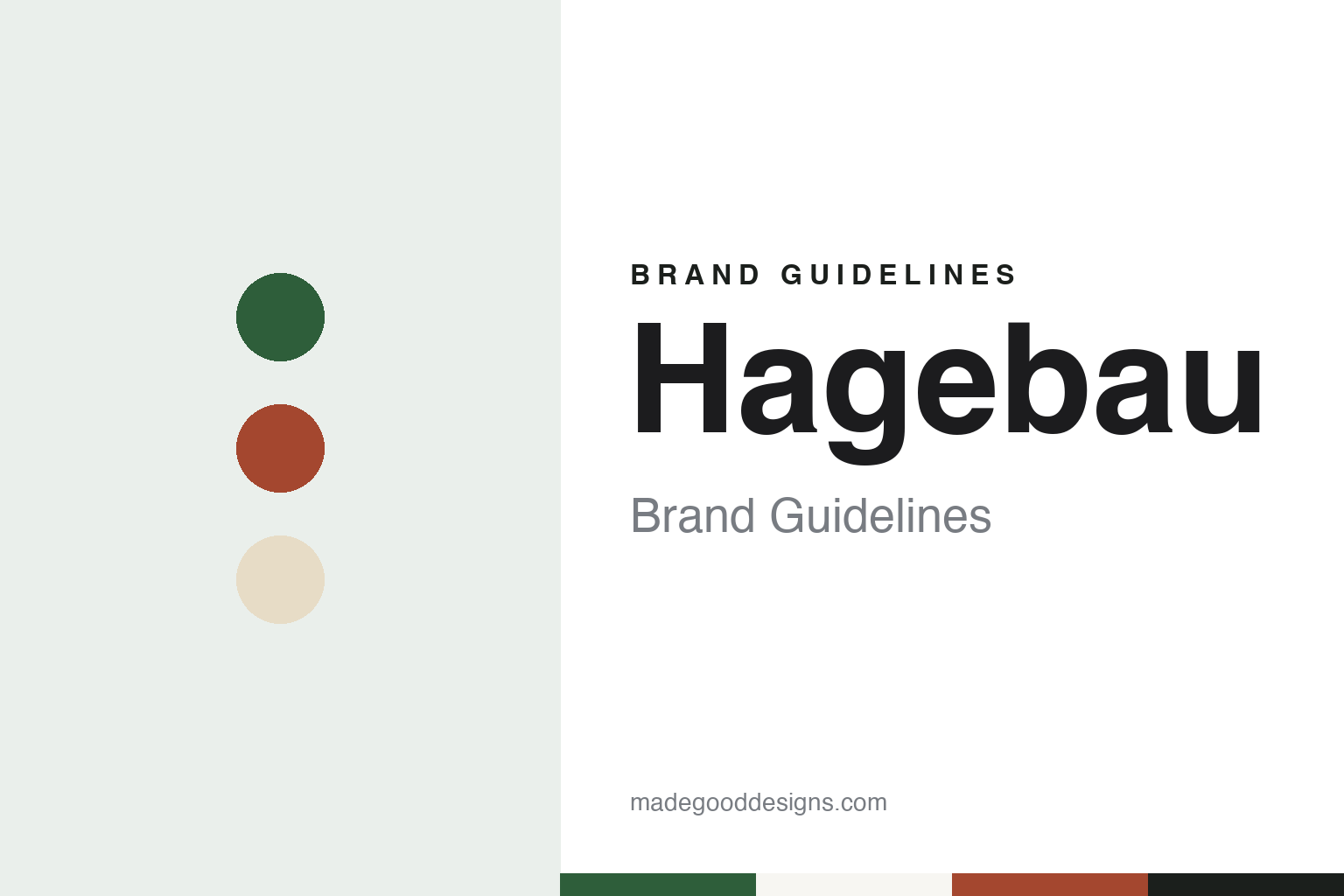
Two constants: a heath green, brick and sand palette and a co-operative sans register. Abstract homage — not a Hagebau sign, product or mark; no logo or store fascia is reproduced.
Thirty-four merchants
A buying group in Lower Saxony.
Hagebau is not a single company in the usual sense but a co-operative of independent traders. German Wikipedia gives its full name as Handelsgesellschaft für Baustoffe — roughly “trading company for building materials” — shortened to Hagebau and written in lower case, hagebau, by the group itself. Its head office is in Soltau, a town in Lower Saxony.
It was founded in 1964 as a purchasing association of 34 building-materials merchants, according to both German and English Wikipedia. Growth came through new members: German Wikipedia says the hundredth shareholder joined seven years after the founding. The legal form reflects that shared ownership, a limited partnership whose general partner is a management company also based in Soltau.
The step into consumer retail came in 1979, when the first hagebaumarkt DIY store opened, English Wikipedia says. Over the following decades the group added specialist trade divisions. German Wikipedia records the founding of Hagebau Österreich in 1995, a timber-trade division in 1997, and in January 2007 a third specialist division for tiles and natural stone, created by folding in a former joint venture with the Essen architectural-materials firm IGA. In that division the group developed an own-label tile programme under the IGA name, aimed at the upper end of the market.
Colour
Merchants, DIY stores and centres.
Hagebau works on two levels: the trade merchant yard and the DIY store. German Wikipedia describes a network of around 350 medium-sized wholesale and retail firms with more than 1,500 locations in Germany, Austria, Switzerland, Luxembourg, France, Belgium and Spain; English Wikipedia, citing trade reporting, puts the number of member merchants at about 356 in 2023. The building-materials trade, with more than 900 outlets, is the core of the business, German Wikipedia says.
The consumer side is a franchise system. The hagebaumarkt stores in Germany and Austria come in different sizes and ranges, and many include a garden centre. Smaller local stores trade as hagebau kompakt, a format formerly called Werkers Welt. Where a merchant yard and a hagebaumarkt share one site, the result is called a Hagebaucentrum. Supplies run through six logistics centres near motorways, at Neumünster, Westerkappeln, Herten, Schleinitz, Burgau and Walsrode, each holding between 6,000 and 10,000 lines for the merchants, stores and garden centres, according to German Wikipedia. Beyond Germany, the group holds a minority stake in A.R.E.N.A., a French company based at Bondoufle, south of Paris, the same source says.
The retail system was reorganised in the 2010s. Hagebau had held a stake since 2003 in ZEUS, the central purchasing and service company for the DIY stores; ZEUS became a wholly owned subsidiary in 2013, and with effect from 1 January 2018 it was merged into the group as hagebau Einzelhandel, which now acts as the franchisor, both Wikipedia editions say. Online, Hagebau ran the Baumarkt Direkt venture with the Otto Group from 2007 until July 2019, when Otto took it over completely; the group’s own online shop is now run by hagebau connect in Hamburg. In September 2019 it opened its first hageworX workshop, a fitted room that customers can book for their own projects, in a hagebaumarkt in Hanover, German Wikipedia says; a second followed at a hagebaumarkt in Iserlohn. The consumer website, hagebau.de, combines an online shop with a store finder and click-and-reserve collection from local stores.
Typography
Signs, sheds and own-label names.
European DIY chains and builders’ merchants present themselves first through the building: a large shed on a retail park or industrial estate, with a fascia sign and on-site parking and loading. In the trade press, store openings are reported branch by branch, with the site, the town and the running total, and that branch count is often the main public measure of how a network has grown.
Ownership shapes the identity more than in most retail sectors. Some chains are owned by listed building-materials groups that run several trading names side by side; others are co-operatives or buying groups whose members are independent family firms. In the co-operative model the shared name may sit above the member’s own name rather than replacing it, and store formats are often run as franchises supplied by a central organisation.
Formats are named and graded with care. A group may run a full-size DIY store with a garden centre, a smaller local format, a trade-only warehouse and a merchant yard for builders, each with its own sign but a shared family resemblance. Own-label ranges, hire counters, kitchen design services and click-and-collect services are named by the companies themselves and appear in their store descriptions and opening announcements.
Corporate pages fill in the rest: founders, founding dates, acquisitions and the parent company. The guides in this series set out what dated, independent sources say about each chain — when it began, who owns it and how its network has changed — and keep the companies’ own descriptions clearly marked as theirs.
Aa
A plain, sturdy sans for store fascias and yard signs. (Specimen set in Barlow, a sans STAND-IN; NOT the Hagebau logo.)
Hagebau
One umbrella over many family names.
The group’s brand was reorganised in 2022. In February that year the Lebensmittel Zeitung reported that Hagebau wanted to become not only a buying group but a joint sales organisation, and was preparing an umbrella brand for its 300 shareholders in retail and the specialist trade.
The new architecture was presented in July 2022. W&V reported that Die Neue Vernunft, a subsidiary of the agency KNSK, had developed the name, design and claim of a structure in which hagebaumarkt, hagebau kompakt and hagebau Profi, the format for the trade, appear together, while each merchant keeps trading under its own name and can present its range to its own customers; the aim was to make the roughly 1,400 locations in Germany and Austria more visible.
The first campaign to show all three together came for the group’s 60th anniversary. In February 2024 Horizont reported a KNSK campaign under the line “Zusammen geht das” — roughly “together, it works” — which for the first time put the retail and trade formats into one campaign under the Hagebau umbrella introduced in 2022. Real employees took the main roles, and the film used real projects and settings rather than studio sets, the magazine reported. The campaign ran on television, online, at the point of sale and on radio, with social-media formats and internal clips that also featured staff; the spot was produced by Markenfilm Crossing.
The co-operative’s management was enlarged in 2026: from April it had four managing directors, adding a new role for digital, IT and technology, Lebensmittelpraxis and CIO reported. CIO put the group’s workforce at about 1,500 in 2025.
For a design guide, Hagebau shows how one shared brand can sit above hundreds of independent family names without replacing them. Compare Hornbach, another German DIY chain, and OBI, a German DIY brand. For this guide we use a heath green, fired brick and sand with a sans, an unofficial interpretation; no product or logo is reproduced.
Explore & save
Keep Hagebau’s identity on hand — save it to a board in the Made Good inspiration library.
Hagebau identity set
Pin the heath green, brick and sand palette and the co-operative sans register to your own board.
Source & notes
Frequently Asked Questions
What font can I use to match the Hagebau look?
This guide describes Hagebau’s type as “A plain, sturdy sans for store fascias and yard signs”. Its type specimen is set in Barlow from Google Fonts as a stand-in; Barlow is not Hagebau’s own lettering.
What colours are in the Hagebau palette?
This guide’s Hagebau palette is Heath green #2E5E3A, Slate #1B1F1C, Fired brick #A4472F, Sand #E7DCC6 and Paper #F7F6F2. The tones are the guide’s own unofficial interpretation, not official Hagebau hex codes.
When was Hagebau founded?
Hagebau was founded in 1964, in Soltau, Lower Saxony, Germany.
Who founded Hagebau?
Hagebau was founded by 34 building-materials merchants in 1964.