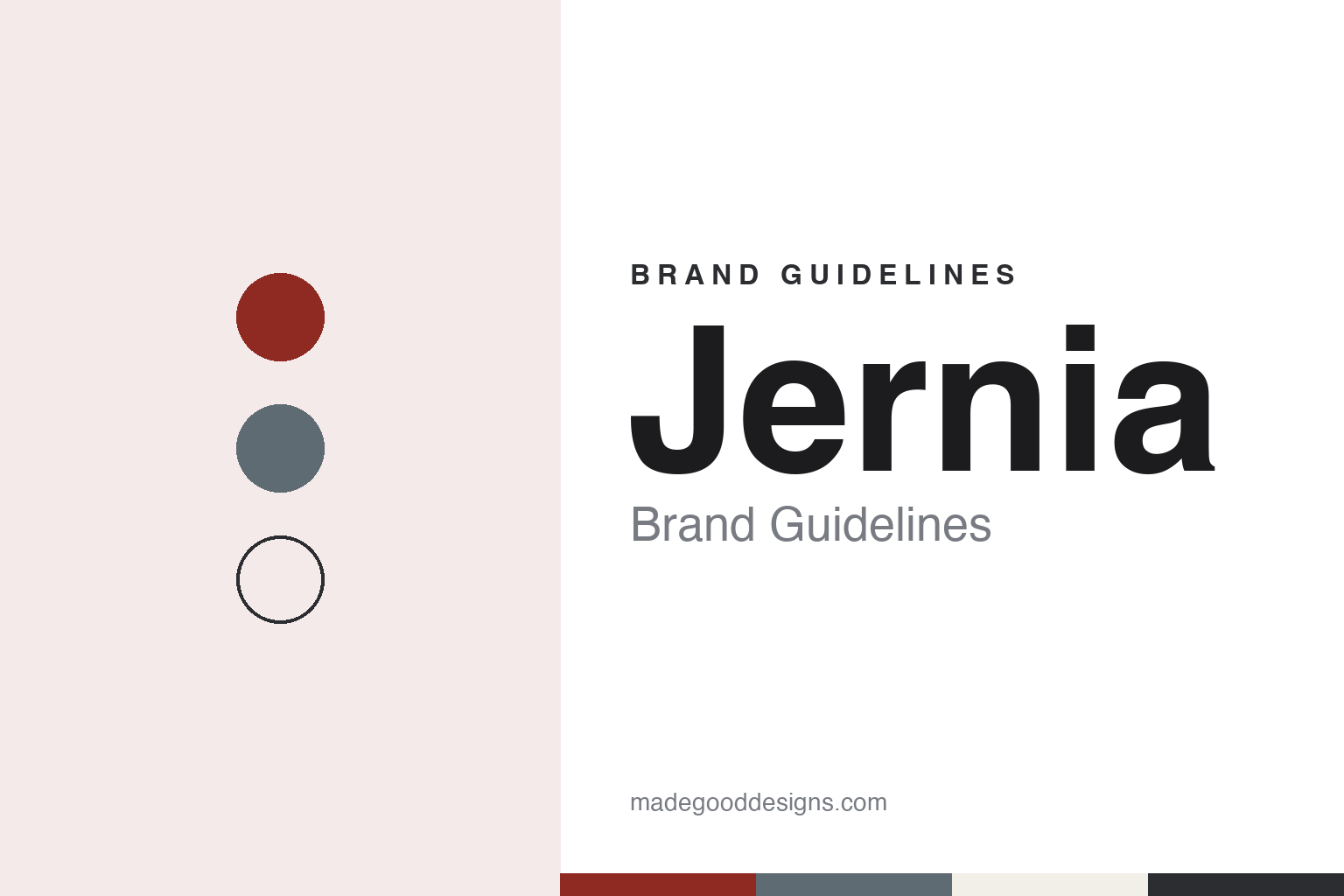
Jernia Brand Guidelines
Norway’s 1951 hardware buying group, still a specialist chain.
Aa
Two constants: a rust red, iron grey and pale linen palette and a plain shopfront sans register. Abstract homage — not a Jernia asset; no logo, sign or product is reproduced.
Jernvarekjøp
Twenty-two hardware dealers buy together.
Jernia is a Norwegian chain of hardware stores. It began in 1951 as the co-operative A/L Jernvarekjøp, a joint buying group for 22 hardware dealers, set up on the initiative of Ola Brath, according to the Norwegian encyclopaedia Store norske leksikon. The company’s own website describes the same start: a purchasing partnership set up in 1951 to supply products for house and home.
The start was not smooth. When the building-trade site Bygg.no marked the chain’s 60th birthday in October 2011, the head of the retail arm described a difficult birth: angry letters, exclusion from trade associations and a boycott of deliveries, with refusals to supply that ended in a court case. The dealers had joined forces to get better purchase prices, but wholesalers of the day saw chain-building as a kind of co-operative, which they regarded as no business for merchants, the article says. The dealers overcame the resistance in time.
The name changed several times. In 1954 the buying group merged with the hardware wholesaler K. E. Larsson; Store norske leksikon says the company then took the name KELA, while Norwegian Wikipedia says it carried the wholesaler’s name until 1966, when the name Jernia was created. In 1968 it became Jernia Norsk A/S, and it took the name Jernia A/S in 1982 according to Store norske leksikon, or 1983 according to Norwegian Wikipedia. The sources used for this guide do not say how the wholesaler K. E. Larsson operated during the occupation of 1940–1945.
Colour
From nails to paint, kitchenware and services.
Jernia’s range widened in steps. In 1980 it formed an industrial arm, Jernia Industri, which later became ProffPartner, according to Store norske leksikon. In 1994 it merged with Samkolør, which brought paint into the range; Norwegian Wikipedia says that this was when it began distributing paint widely to its members. In 1998 finer kitchen, household and gift items followed, Bygg.no reported in 2011.
By then the classic ironmonger’s shop had gone, the same article said, and building-supply warehouses had taken over many of its goods. Jernia’s answer was to stay a specialist trade: in 2011 it described its market segments as house, garden, tools and kitchen, and said that every new employee took an e-learning course with a test afterwards, with product and sales training run with its main suppliers in categories such as grills, lawn equipment, pressure washers and kitchenware. A year earlier, in 2010, Jernia had teamed up with the Norwegian online retailer Komplett for a larger push into online sales, Bygg.no reported.
Store norske leksikon now describes Jernia AS as a hardware company selling hardware, tools, paint, environmental products and industrial supplies at retail. The company’s own website lists a range across kitchen, hardware, tools, paint, grills, and house and garden products, sold through stores across Norway and an online shop, and names services including repairs and servicing of selected products, key cutting, tool rental and take-back schemes for items such as electrical products and some kitchen equipment.
In April 2019 the newspaper Nettavisen interviewed the then chief executive, Espen Karlsen, at the head office in Vinterbro. He said the chain had launched same-day delivery in Oslo from its online shop and was rolling it out to the other large cities, and that it took back old pots, pans and knives in its stores so that the metal could be recycled. He pointed to the Norwegian retailer Vinmonopolet as an example of a specialist trade whose staff are trained to ask about customers’ needs, and said Jernia’s employees were trained in the same way in its customer concept.
Typography
Design and documentation.
European DIY chains and builders’ merchants present themselves first through the building: a large shed on a retail park or industrial estate, with a fascia sign and on-site parking and loading. In the trade press, store openings are reported branch by branch, with the site, the town and the running total, and that branch count is often the main public measure of how a network has grown.
Ownership shapes the identity more than in most retail sectors. Some chains are owned by listed building-materials groups that run several trading names side by side; others are co-operatives or buying groups whose members are independent family firms. In the co-operative model the shared name may sit above the member’s own name rather than replacing it, and store formats are often run as franchises supplied by a central organisation.
Formats are named and graded with care. A group may run a full-size DIY store with a garden centre, a smaller local format, a trade-only warehouse and a merchant yard for builders, each with its own sign but a shared family resemblance. Own-label ranges, hire counters, kitchen design services and click-and-collect services are named by the companies themselves and appear in their store descriptions and opening announcements.
Corporate pages fill in the rest: founders, founding dates, acquisitions and the parent company. The guides in this series set out what dated, independent sources say about each chain — when it began, who owns it and how its network has changed — and keep the companies’ own descriptions clearly marked as theirs.
Aa
A plain shopfront sans for signs and shelf labels. (Specimen set in Work Sans, a sans STAND-IN; NOT the Jernia logo.)
Jernia
Owned by Canica since 2005.
Ownership settled in 2005, when the investment company Canica AS bought the whole Jernia chain, according to Store norske leksikon and Norwegian Wikipedia. The encyclopaedia says Jernia AS is owned and controlled through Canica, which in turn is owned by Stein Erik Hagen and his family.
The industrial arm was sold. In July 2013 Jernia agreed that the Swedish group Ahlsell would buy ProffPartner, a supplier of tools and personal protective equipment to offshore, industrial and construction customers, together with Lexow and ProffPartner Security, Bygg.no reported. At the time ProffPartner had 24 outlets of its own in Norway, worked with 21 independent dealers and had seven outlets in Sweden, the report said; the deal needed approval from the Norwegian Competition Authority. In September 2013 Ahlsell described itself as carrying out the purchase of ProffPartner from Jernia.
In October 2011, Bygg.no reported, 162 Jernia stores in Norway marked the 60th birthday. Norwegian Wikipedia, citing the company’s website in October 2025, gives more than 130 stores. It says about 70 of them are owned by the subsidiary Jernia Detalj AS and the rest are locally owned.
Store norske leksikon says Espen Karlsen led the company from 2017 and was succeeded as chief executive in February 2024 by Vebjørn Torsetnes, previously a board member. The company’s website gives its head office and central warehouse at Vinterbro, south of Oslo.
For a design guide, Jernia shows how a buying group of independent dealers can grow into one shopfront name while keeping the specialist trade at its centre. Compare K-Rauta, a Finnish hardware chain owned by Kesko, and OBI. For this guide we use rust red, iron grey and pale linen with a sans, an unofficial interpretation; no product or logo is reproduced.
Explore & save
Keep Jernia’s identity on hand — save it to a board in the Made Good inspiration library.
Jernia identity set
Pin the Jernia rust red, iron grey and pale linen palette and the plain shopfront sans register to your own board.
Source & notes
Frequently Asked Questions
What font can I use to match the Jernia look?
This guide describes Jernia’s type as “A plain shopfront sans for signs and shelf labels”. Its type specimen is set in Work Sans from Google Fonts as a stand-in; Work Sans is not Jernia’s own lettering.
What colours are in the Jernia palette?
This guide’s Jernia palette is Rust red #8E2A22, Iron grey #2B2D30, Fjord slate #5E6B73, Pale linen #F2EEE8 and Paper #FAF8F5. The tones are the guide’s own unofficial interpretation, not official Jernia hex codes.
When was Jernia founded?
Jernia was founded in 1951 (as A/L Jernvarekjøp), in Norway.
Who founded Jernia?
Jernia was founded by Ola Brath (initiator) in 1951 (as A/L Jernvarekjøp).
Who owns Jernia?
Jernia is owned by Canica AS (since 2005). This guide dates Jernia to 1951 (as A/L Jernvarekjøp), in Norway.