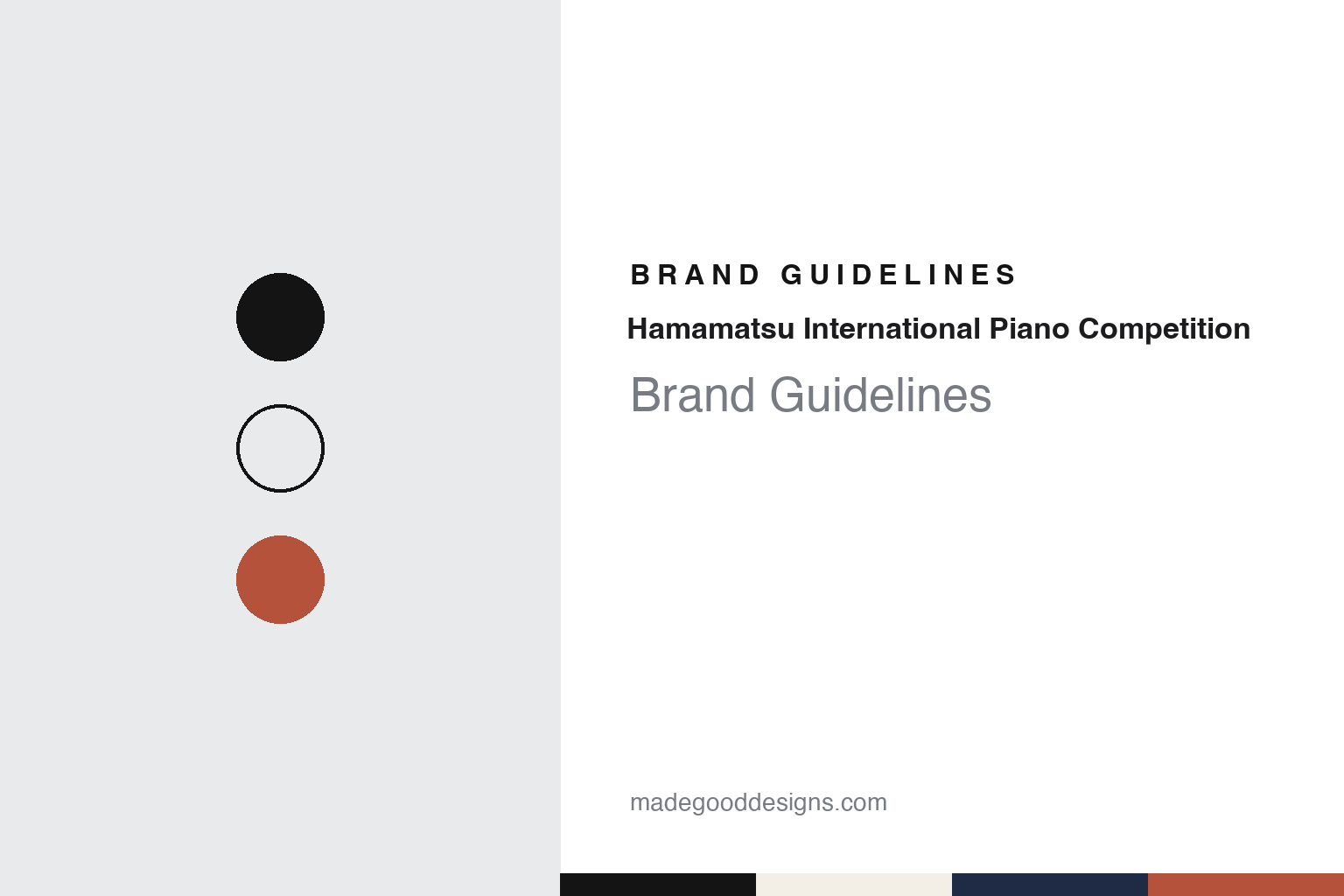
Hamamatsu International Piano Competition Brand Guidelines
A city of instrument makers that holds a piano contest every three years.
Aa
Two constants: a black, ivory, indigo and vermilion palette and a Mincho serif register. Abstract homage — not a Hamamatsu International Piano Competition asset; no logo, key visual or medal is reproduced.
An anniversary contest
Begun for the city’s 80th birthday.
The Hamamatsu International Piano Competition began in 1991. The competition says it was started to mark the 80th anniversary of the founding of Hamamatsu City, which English Wikipedia dates to 1 July 1911, and that it has been held every three years since. Interlude, the Hong Kong classical music site, gave the same origin in a preview of the 2024 edition published on 1 November 2024. Hamamatsu lies in Shizuoka Prefecture, and the competition’s own pages describe it as a “city of music and musical instruments.”
Japanese Wikipedia names the organisers as the City of Hamamatsu and the Hamamatsu Cultural Foundation, and the competition’s secretariat sits inside the foundation. Its published organisation chart for the 13th edition, posted in 2026, puts the mayor of Hamamatsu at the head of the executive committee, with the chairs of the Hamamatsu Cultural Foundation and the Hamamatsu Foundation for International Communications and Exchanges as vice-presidents. Members of that committee include representatives of the city assembly, the local chamber of commerce, the Shizuoka University of Art and Culture, regional newspapers and the Shizuoka station of the public broadcaster NHK. The management committee below it includes officers of Yamaha Corporation, Kawai Musical Instruments and Roland Corporation.
The early history is short and dated. Japanese Wikipedia says the first edition, in 1991, was held at the Hamamatsu Civic Hall, and that from the second edition, in 1994, the competition moved to ACT CITY Hamamatsu. The competition’s history page lists every edition from the first, held from 14 to 24 November 1991, to the twelfth, held from 8 to 25 November 2024: each one has taken place in November. English and Japanese Wikipedia both say the competition became a member of the World Federation of International Music Competitions in 1998.
One edition did not take place. Japanese Wikipedia says the 11th competition, scheduled for 2021, was called off, and that a Hamamatsu International Piano Festival was held in its place; Interlude also recorded the break in 2021. The cycle resumed with the 12th competition in 2024.
Colour
Four stages, a violin sonata and an orchestra.
The competition is open to young pianists. English Wikipedia gives the upper age as 30, and the prospectus for the 13th edition, published in July 2026, sets eligibility by date of birth: entrants must be born on or after 1 January 1997. Applications are made online, and a preliminary selection is judged from video. The prospectus asks for one unedited recording, made in a single take with the face and hands visible, of a piece from Bach’s Well-Tempered Clavier, a sonata by Haydn, Mozart or Beethoven, and an étude by one of a set list of composers running from Chopin to Ligeti.
Those selected travel to Hamamatsu for four stages. The First Stage is a free recital of up to 20 minutes that must include an étude. The Second Stage, of up to 40 minutes, opens with a new work by a Japanese composer commissioned for that edition, whose score reaches the contestants three months ahead, followed by pieces drawn from at least two periods. The Third Stage pairs a violin sonata by Beethoven or Brahms, played with a violinist appointed by the secretariat, with a solo recital, up to 70 minutes in all. In the Final Stage each finalist plays a concerto with orchestra; the 2024 final was given with the Tokyo Symphony Orchestra, Pianist magazine reported on 28 November 2024, and the current prospectus names the same orchestra. Contestants try the pianos provided by the secretariat and choose one; Pianist reported a choice of three instruments in 2024.
The prize list follows the stages. The prospectus sets six ranked prizes, with gold, silver and bronze medals for the first three and a certificate of merit for each, alongside a prize for the performer of the Japanese work, a Violin Sonata Award, a diploma of outstanding merit and an Audience Prize. The winner of the first prize also receives the Mayor of Sapporo Award, a concert in Sapporo under a cultural exchange declaration between the two cities. Prizewinners give a concert after the awards ceremony.
The competition reaches beyond the hall. Interlude wrote in November 2024 that roughly 100 candidates take part over about three weeks, and that competitors who do not reach the final can stay with host families and are asked to play in schools, shopping centres and community facilities. Japanese Wikipedia notes that the novelist Riku Onda listened to the competition from its 2006 edition onward while writing Mitsubachi to Enrai, a novel about a piano competition; Interlude describes the book, published in English as Honeybees and Distant Thunder, as inspired by Hamamatsu.
Typography
Design and documentation.
Classical music and dance competitions tend to introduce themselves through a small set of names. Many carry the name of a musician, a composer or a founding patron; the Van Cliburn International Piano Competition is named for an American pianist, and the Warsaw competition for the composer Fryderyk Chopin. Most are also tied to a city, and to the body that runs them, whether a foundation, a national institute, a broadcaster or a school.
Time is measured in years rather than seasons. A competition may run every two, three, four or five years, and each edition is usually known by its number as well as its date. The rules for an edition set out who may enter, most often through an age limit or a range of birth years, and what must be played: a free choice within a time limit, set lists, a newly commissioned piece, or, in Warsaw, the works of a single composer.
The rounds narrow step by step. Recorded applications or screening auditions lead to preliminary rounds, then to one or more further stages, and finally to a small group of finalists. In piano competitions the last stages often bring in an orchestra, with each finalist playing a concerto alongside the solo recitals of earlier rounds. Juries are appointed for each edition, and some organisers publish their scoring rules or the scores themselves.
The hall is often part of the identity. A competition may return to the same stage edition after edition, and its programmes, webcasts and printed material repeat the city, the venue, the namesake and the edition number. This guide looks at how each organiser presents those constants, using what the organisers and independent sources document.
Aa
A calm Mincho serif with a crisp sans. (Specimen set in Shippori Mincho, a serif STAND-IN; NOT the Hamamatsu International Piano Competition logo or lettering.)
A door that opens
A key visual made of a piano and a staircase.
The competition explains its own artwork. For the 13th edition it published a key visual whose “base design” brings together two images: a piano that also works as an opening door. The competition says the door begins closed and opens step by step, standing for the passage of time as contestants move on, and that the main visual shows the moment just before it opens fully. Beyond the doorway sits a staircase with a piano-key motif, which the competition says stands for contestants moving to the next stage, drawn in contrasting bold and delicate lines that express shifting emotions and the dynamics of performance. It credits the design to the creative team of Matsumoto Printing Co., Ltd.
The setting carries much of the identity. ACT CITY Hamamatsu, whose concert hall hosts the early stages and whose main hall hosts the final and the awards in the current schedule, has a high-rise tower that Interlude described in 2024 as shaped like a harmonica. Pianist put the audience for the 2024 final at about 2,300 in the main hall. The city around it adds a second layer: Interlude noted that a piano showroom at Hamamatsu Station alternates instruments from Yamaha and Kawai, the two piano makers based in the city, every six months, and that the city also houses the Hamamatsu Museum of Musical Instruments.
The organisation reads as civic rather than private. The mayor chairs the executive committee, the cultural foundation runs the secretariat, the local press and broadcaster sit on the committee, and the companies that make instruments in the city help manage it. Recordings are part of the record too: the prospectus reserves the right to broadcast, stream and record performances, and in April 2025 the competition announced a CD of the 2024 edition.
For a design guide, the Hamamatsu International Piano Competition shows how a contest can borrow its look from a place: a city of instrument makers, a three-year cycle and a key visual that turns a piano into a doorway. Compare the piano makers Yamaha and Kawai, whose officers sit on the competition’s management committee. For this guide we use lacquer black, key ivory, a dusk indigo and a muted vermilion with a Mincho serif, an unofficial interpretation; no product or logo is reproduced.
Explore & save
Keep Hamamatsu International Piano Competition’s identity on hand — save it to a board in the Made Good inspiration library.
Hamamatsu International Piano Competition identity set
Pin the black, ivory, indigo and vermilion palette and the Mincho serif register to your own board.
Source & notes
Frequently Asked Questions
What font can I use to match the Hamamatsu International Piano Competition look?
This guide describes Hamamatsu International Piano Competition’s type as “A calm Mincho serif with a crisp sans”. Its type specimen is set in Shippori Mincho from Google Fonts as a stand-in; Shippori Mincho is not Hamamatsu International Piano Competition’s own lettering.
What colours are in the Hamamatsu International Piano Competition palette?
This guide’s Hamamatsu International Piano Competition palette is Lacquer black #141414, Key ivory #F3EFE6, Dusk indigo #1F2A44, Muted vermilion #B5523B and Paper #FAF8F3. The tones are the guide’s own unofficial interpretation, not official Hamamatsu International Piano Competition hex codes.
When was Hamamatsu International Piano Competition founded?
Hamamatsu International Piano Competition was founded in 1991, in Hamamatsu, Shizuoka, Japan.