Hercules Segers is the printmaker to study if you work with risograph, screen print or any process where the paper and ink are part of the design. In Amsterdam in the 1620s he took a copper plate, a press and a set of invented mountain valleys, and refused to print the same thing twice. One plate could come out blue-green on a yellow ground, brown on linen or black on white, sometimes trimmed to a new shape.
His name also appears as Seghers, the spelling the Cleveland Museum of Art uses.
Who was Hercules Segers?
The Rijksmuseum and the National Gallery in London both record that he was born in Haarlem; the Rijksmuseum adds that his family were Flemish migrants. Both say he learned to paint in Amsterdam under the Flemish landscape painter Gillis van Coninxloo, though the National Gallery phrases this as “probably”. The National Gallery lists Haarlem, Amsterdam and The Hague as the cities where he worked.
His dates are uncertain. The Rijksmuseum gives 1589/90 to c. 1633/40, the National Gallery “1633 or later”, and the Cleveland Museum of Art and the Metropolitan Museum of Art both give his death as about 1638. Writing in Apollo, the print historian Antony Griffiths notes that the documentation on his life is so thin that neither date can be established.
What is documented is his effect on other artists. The Rijksmuseum and CODART, the international network of curators of Dutch and Flemish art, both report that Rembrandt owned eight of his paintings. In 2016–17 the Rijksmuseum mounted a complete survey of his work, with eighteen paintings and 110 impressions of 54 prints, which then travelled to the Met; CODART and Apollo both record those figures.
What to look at in a Hercules Segers print
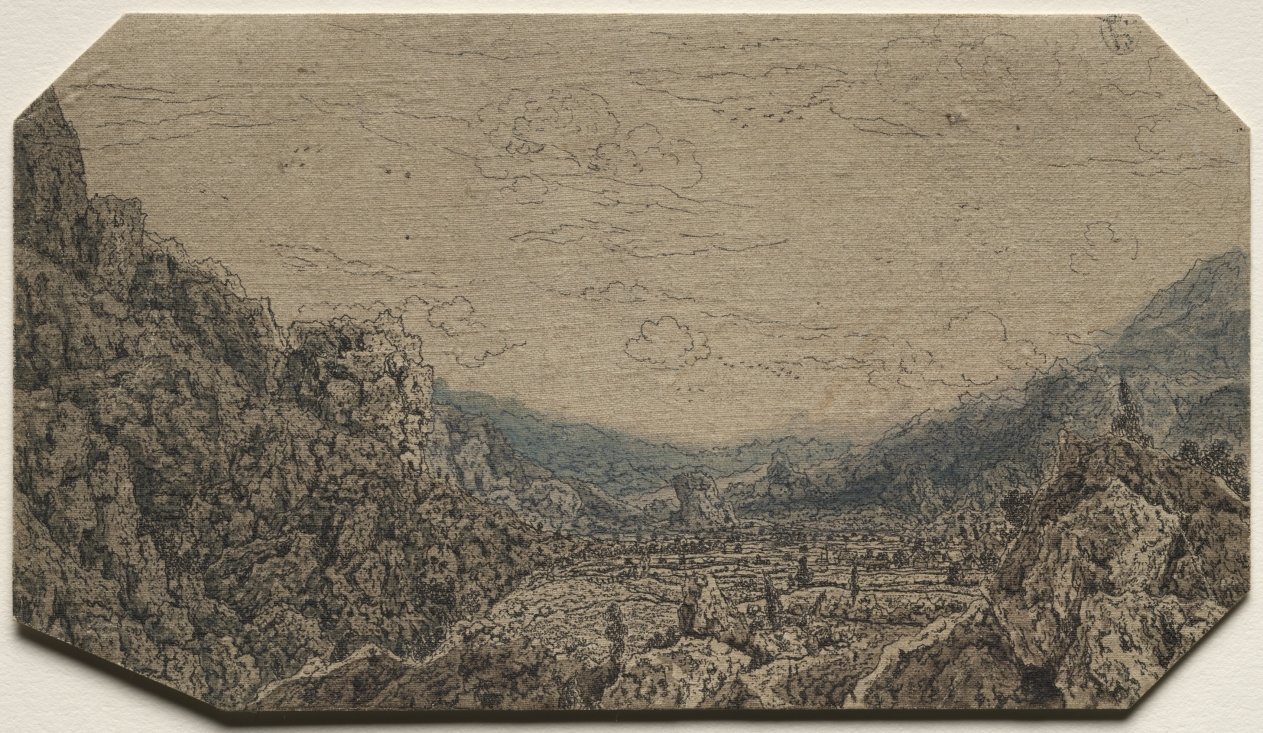
Start with Enclosed Valley in Cleveland, shown above. It is tiny: the museum gives the platemark as 10.7 by 19 centimetres. Then look for these features.
- Earth, not sky. Rock fills the sides and bottom of the sheet, and the eye drops into a flat valley floor. The sky is a few etched cloud outlines on bare cloth.
- Invented places. The Rijksmuseum describes his scenes as imagined mountain landscapes. CODART adds that there is no evidence he ever travelled or saw mountains, and that he even set a view from his own house on the Lindengracht in Amsterdam inside a mountain valley.
- Texture as tone. Rocks are built from dense dots, flicks and broken contours rather than smooth hatching, so the surface reads like lichen or sponge.
- The shape of the sheet. The Cleveland impression has its corners clipped, giving an elongated octagon. Cropping and trimming are part of the composition, not an afterthought.
- No lettering. Griffiths observes in Apollo that his plates carry no text at all, not even his name, which set them apart from commercial prints of the time.
Measured from the museum’s scan of this impression, the dominant colours are a warm linen grey (#A29279), a dark umber ink (#504A40), a mid stone (#998A73), a grey-brown shadow (#6A6254), a taupe (#7E7463) and a light sand (#AA9B82). These are the colours of the scan as it survives today, not a record of his original pigments. A thin grey-blue wash sits over the distant hills, and that one cool note against all the warm neutrals is what pushes the valley back. You can test a similar range in our image colour picker.
Technique: etching as painting
The Cleveland Museum of Art says he combined etching and colouring techniques to make what he considered printed paintings, and that instead of standard black-on-white editions he made each impression individual. CODART credits the phrase “printed paintings” to Samuel van Hoogstraten, whom CODART calls a contemporary, and summarises Rijksmuseum research showing that he made his etchings in a painter’s studio with painter’s materials, printing with oil paint on coloured grounds and on linen and cotton.
The museum records spell out the variety:
- Cloth as paper. Cleveland’s Enclosed Valley is etching on cloth, hand coloured with watercolour.
- Coloured ink on a coloured ground. The Met catalogues its Mountain Valley with a Plateau (about 1625–30) as line etching, drypoint and metal punch printed in blue-green on a yellow-green ground, coloured with a brush.
- Imported paper. Griffiths lists imported Japanese paper among his supports, and CODART reports that the Rijksmuseum team found he used paper from the Far East about twenty years before Rembrandt printed on Japanese paper.
- Painting after printing. The Rijksmuseum says he painted his prints and printed on canvas, so that no two impressions are the same.
The numbers explain why his prints are rare. Cleveland and Apollo both give 54 etchings. Griffiths cites 183 surviving impressions from Egbert Haverkamp-Begemann’s 1973 catalogue, while the Rijksmuseum’s current page gives 184. For context on the process itself, see our guide to etching.
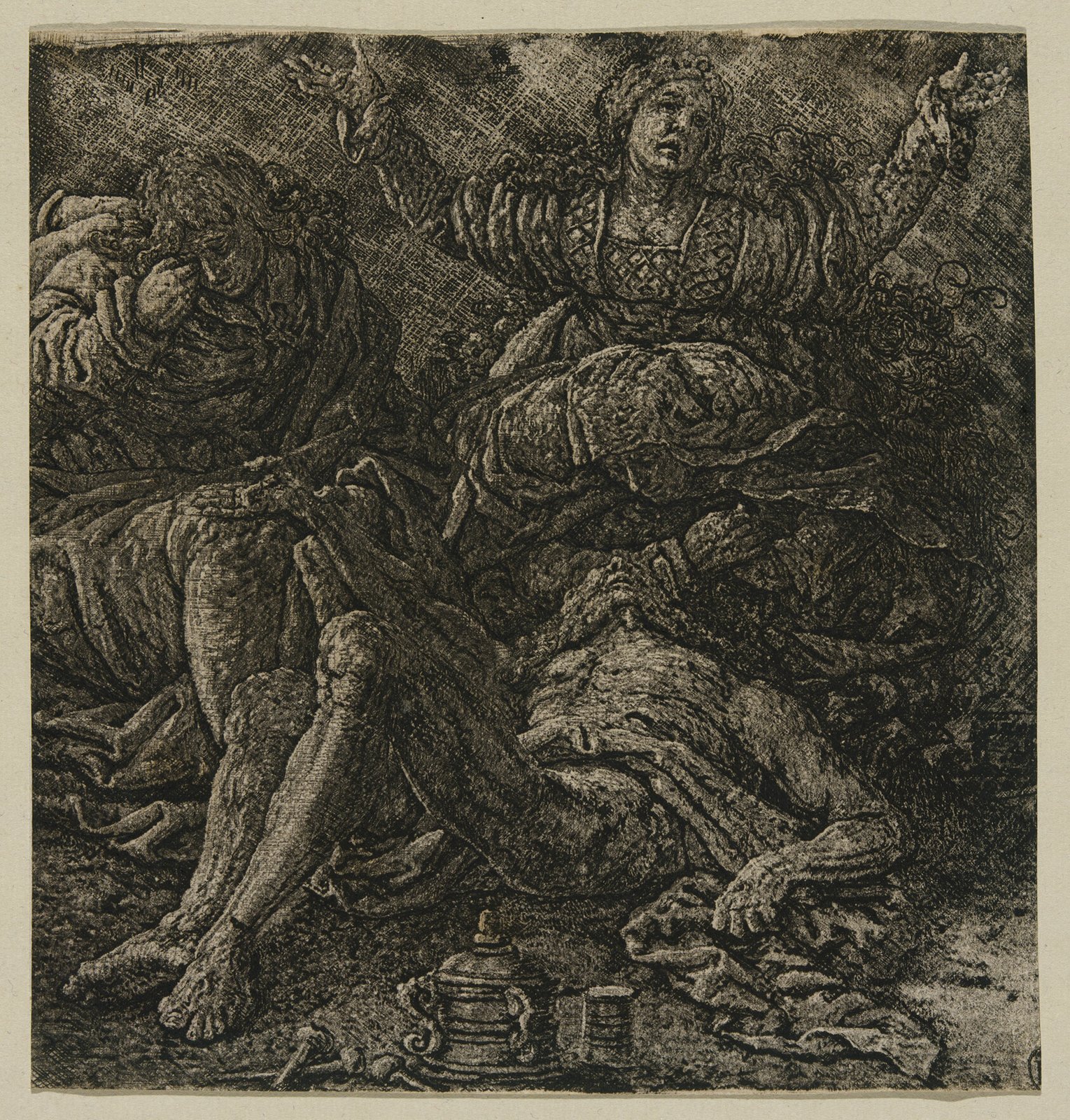
Figure subjects are unusual in his work. The Art Institute of Chicago’s Lamentation, which the museum dates to about 1607 and catalogues as etching in brown-black on ivory laid paper, shows how he handled a crowded composition. Robes and faces are built from the same nervous, broken line as his rocks, and the brown-black ink keeps the whole sheet in a narrow, sombre value range.
Key works and where to see them
- Enclosed Valley (c. 1623–30), etching on cloth with watercolour, Cleveland Museum of Art. The museum states that it is one of only ten known impressions of the print’s first state.
- Mountain Valley with a Plateau (c. 1625–30), coloured etching, the Metropolitan Museum of Art.
- The Two Trees, The Mossy Tree and Valley with a River and a Town with Four Towers, all in the Rijksmuseum, which holds more Segers prints than any other print room according to CODART and Apollo.
- View through the Window of Segers’ House toward Noorderkerk (c. 1622–30), Rijksmuseum.
Paintings are even scarcer. The Rijksmuseum’s artist page counts 16 surviving paintings, and CODART reports that the museum’s research for the 2016 exhibition added six works to a group of twelve previously known.
Rembrandt and the reworked plate
CODART says Rembrandt acquired an etching plate from Segers’s estate, replaced the figures with his own and kept the landscape. The museum records agree on the plate. The Met calls its impression Flight into Egypt: Altered from Tobias and the Angel by Hercules Segers and dates it about 1653, as does the Rijksmuseum; the Art Institute of Chicago dates its impression to about 1652.
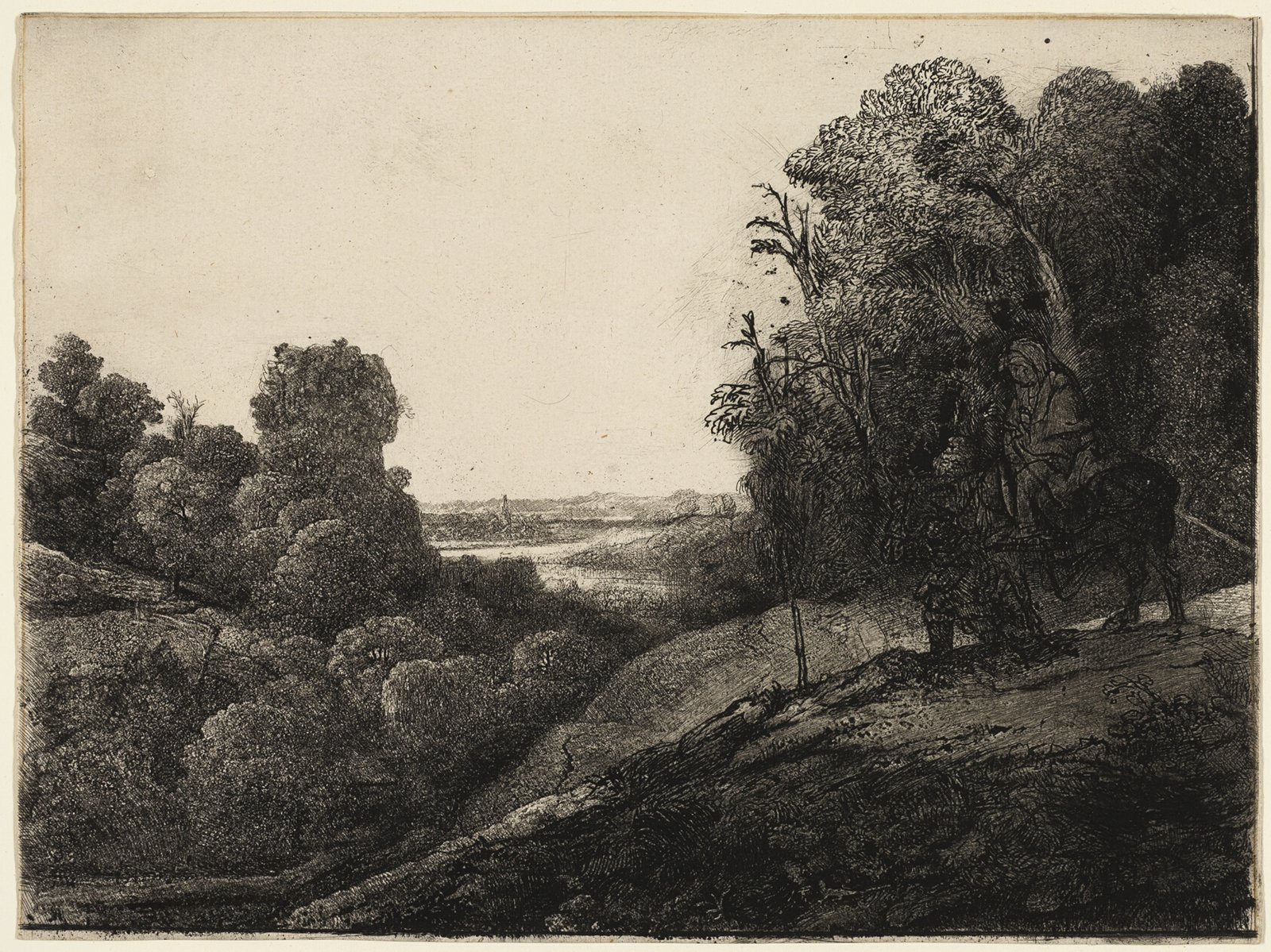
This is Rembrandt’s print, not Segers’s, but the open sky, falling hillside and dark mass of trees show how a strong landscape structure survives a change of subject. For more on the younger artist, see our Rembrandt guide, and for the Haarlem landscape painters of the same generation, see our guide to Esaias van de Velde.
How designers can borrow from Hercules Segers
- Treat the substrate as a colour. Print one file on kraft, tinted stock, linen tape or fabric and let the base tone do the work of a background fill.
- Make variants, not copies. For a print run or a set of social tiles, keep one line drawing and change only ink colour and ground. Ten versions of one image can feel like a series.
- Use one cool accent. In a warm neutral palette, a single thin blue or grey-blue pushes distance and draws the eye, as the wash does in Enclosed Valley.
- Build tone from marks. Replace smooth gradients with stipple, flicks and broken contours. Texture brushes and halftone dots give an illustration a tactile surface.
- Crop the frame. Clip corners or trim to an unusual ratio. The edge of the sheet is a design decision.
- Let the image speak without type. For a poster or cover, try a version with no lettering on the image itself, and move the information to a separate band or the reverse.
To put a warm neutral scheme with one cool accent together, try our colour palette generator. For more cleared prints, browse the MGD museum inspiration collection and its printmaking theme.
Using Hercules Segers images
The three images in this guide are flagged by their museums as open access: Cleveland marks Enclosed Valley CC0, and the Art Institute of Chicago marks both of its prints public domain. Seventeenth-century works like these are public domain in the US. Check each museum record before reusing other impressions.
Frequently asked questions
What is Hercules Segers known for?
He is known for imagined mountain landscapes and for experimental etchings printed in coloured inks on tinted paper, linen and cotton, often painted by hand, so that each impression is different.
Is it Segers or Seghers?
Both spellings are used. The Rijksmuseum and the Art Institute of Chicago use Segers, and the Cleveland Museum of Art uses Seghers.
How many prints by Hercules Segers survive?
Fifty-four etchings are known. Antony Griffiths in Apollo cites 183 surviving impressions from the 1973 catalogue; the Rijksmuseum gives 184.
Did Rembrandt collect Hercules Segers?
Yes. The Rijksmuseum and CODART both report that he owned eight Segers paintings, and he reworked one of Segers’s plates as The Flight into Egypt.