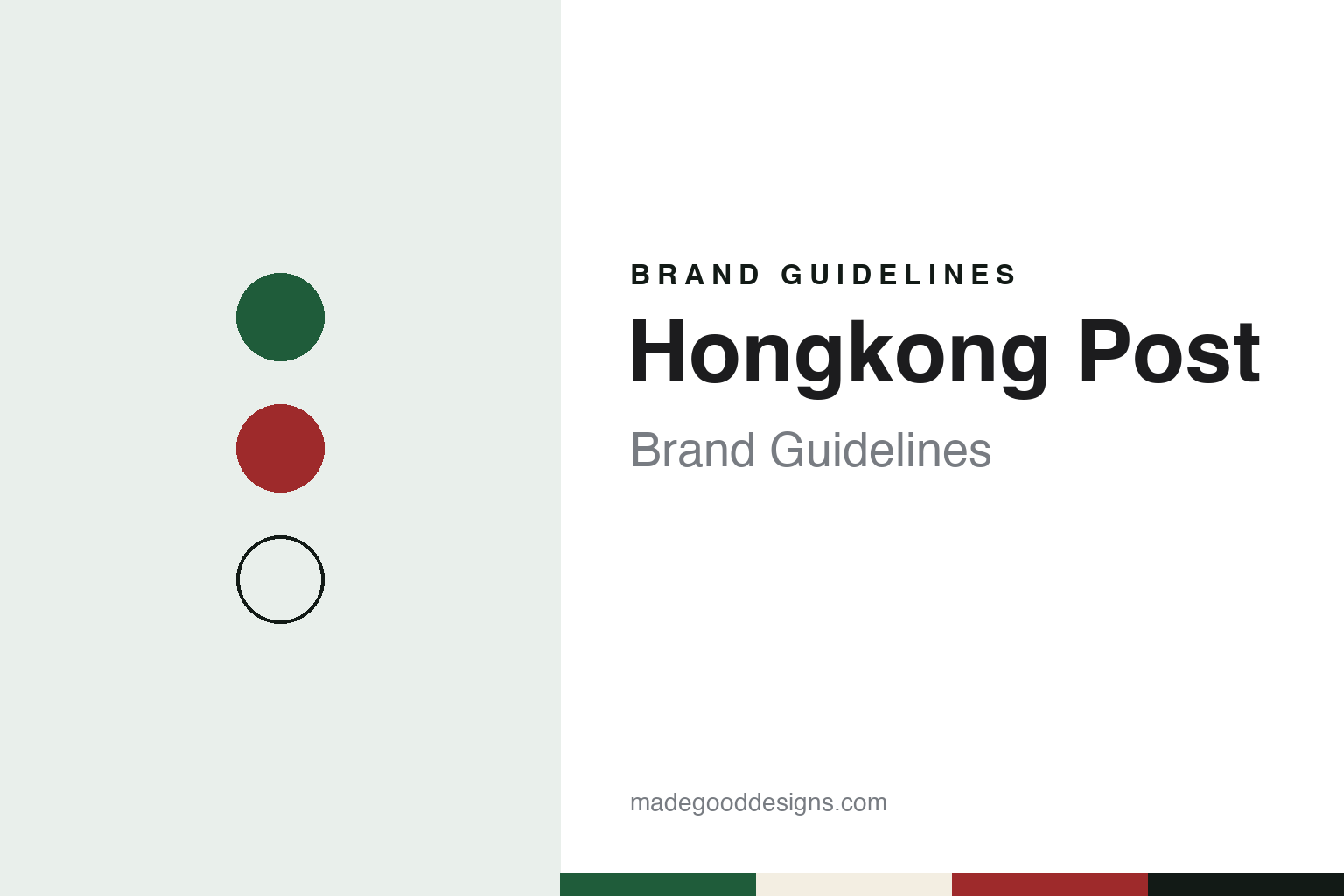
Hongkong Post Brand Guidelines
From 1841 and red pillar boxes to green ones and a trading fund.
Aa
Two constants: a green, cream and muted red palette and a bilingual serif register. Abstract homage — not a Hongkong Post product or mark; no stamp, logo or post box is reproduced.
The Postal Department
A post office for both sides of the harbour.
Hongkong Post dates its founding to 28 August 1841, in the first months of British rule, after merchants trading on both sides of Victoria Harbour had complained about the lack of a proper postal service, according to English Wikipedia. The first post office opened on 12 November 1841 near the present site of St John’s Cathedral. The service at first belonged to Britain’s Royal Mail, which set up the territory’s first General Post Office; control passed to the colony’s Postmaster General on 1 May 1860.
For two decades there were no stamps. Postmarks reading “HONG KONG” and “PAID” certified payment, and the earliest marks came from military field offices. The first local stamps appeared on 8 December 1862, printed by De La Rue with a portrait of Queen Victoria in seven values, and their use became compulsory by law in 1864. Hong Kong joined the Universal Postal Union in 1877; Hongkong Post remains a sub-member, separate from China Post, English Wikipedia says. The 1941 centenary set was the first to show local scenes.
The Japanese occupation interrupted the British service. Hong Kong surrendered to Japan on 25 December 1941; postal services resumed in early 1942 with Japanese definitive stamps, some later surcharged during hyperinflation and overprinted for the “Office of the Governor of Hong Kong,” according to Wikipedia’s survey of Hong Kong postal history. It describes censorship, Japanese-format addresses and renamed districts and buildings making the system chaotic, while stocks of British stamps were hidden in vaults or sent to Australia and South Africa. British postal service resumed on 25 August 1945, at first free, with “HONG KONG 1945 POSTAGE PAID” handstamps until stamp sales restarted on 28 September.
Colour
Stamps, cyphers and a change of livery.
Stamps are where the Hong Kong post has shown its design most plainly. A “Victory” issue of August 1946 carried a phoenix and the Latin motto “1941 RESURGO 1945.” The 1962 definitives, designed by Cheung Yat-man around a frameless Pietro Annigoni portrait of Queen Elizabeth II, dropped the traditional frames. Chinese zodiac commemoratives began in 1967, and in 1968 the bauhinia flower and the coat of arms appeared on definitives, the first local themes in that series. A Hongkong Post Stamps division was set up in 1974 to handle stamp design and production, advance orders and philatelic marketing.
The 1997 handover reshaped the look. On 23 May 1996 it was announced that stamps with the Queen’s portrait or British features would become invalid on 1 July 1997; a “neutral” set of definitives showing the Victoria Harbour skyline was issued on 26 January 1997, and colonial stamps could be exchanged until 31 July 1997. Stamps since then carry the name “Hong Kong, China.” The first definitives of the new era came on 18 October 1999, followed by series on East and West (2002), the birds of Hong Kong (2006) and the UNESCO Global Geopark (2014).
Street furniture tells the same story. English Wikipedia says Hong Kong imported post boxes from Britain until the 1980s; before 1997 they were painted red and carried a royal cypher, and since then their livery has been green, with the Hongkong Post logo. It counted 1,148 free-standing post boxes in October 2015, 59 of them colonial-era boxes still in service.
Typography
Design and documentation.
Postal operators are among the oldest names a country carries. Many began as royal or state services centuries ago and became companies only in recent decades, and their identities often hold on to symbols from that past while the business shifts from letters to parcels. Colour does much of the work: red, yellow, blue and orange wordmarks appear on post boxes, vans, uniforms and counters, and a colour can outlast the institution that first chose it. Denmark’s postal service wore red and yellow even before it was nationalised in 1711, and Sweden’s has used a post horn with a crown since its foundation in 1636, according to English Wikipedia.
The symbols repeat across borders. Post horns appear in several European marks; envelopes, birds in flight and arrows suggest movement elsewhere. Names matter too. Many operators use the national name in the local language, or in two or three languages at once, and some now trade under a group name that sits above the post office itself.
Their public faces have changed with the work. Websites now lead with parcels, tracking and delivery options, then letters and stamps and, for some operators, payments, money transfers or banking. Parcel lockers, service points inside shops, delivery vans and counter photography have become as common in their imagery as the post box. Stamp issues remain a design programme of their own, with commemorative sets and products for collectors, and philately keeps older issues in view.
Most of these operators are state-owned, or were until recently, so laws, annual reports and press releases are the main record of their ownership and structure. This guide sets out what those records and independent press say about each operator’s history, ownership and visual habits, and marks the companies’ own claims as theirs.
Aa
A bilingual serif — English beside traditional Chinese characters. (Specimen set in Noto Serif, a serif STAND-IN; NOT the Hongkong Post logo.)
Hongkong Post
A government department that pays its own way.
Before 1997 the department was known in English as the Post Office or Postal Department. Since August 1995 it has operated as a trading fund, a self-financing arm of government, and its head carries the title Postmaster General and general manager of the Post Office Trading Fund. Automated mail sorting arrived at the General Post Office in 1989. Hong Kong has no postcode system, English Wikipedia notes.
Services reach well beyond letters: Speedpost, Local Courier Post, bill payment through PayThruPost, philatelic products and, since 2000, digital certificates under the e-Cert name, which make Hongkong Post a recognised root certificate authority. English Wikipedia counted 122 post offices, including 3 mobile ones, in 2023, and 23 iPostal Kiosks for round-the-clock posting by July 2023, after the first launched in mid-2021.
The finances are under pressure. In May 2026 Hong Kong Free Press reported that Hongkong Post had applied to the Legislative Council for government funding to support its operations over three years and to refurbish its 28-year-old Air Mail Centre. HKFP said the 2024–25 loss was the largest since the self-financing model began in 1995, and a Commerce and Economic Development Bureau paper put the fall in mail volume at about 7% a year from 2019–20 to 2024–25, a cumulative drop of 44%. The application was made in May 2026 and was awaiting the legislature at the time of that report.
For a design guide, Hongkong Post shows how a postal identity can move from red boxes to green ones while its stamps carry the city’s history. Compare Royal Mail, which ran Hong Kong’s first post office, and SingPost, another Asian city postal operator. For this guide we use a deep green, a warm cream and a muted red with a serif, an unofficial interpretation; no product or logo is reproduced.
Explore & save
Keep Hongkong Post’s identity on hand — save it to a board in the Made Good inspiration library.
Hongkong Post identity set
Pin the Hongkong Post green, cream and muted red palette and the bilingual serif register to your own board.