IFA Brand Guidelines
Berlin’s September tech show, born as a radio exhibition in 1924.
Aa
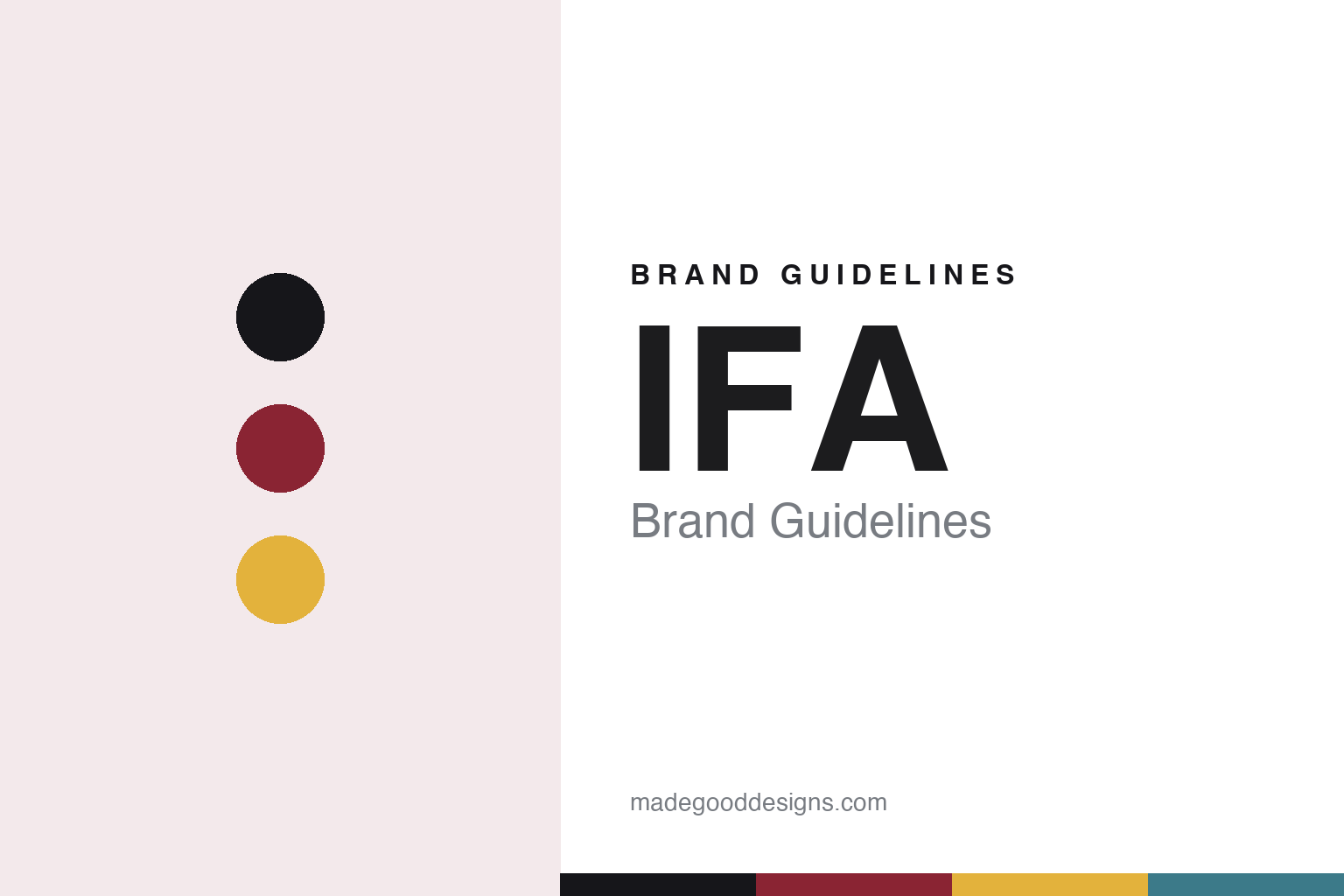
Two constants: a graphite, red, amber and teal palette and a broadcast grotesk register. Abstract homage — not an IFA asset; no logo, Funk-Otto head or test pattern is reproduced.
Funkausstellung
A radio show beside a new tower in Berlin’s west end.
IFA began as a radio exhibition. Its organiser’s history page says the “Große Deutsche Funkausstellung” (Great German Radio Exhibition) opened for the first time on 4 December 1924 at the Messedamm in Berlin’s Westend district, showing detector sets and valve radio receivers. German Wikipedia adds that the first show ran until 14 December in a purpose-built hall for the radio industry, on the site of today’s Hall 14 of the exhibition grounds.
The grounds gained their landmark soon after. Work on the Funkturm, the radio tower, began in 1924, and the tower was opened on 3 September 1926, at the start of the third exhibition, according to both the IFA history page and German Wikipedia. The IFA page says a television programme was broadcast live during the 1928 show. The exhibition was held every year until 1939.
The shows of the 1930s took place under the National Socialist government. The Deutsches Historisches Museum, in its online history LeMO, says that the Volksempfänger VE 301, a low-cost radio set developed at the instigation of the government’s propaganda ministry, was presented at the 10th Große Deutsche Funkausstellung in Berlin in August 1933, and that every radio maker in Germany was obliged to build it to the same design. An IFA review of the years 1934 to 1949, published by the trademark owner gfu in August 2024, notes that the making of the set was demonstrated at the 1934 show. The IFA history page says no show took place from 1940 to 1949 because of the Second World War.
The exhibition returned in 1950, in Düsseldorf; German Wikipedia counts that edition as the 17th Funkausstellung and says it introduced a two-year rhythm from 1953. Over the next two decades the show moved between Düsseldorf, Frankfurt am Main, Stuttgart and Berlin, which hosted it again from 1961. In 1971 it was renamed Internationale Funkausstellung and settled permanently on the Berlin grounds; German Wikipedia explains that “international” meant foreign exhibitors were now admitted, where before they needed a production site in Germany.
Colour
From a biennial radio fair to a yearly show each September.
IFA stayed biennial for decades. German Wikipedia says it was held, with a few exceptions, every two years from 1950 to 2005, and the IFA history page dates the return to an annual rhythm to 2006. The colour television start of West Germany took place at the Berlin show in 1967, and household appliances were admitted for the first time in 2008, under the name Home Appliances@IFA, according to the history page.
The page lists other additions: the IFA+ Summit conference and the CityCube Berlin hall in 2014, and IFA Next, a stage for start-ups, research labs and companies, from 2017. In 2019 IFA Next hosted a partner country for the first time, Japan. The show runs in early September at Messe Berlin, and the organiser pairs it with the trade-only IFA Global Markets sourcing show at STATION Berlin.
Ownership and organisation are split. German Wikipedia says the industry body gfu Consumer & Home Electronics has held the name rights since 1973, and the IFA website describes gfu as the brand owner of IFA. Since 2023 the show has been run by IFA Management GmbH, a joint venture of gfu and the event organiser Clarion Events. German Wikipedia adds that, under this arrangement, the state-owned Messe Berlin rents out the halls and provides services rather than organising the show, under an agreement to hold it at the traditional site until 2032.
The name has shifted with the ownership. The IFA website says the initials come from the original radio exhibition and were kept as a nod to that history. Since 2024 the organiser has said the three letters stand primarily for the claim “Innovation für Alle”, “Innovation for All” in English, while a logo variant for Internationale Funkausstellung was also created. The website and its press material often use the form IFA Berlin.
Typography
How technology trade shows and conferences present themselves.
Technology trade shows and conferences usually present themselves through a short name. Many are acronyms or initials that once stood for a longer title, as CES did for “Consumer Electronics Show” and IFA did for “Internationale Funkausstellung”; others pair a city or a country with a word such as “summit,” “congress” or “messe.” Editions are often announced simply as the name followed by the year.
Most are fixed to a month. CES opens in Las Vegas in the first part of January, and IFA in Berlin in early September, and CES, for one, lists its dates three years ahead. Behind each show stands an organiser of a particular kind: a trade association, an exhibition company, a joint venture between an industry body and an events firm, or a group that began among students and start-ups. The halls themselves may belong to a separate venue company that rents them out.
Inside, the layout tends to follow a shared pattern. Exhibition halls are divided by product area, and a conference programme with keynote addresses runs alongside the stands. Many shows also set aside a dedicated zone or stage for start-ups and research groups, such as Eureka Park at CES or IFA Next in Berlin, and some add trade-only areas for sourcing and buying.
The visual side usually splits in two. A wordmark is kept for years or decades, while the key visual, the campaign image and the colour of each edition can change from year to year. When a wordmark does change, there is usually a reason: CES and IFA both introduced new logos in 2024, each linked to a centenary. For a design guide, that pairing of a steady name and a changing yearly look is the most useful thing to study, and the colours and type in these guides are our own interpretation rather than official assets.
Aa
A squared grotesk with a broadcast-era feel, for hall signs and programme pages. (Specimen set in Space Grotesk, a sans STAND-IN; NOT the IFA logo or Funk-Otto emblem.)
IFA
Funk-Otto steps back; the test card steps in.
For decades the show’s emblem was a stylised head known as Funk-Otto. The IFA history page says the emblem was designed by the German graphic designer Helmut Lortz, a professor at the Berlin University of the Arts, and has been a symbol of IFA since 1971; in an April 2024 interview published by IFA, the head was described as celebrating its 70th birthday that year, so the two organiser accounts give different starting points. The earlier logo, refreshed in the early 2000s, combined the IFA lettering, a claim, the event date and the red Funk-Otto head.
For the show’s centenary in 2024, IFA Management commissioned Highsnobiety to rework the brand. In the April 2024 interview, IFA Management’s chief executive Leif Lindner said the colour scheme was based on the television test pattern broadcast in West Germany until the mid-1990s, as a reference to the 1967 start of colour television at the show, and gfu’s managing director Sara Warneke said the aim was a much simpler design. Funk-Otto was taken out of the main logo but kept as part of the wider brand family. The trade magazine kbbreview reported the same changes in 2024, describing several colour variations of the new logo that recall the West German test card.
For a design guide, IFA shows how a show can keep three historic initials while giving them a new meaning, and swap a mascot head for a palette drawn from broadcast history. Compare it with CES, the January show in Las Vegas, and with Messe Berlin, whose grounds under the Funkturm host the show. For this guide we use tower graphite, Funkturm red, test-card amber and valve teal with a grotesk sans, an unofficial interpretation; no product or logo is reproduced.
Explore & save
Keep IFA’s identity on hand — save it to a board in the Made Good inspiration library.
IFA identity set
Pin the tower graphite, Funkturm red, test-card amber and valve teal palette and the broadcast grotesk register to your own board.
Source & notes
Frequently Asked Questions
What font can I use to match the IFA look?
This guide describes IFA’s type as “A squared grotesk with a broadcast-era feel, for hall signs and programme pages”. Its type specimen is set in Space Grotesk from Google Fonts as a stand-in; Space Grotesk is not IFA’s own lettering.
What colours are in the IFA palette?
This guide’s IFA palette is Tower graphite #16161A, Funkturm red #8A2433, Test-card amber #E3B23C, Valve teal #3C7A89 and Hall paper #F4F1EA. The tones are the guide’s own unofficial interpretation, not official IFA hex codes.