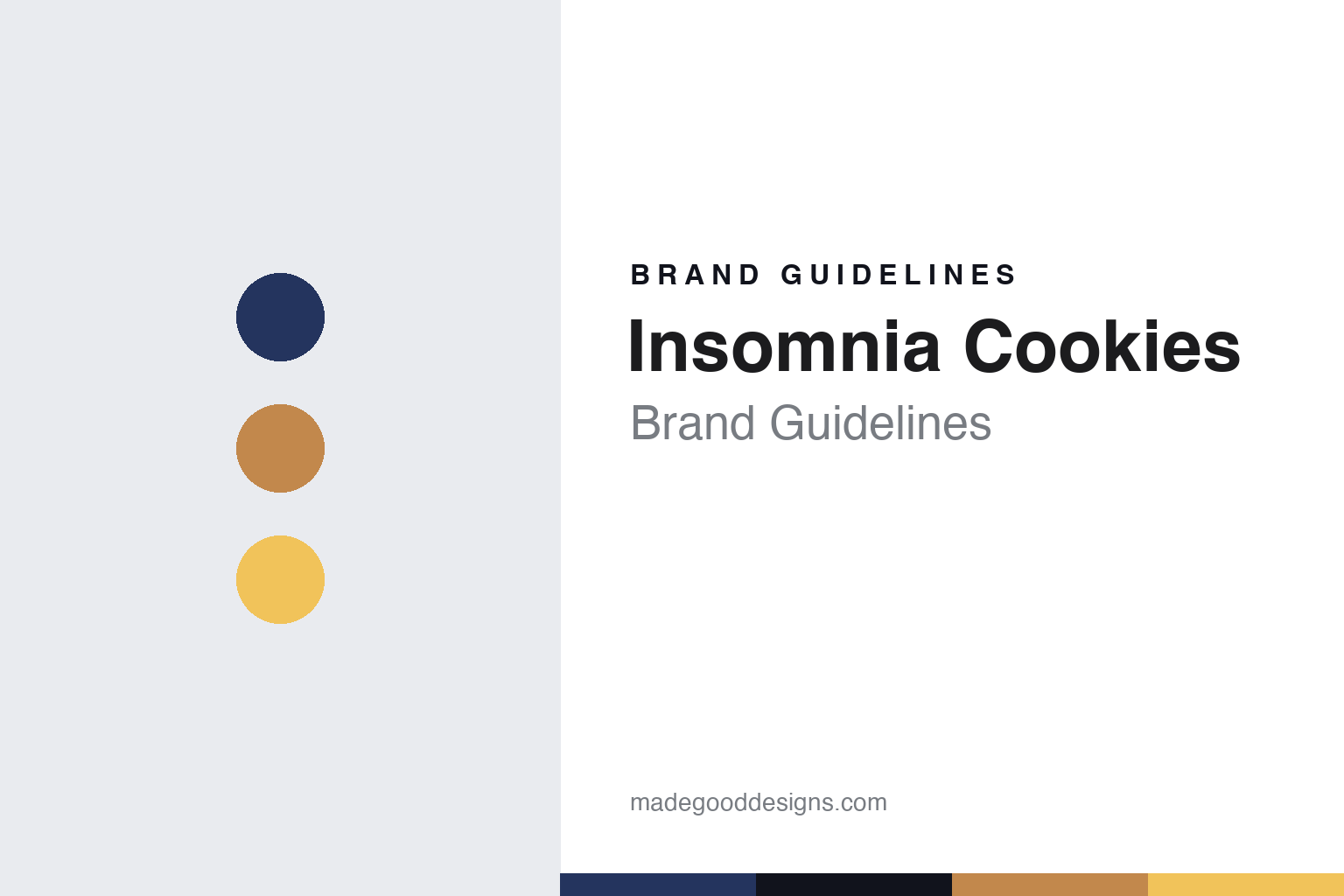
Insomnia Cookies Brand Guidelines
A 2003 dorm-room delivery service turned late-night bakery chain.
Aa
Two constants: a midnight blue, baked brown and lamp yellow palette and a soft serif register. Abstract homage — not an Insomnia Cookies product or mark; no box, logo or cookie is reproduced.
A dorm at Penn
Cookies for students who were still awake.
Insomnia Cookies is a chain of bakeries that sells warm cookies late into the night, mainly in the United States. It began in 2003 at the University of Pennsylvania in Philadelphia, where Seth Berkowitz, then a junior economics major, started baking cookies and delivering them to hungry students in the dorms late at night, the Philadelphia television station 6abc Action News reported in October 2016. “I had a sweet tooth and Insomnia was born,” Berkowitz told the station. English Wikipedia says the first shop opened on the Penn campus in the same year and that the company is based in New York City and Philadelphia.
The name describes the business model. Restaurant Business reported in July 2018 that the chain operated mainly in urban areas and near college campuses, with shops open until 3 a.m. and cookies available for delivery, and that it sold cookies, milk, ice cream and mix-ins. English Wikipedia gives typical hours of 10 a.m. to 3 a.m. on weekdays and noon to 3 a.m. at weekends, and lists cookie cakes, brownies and ice cream sandwiches alongside a range of classic and deluxe cookies, including vegan options.
Growth followed the campus map. In October 2016 the chain opened its 100th shop, reaching as far west as Colorado, 6abc reported; Berkowitz told the station that he did not think “a cookie store on every corner” fitted the brand, and that he wanted it to fit into neighbourhoods and communities. By then, the station said, the customers had widened from students to parents, children and professionals, and Berkowitz named the double chocolate chunk as the cookie he favoured. English Wikipedia records the 200th shop opening in Exton, Pennsylvania, in June 2021, and the first shops outside the United States, in Manchester, England, and Toronto, Canada, in 2023. By July 2024 the chain had 265 locations, Restaurant Business reported, citing its sister company Technomic.
Colour
A name that sets the opening hours.
The brand’s idea sits in its name: a bakery for people who are awake when others are not. English Wikipedia describes the chain as specialising in delivering warm cookies, baked goods and ice cream, and the late opening hours and delivery service reported by Restaurant Business in 2018 follow from that promise. Shops near universities, which English Wikipedia says serve students who want cookies after traditional bakeries have closed, keep the founding story of a dorm-room delivery service in view.
The company has also tried new formats under the same name. English Wikipedia says that in April 2021 it opened a shop in South Philadelphia with an experimental section called CookieLab, described as a “cookie speakeasy” with customisable cookies and a bar serving milk and milkshakes. In October 2023, the same source says, it worked with Universal Pictures and Scott Cawthon Productions on a “Freddy Fazbear’s Cookie Pizza” to promote the film Five Nights at Freddy’s. Product naming is otherwise plain: cookies are sold in classic and deluxe ranges, and the cookie cake and the ice cream sandwich are named for what they are.
Berkowitz has stayed with the business through each change of owner. Restaurant Business reported in 2018 that he would continue to lead the chain under Krispy Kreme, and in 2024 that he would continue as chief executive under its new investors, calling the years with Krispy Kreme a “very successful” partnership. That continuity links the student delivery service of 2003 to the chain of 265 shops it had become by 2024.
Typography
How the category presents itself.
Doughnut, cookie and cupcake chains sell small things that are eaten quickly, so much of their identity has to work at the counter and in the hand. The box, the bag and the cup travel further than any shop sign in a takeaway trade. Crumbl is a clear case: its own history page calls its long pink box a signature, and Restaurant Business wrote in 2026 that the box makes the cookies look almost as if they are on display.
The product itself is often the second carrier. Glazed rings seen through a window, warm cookies on a counter and cupcakes stacked into towers are the images these companies choose to publish on their own sites and social channels. Some chains add a time or a temperature to the promise: Insomnia Cookies built its name around warm cookies sold late into the night, with shops near college campuses open until 3 a.m., as Restaurant Business reported in 2018.
Flavour naming tends to be plain and descriptive. A cookie or doughnut is usually named after the dessert or ingredient it borrows from, as with the Blueberry Muffin and Dubai Chocolate Brownie that Restaurant Business reported on Crumbl’s menu in 2026, and rotating or seasonal flavours are announced week by week so that the menu itself becomes news. Shops are generally identified by their town, street or campus rather than given names of their own.
Behind the shopfront, corporate pages tell a founder story and, more rarely, an ownership story. Several of the chains in this group began with one person or one family and one shop, then passed through franchising, a larger food company or a private-equity investor. Those changes are dated in trade and business press, and each guide here gives them as dated facts.
Aa
A soft serif for a late-night bakery. (Specimen set in Fraunces, a serif STAND-IN; NOT the Insomnia Cookies logo.)
Insomnia Cookies
From Krispy Kreme to private equity.
Insomnia has had three sets of owners. On 20 July 2018 Restaurant Business reported that Krispy Kreme Doughnut Corp. had agreed to buy a majority stake; terms were not disclosed, and Krispy Kreme said the two brands would continue to operate independently. The doughnut chain was itself owned at the time by JAB Holding, the Luxembourg-based investment firm that had taken it private in 2016, the same report said.
Krispy Kreme held the majority for about six years. On 22 July 2024 Restaurant Business reported that it had sold a majority stake in Insomnia to two private-equity groups, Verlinvest and Mistral Equity Partners, while keeping a 34% interest. The publication noted that Mistral had earlier invested in restaurant chains including El Pollo Loco and Dunkin’, and that Verlinvest had backed food and drink brands such as the oat-milk maker Oatly. The doughnut company said the sale would let it focus on producing, selling and distributing fresh doughnuts. Krispy Kreme had put Insomnia on the market the year before, the publication added. In June 2025 Krispy Kreme sold its remaining stake to Insomnia Cookies and the shareholders who had taken part in the earlier sale, which it dated to 17 July 2024, QSR Web reported on 11 June 2025.
For a design guide, Insomnia Cookies shows how a name and an opening time can carry a brand story: the late hours, the delivery service and the campus locations all point back to a dorm room in 2003. Compare Krispy Kreme, its majority owner from 2018 to 2024, and Crumbl, another American cookie chain. For this guide we use a midnight blue, night ink and a baked brown with a lamp yellow and a soft serif, an unofficial interpretation; no product or logo is reproduced.
Explore & save
Keep Insomnia Cookies’s identity on hand — save it to a board in the Made Good inspiration library.
Insomnia Cookies identity set
Save the midnight blue, baked brown and lamp yellow palette and the soft serif register to your own board.