Ben’s Cookies Brand Guidelines
An Oxford market stall and a Quentin Blake drawing.
Aa
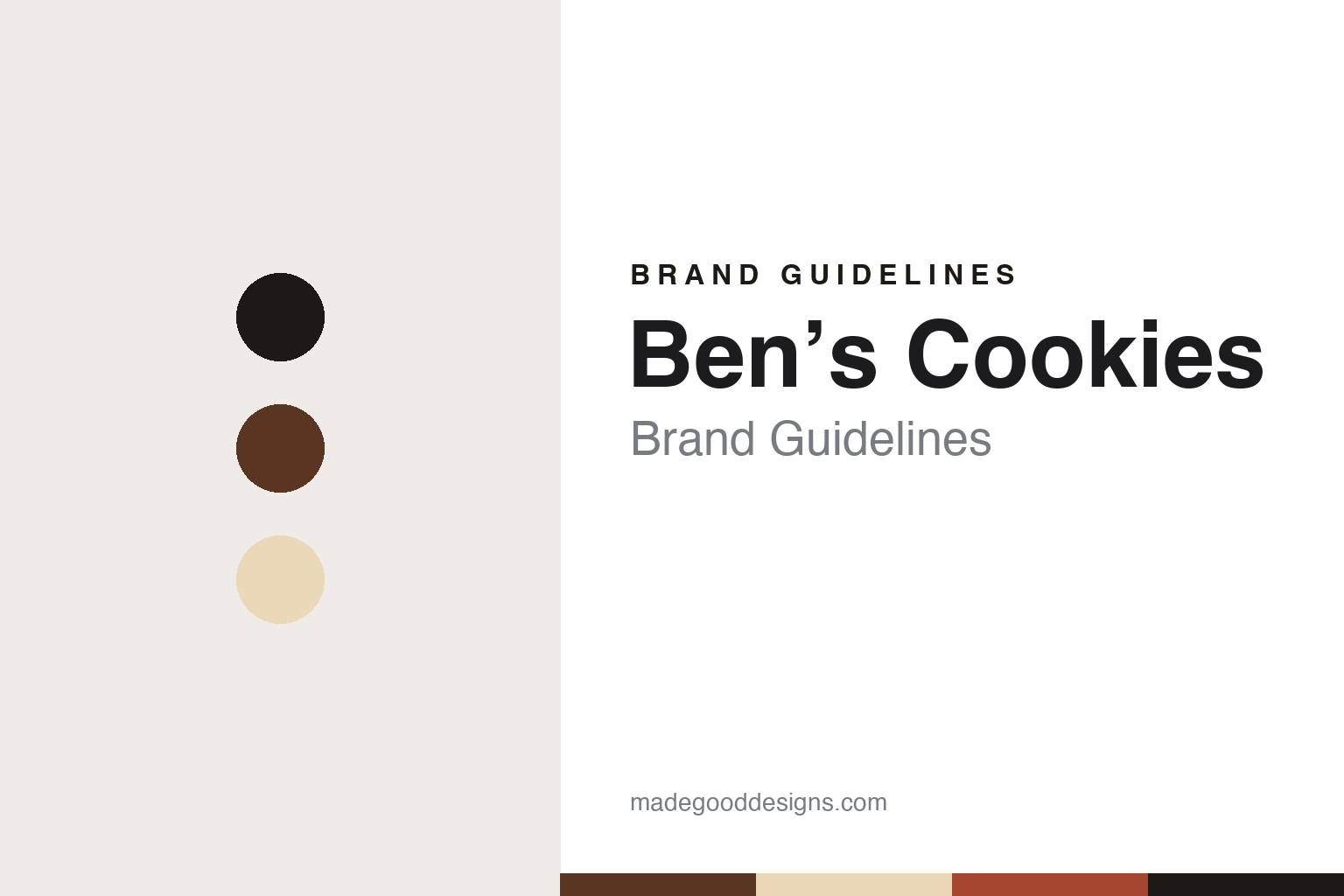
Two constants: a chunk brown, biscuit and oven red palette and a Warm serif register. Abstract homage — not a Ben’s Cookies product or mark; no cookie, drawing or logo is reproduced.
A Covered Market stall
A cookery writer and a stall in Oxford.
Ben’s Cookies began in Oxford. The company says it has been “baking since 1983”, and that its founder, the cookery writer Helge Rubinstein, opened the first Ben’s Cookies shop in Oxford’s Covered Market in 1984. English Wikipedia tells the same story in slightly different words: after making cookies at home, Rubinstein opened a stall to sell them in the market in 1984. Later press reports give 1983 as the founding year. Singapore’s Mothership described the chain in May 2023 as founded in Oxford in 1983, and India’s BusinessLine said in May 2026 that it was established in 1983 at the Covered Market. The company’s own page uses both dates: 1983 for the baking and 1984 for the shop.
The name is personal. According to English Wikipedia, the business was named after Rubinstein’s son, Ben. The Covered Market shop is still trading, the company says, and the market’s own trader listing repeats the account of the 1984 opening and places the shop among the market’s food traders. English Wikipedia describes the format plainly: the cookies are baked on site in the shops and can usually be bought warm.
The product line is narrow and built around one idea. Ben’s Cookies says its cookies are made with “chocolate chunks, not chips”, and Mothership repeated that description in 2023 when it reported the chain’s return to Singapore. The company’s menu runs from Milk Chocolate Chunk, which it calls “the original”, to Triple Chocolate Chunk, Oatmeal & Raisin and Matcha & White Chocolate.
Colour
A Quentin Blake drawing.
The most documented part of the Ben’s Cookies identity is a drawing. English Wikipedia says the logo was created by the British artist Quentin Blake, a friend of the Rubinstein family. The Cambridge student paper Varsity said the same in February 2015: introducing an interview with Blake, its writer described seeing people in London eating Ben’s Cookies, “the logo of which Blake drew”, alongside greetings cards and bed linen carrying his work. The same interview discussed his student years and his long collaboration with Roald Dahl, whose children’s books Blake illustrated.
That makes the mark an illustrator’s work rather than a lettering or monogram commission.
The company’s own copy keeps an informal voice. Its flavour pages give each cookie a short character sketch rather than a list of ingredients: the Milk Chocolate Chunk is “the daddy of cookies”, the Matcha & White Chocolate “wakes up at the crack of dawn and does yoga”, and the Ginger & Dark Chocolate comes “from the Scottish Highlands”. The same joking register runs through the whole range, from the dark chocolate cookies to the white chocolate ones.
The format travels without changing its shape. English Wikipedia lists shops in Bath, Bristol, Cambridge, Edinburgh, London and Reading in the UK, and overseas in Singapore, South Korea, Japan, the United Arab Emirates, Malaysia, Manila and Dallas, among others, and notes that most of the UK shops are in London. The company says it now has more than 85 shops around the world, and that from its smallest kiosks to its largest shops it tries to stay true to “the original Ben’s market stall in Oxford”.
Typography
Design and documentation.
Doughnut, cookie and cupcake chains sell small things that are eaten quickly, so much of their identity has to work at the counter and in the hand. The box, the bag and the cup travel further than any shop sign in a takeaway trade. Crumbl is a clear case: its own history page calls its long pink box a signature, and Restaurant Business wrote in 2026 that the box makes the cookies look almost as if they are on display.
The product itself is often the second carrier. Glazed rings seen through a window, warm cookies on a counter and cupcakes stacked into towers are the images these companies choose to publish on their own sites and social channels. Some chains add a time or a temperature to the promise: Insomnia Cookies built its name around warm cookies sold late into the night, with shops near college campuses open until 3 a.m., as Restaurant Business reported in 2018.
Flavour naming tends to be plain and descriptive. A cookie or doughnut is usually named after the dessert or ingredient it borrows from, as with the Blueberry Muffin and Dubai Chocolate Brownie that Restaurant Business reported on Crumbl’s menu in 2026, and rotating or seasonal flavours are announced week by week so that the menu itself becomes news. Shops are generally identified by their town, street or campus rather than given names of their own.
Behind the shopfront, corporate pages tell a founder story and, more rarely, an ownership story. Several of the chains in this group began with one person or one family and one shop, then passed through franchising, a larger food company or a private-equity investor. Those changes are dated in trade and business press, and each guide here gives them as dated facts.
Aa
A warm serif — set against a hand-drawn mark by Quentin Blake. (Specimen set in Fraunces, a serif STAND-IN; NOT the Ben’s Cookies logo.)
Ben’s Cookies
Openings, a pause and a return.
The chain’s overseas record has not been a straight line. Mothership reported in May 2023 that Ben’s Cookies first opened in Singapore in 2014 and shut there in 2021, and that hoarding at its old spot in the basement of the Wisma Atria mall on Orchard Road announced a return in June 2023. The paper said the shop would return to the same basement spot, which links Orchard station with the neighbouring Ngee Ann City mall.
In May 2026 BusinessLine, which described the brand as known for its “chunky and gooey” cookies, reported that India’s DS Group, the company behind brands such as Catch spices and Pulse candy, had signed a partnership with Ben’s Cookies to bring the brand to India, starting in Delhi and Mumbai with shops on high streets and in malls. The paper quoted the Indian operation as saying that the dough is imported and kept in a cold chain, with cookies baked in live ovens in each store and positioned as “premium handcrafted cookies”, and listed shakes, coffee and ice cream for the menu alongside the cookies.
Those two reports describe the same model the company sets out for itself: a small counter, a short menu of chunk cookies, and baking done in front of customers. The Oxford stall remains the reference point in the company’s own story, which still opens with Rubinstein and the Covered Market.
For a design guide, Ben’s Cookies shows how an illustrator’s drawing, a single market stall and a playful flavour voice can stay at the centre of a chain’s identity as it opens abroad. Compare it with Millie’s Cookies, another British cookie chain founded in the mid-1980s, or with the American chain Insomnia Cookies. For this guide we use chunk brown, biscuit and oven red with a serif, an unofficial interpretation; no product or logo is reproduced.
Explore & save
Keep Ben’s Cookies’s identity on hand — save it to a board in the Made Good inspiration library.
Ben’s Cookies identity set
Pin the Ben’s Cookies chunk brown, biscuit and oven red palette and the Warm serif register to your own board.