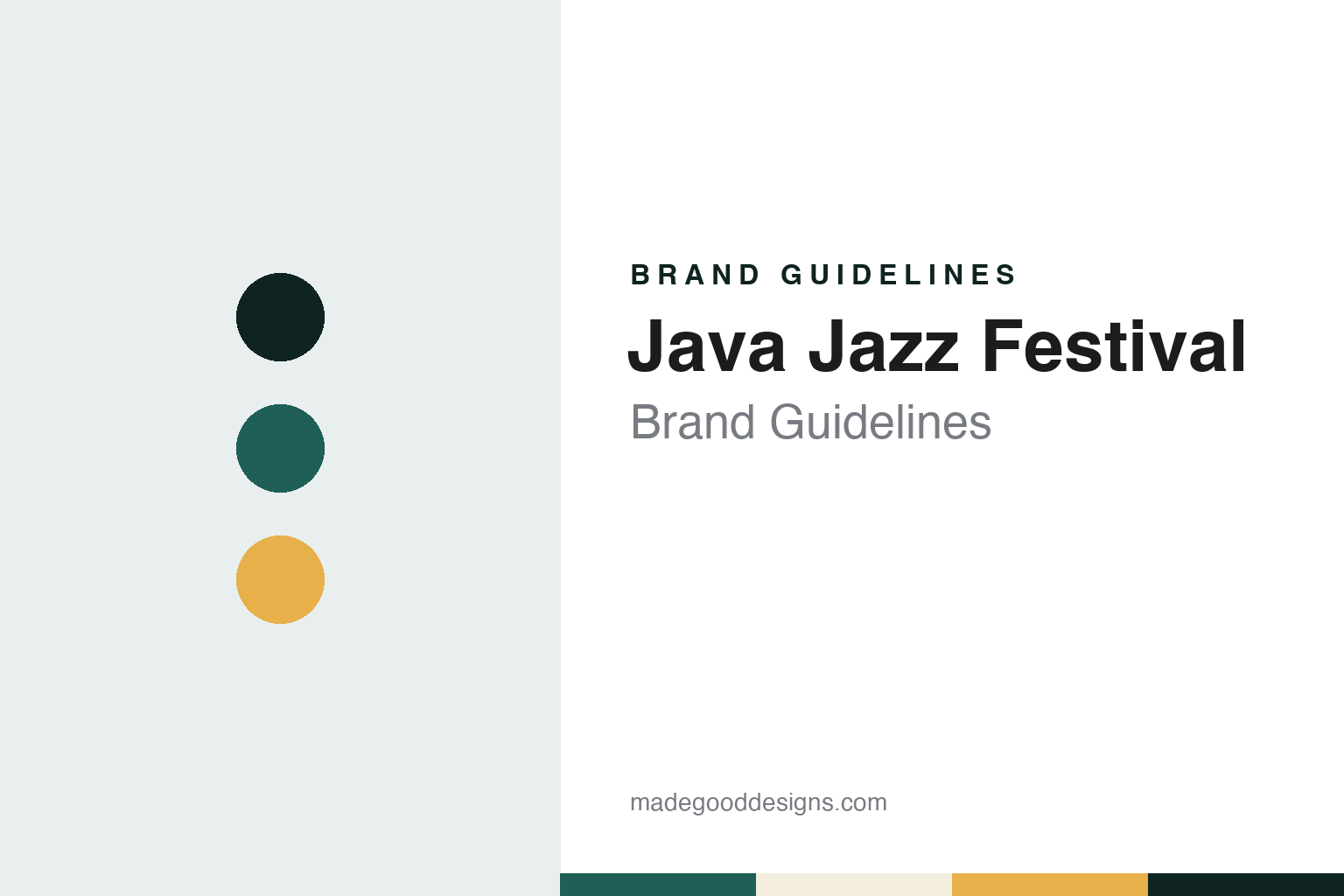
Java Jazz Festival Brand Guidelines
Jakarta’s many-stage festival, now held at PIK 2.
Aa
Two constants: a Java Jazz monsoon teal and marigold palette and a Festival serif register. Abstract homage — not a Java Jazz Festival poster or mark; no logo, artwork or photograph is reproduced.
Jakarta, 2005
A convention centre, a founder and a theme line.
The festival’s full name is the Jakarta International Java Jazz Festival, and it is widely shortened to Java Jazz Festival or simply Java Jazz. English Wikipedia says it was founded by the Indonesian businessman Peter F. Gontha, and Indonesian Wikipedia names its organiser as Java Festival Production.
The first edition ran from 5 to 7 March 2005 at the Jakarta Convention Center in Senayan, English Wikipedia records, under the theme “Bringing the World to Indonesia.” Each early edition carried a theme line of its own — “Bringing the World Together” in 2007, “Taste the Spirit of Jazz” in 2008, “It’s a Festival for All” in 2009 — and the stages multiplied from eleven in 2005 to nineteen by 2008, according to the same source. The festival stayed at the convention centre until 2009.
From 2010 the festival moved to the Jakarta International Expo (JIExpo) in Kemayoran, Central Jakarta, as The Jakarta Post describes it, and it was held there until 2025, English Wikipedia says. The exhibition halls allowed many stages under one roof and across the grounds: The Jakarta Post, reviewing the 15th festival in March 2019, counted 11 stages and 100 artists over three days, from 1 to 3 March, with tens of thousands of visitors each day.
For most of its history the festival was a late-February or early-March fixture. The 2021 edition was not held, English Wikipedia records, and since its return in 2022 the festival has been staged in late May or early June: NME reported the 2022 festival for 27 to 29 May and the 2023 edition for 2 to 4 June, both at JIExpo Kemayoran. English Wikipedia records that the 2025 festival, from 30 May to 1 June and still at JIExpo, marked the event’s 20th anniversary, with 11 stages and more than a thousand musicians.
Colour
Title names and a festival of many stages.
The festival’s public name has carried a bank’s name for long stretches. The Jakarta Post called the 2019 edition the Jakarta International BNI Java Jazz Festival, and NME described the 2023 event as the BNI Java Jazz Festival, after the bank BNI. Indonesian Wikipedia says BNI remained the main sponsor until 2025.
From 2026 the title changed. Bandwagon Asia reported in February 2026 that the 21st edition would be the myBCA International Java Jazz Festival, after the digital banking app of Bank Central Asia, and The Star of Malaysia used the same name in May 2026, adding that it is also referred to simply as Java Jazz Festival. The festival’s own social accounts, @javajazzfest for the event and @javafestpro for the organiser, keep the short form.
The programme has always been broad. The Jakarta Post noted in 2019 that the bill encompassed almost the entire spectrum of music, from long-standing jazz performers to soul, R&B and electronic pop, and named the rock band Toto as that year’s headliner. It also described the festival’s habit of special collaborations, tributes and projects, including a sponsor-branded project in which a horn section backed Indonesian singers in songs by past performers.
A distinctive part of the format is the special show: a headline concert inside the festival that needs an additional ticket beyond the general pass, as NME reported for the 2022 and 2023 editions. English Wikipedia lists the special shows edition by edition, and The Star listed the 2026 special performances apart from the main line-up. The festival is run by PT Java Festival Production, whose president director in 2026 was Dewi Gontha, according to The Star and Bandwagon Asia.
Typography
How jazz festivals build an identity.
A jazz festival rarely owns the ground it stands on, yet the ground often does most of the work of making it recognisable. An open-air amphitheatre, a grove of pines by the sea, a park beside a river, a village square under a marquee or a whole small town handed over for a week in summer: audiences remember the setting long after a particular evening’s line-up has blurred, and the festival name tends to fuse with the name of the place.
Inside that setting, stages are given names of their own, after a garden, a building, a street or a hall, and those names become part of the vocabulary regulars use when they plan a day. The annual poster does a similar job over time. Many festivals commission a different illustrator, painter or designer every year, so a run of posters becomes a visual archive that collectors keep and that the festival itself often reprints, exhibits or sells.
Behind the name there is usually a founder or a small founding group, and later an organisation that keeps it going: a non-profit association, a foundation, a tourist office or a public cultural body linked to the town. Changes in that structure seldom change what audiences see, but they shape who books the music, who commissions the poster and who looks after the archive of past editions.
Then there is the practical layer, the part visitors handle with their own hands. Printed programme books and day-by-day schedules, wristbands and passes, site maps, information points, signs that point from one stage to the next, and now festival apps all carry the same name, colours and lettering. This guide looks at how each festival’s identity holds together across those pieces, and keeps to what dated sources record about them.
Aa
A festival serif — a long name, kept short in use. (Specimen set in Fraunces, a serif STAND-IN; NOT the Java Jazz Festival logo.)
Java Jazz Festival
A new site, ten stages and a shuttle map.
In 2026 the festival left Kemayoran. Bandwagon Asia reported in February 2026 that the 21st edition would run from 29 to 31 May at NICE, the Nusantara International Convention Exhibition at PIK 2 in Tangerang, west of Jakarta, organised by Java Festival Production; English Wikipedia places the site in Tangerang Regency, Banten. The Star said in May 2026 that the festival would offer 10 stages each day, with art installations placed around several areas of the site, and named special performances by Jon Batiste and by the South Korean band wave to earth, among others. Bandwagon Asia said Batiste’s special show was set for the Friday, 29 May.
The new site changed the practical layer audiences use. The Star reported that the organiser was running round-trip buses to the venue from Lippo Mall Kemang, Plaza Senayan, fX Sudirman and Sarinah Thamrin, with further routes including one from the Soekarno-Hatta airport station, and that schedules and seat reservations for the shuttles were published on the festival website, javajazzfestival.com. English Wikipedia’s edition listings set out day-by-day line-ups for 2018 and hall-by-hall programmes for 2020, with halls named after partners, such as the BNI Hall.
The festival’s name does much of the visual work: a long official title, shortened in daily use, with a bank partner’s name placed in front of it in the editions reported in 2019, 2023 and 2026. The theme lines of the early editions, beginning with “Bringing the World to Indonesia,” gave each year its own headline, and that line returned for the 2014 edition, English Wikipedia records.
For a design guide, Java Jazz Festival shows how a long official name, a changing title partner and a format of many stages can still read as one festival when the short name stays constant. Compare Detroit Jazz Festival, which has also carried a sponsor’s name in its title, and Montreux Jazz Festival, the Swiss festival Detroit’s took as its model in 1980. For this guide we use a monsoon teal, a rattan cream and a marigold with a serif, an unofficial interpretation; no product or logo is reproduced.
Explore & save
Keep Java Jazz Festival’s identity on hand — save it to a board in the Made Good inspiration library.
Java Jazz Festival identity set
Pin the Java Jazz monsoon teal and marigold palette and the Festival serif register to your own board.
Source & notes
Frequently Asked Questions
What font can I use to match the Java Jazz Festival look?
This guide describes Java Jazz Festival’s type as “A festival serif — a long name, kept short in use”. Its type specimen is set in Fraunces from Google Fonts as a stand-in; Fraunces is not Java Jazz Festival’s own lettering.
What colours are in the Java Jazz Festival palette?
This guide’s Java Jazz Festival palette is Monsoon teal #1F5F57, Deep night #0F2321, Rattan cream #F4EEDF, Marigold #E7B04A and Clay rose #C2715A. The tones are the guide’s own unofficial interpretation, not official Java Jazz Festival hex codes.
When was Java Jazz Festival founded?
Java Jazz Festival was founded in 2005 (first edition, March), in Jakarta, Indonesia.
Who founded Java Jazz Festival?
Java Jazz Festival was founded by Peter F. Gontha in 2005 (first edition, March).


