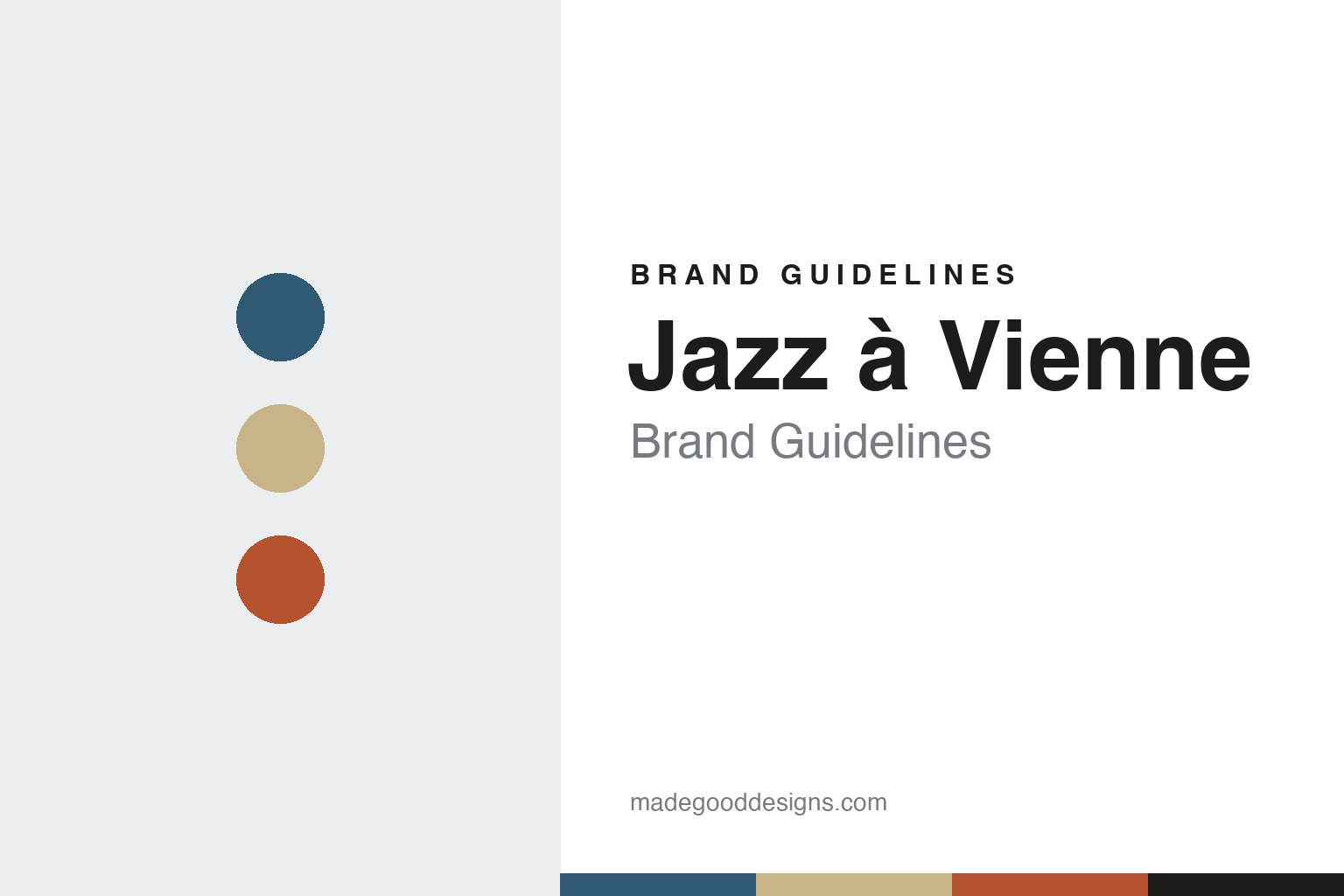
Jazz à Vienne Brand Guidelines
A blues night in 1980, then a fortnight of jazz in a Roman theatre on the Rhône.
Aa
Two constants: a Rhône blue, theatre stone and terracotta palette and an inscriptional serif register. Abstract homage — not a Jazz à Vienne poster or mark; no logo, artwork or wristband is reproduced.
A blues night, then a festival
From one evening in 1980 to a fortnight every summer.
Jazz à Vienne grew out of a single evening. French Wikipedia records that in 1980 Jean-Paul Boutellier organised a first Nuit du Blues, a blues night it describes as the prelude to the festival, and that the event found its home in Vienne, the Rhône town near Lyon in the Isère department. The following summer the festival proper began. French Wikipedia says the first edition was organised in 1981 by an association under the French law of 1901 and ran over five evenings; the festival’s own archive page for that year gives the dates as 5 to 15 July 1981 and also speaks of “five days”, while English Wikipedia dates the start to 6 July 1981.
The festival’s team page credits the creation to Boutellier, helped by two co-organisers and a handful of volunteers, some of whom, it says, still contribute today. Its archive page for 1981 names some of the music heard that year: Dizzy Gillespie at the head of an all-star big band, and Herbie Hancock, who, the page says, introduced a 19-year-old trumpeter to the audience.
The shape set in those first years has held. Writing in the Swiss daily Le Temps on 29 May 2000, as the festival prepared its twentieth anniversary, Arnaud Robert described Boutellier as the creator of the event and said that the programme still followed “the recipe invented in 1980”: established names of contemporary jazz, soul and blues evenings, and a few risks on newer groups.
Two decades later the founder was still part of the story. In a report published on 1 July 2021, when the festival marked its fortieth year, Euronews introduced Boutellier as the festival’s founder and its “living memory”. The same report noted that the 2021 edition ran until 10 July and that a recording of a concert given in Vienne by Miles Davis and his band on 1 July 1991 had just been reissued by Rhino and Warner.
Colour
An association, then a public body; four stages across the town.
The organisation has changed form more than once. French Wikipedia says that in July 2010 the Pays Viennois urban community and the city of Vienne announced the creation of a public industrial and commercial body, an EPIC named Jazz à Vienne, which took over the festival from the association Vienne Action Culturelle. On 1 January 2025, it adds, the EPIC became an EPCC, a public body for cultural cooperation whose members are Vienne Condrieu Agglomération and the city of Vienne. That body is called Cybèle Production, and the festival’s legal notice names the EPCC Cybèle Production as the owner of its website. The team page lists a governing board of elected members of Vienne Condrieu Agglomération alongside a group of qualified individuals, Boutellier among them, and says that more than 200 volunteers and over 120 seasonal staff and technicians work on each edition.
The festival describes itself as running for two weeks at the start of July; French Wikipedia gives a fortnight between the end of June and the start of July. The 45th edition ran from 25 June to 11 July 2026. The festival’s own figures are more than 210,000 visitors, about 1,200 artists, four stages and over 160 concerts, three-quarters of them open without a ticket.
The main stage is the Théâtre antique, the Roman theatre built into the hillside in the first century AD. French Wikipedia gives its capacity as up to 7,500, against the 8,000 cited by Le Temps in 2000; the festival calls it the emblematic venue of Jazz à Vienne. The second centre is the Jardin de Cybèle, an open garden in the archaeological site of the same name in the middle of the town, where, the festival says, the Scène de Cybèle runs from midday with regional and international groups, school and university big bands, and the Kiosque hosts evening jam sessions, DJ sets and a daily live broadcast of the festival radio. Le Club is the late-night stage.
Around those stages sit several regular strands. French Wikipedia says that since 2004 a scheme called Rezzo Jazz à Vienne has presented new French groups on the Cybèle stage in the first days of the festival. Each edition opens with a morning concert in the Roman theatre for local primary-school children, and the Gallo-Roman museum at Saint-Romain-en-Gal hosts a strand called Jazz Ô Musée.
Typography
Design and documentation.
A jazz festival rarely owns the ground it stands on, yet the ground often does most of the work of making it recognisable. An open-air amphitheatre, a grove of pines by the sea, a park beside a river, a village square under a marquee or a whole small town handed over for a week in summer: audiences remember the setting long after a particular evening’s line-up has blurred, and the festival name tends to fuse with the name of the place.
Inside that setting, stages are given names of their own, after a garden, a building, a street or a hall, and those names become part of the vocabulary regulars use when they plan a day. The annual poster does a similar job over time. Many festivals commission a different illustrator, painter or designer every year, so a run of posters becomes a visual archive that collectors keep and that the festival itself often reprints, exhibits or sells.
Behind the name there is usually a founder or a small founding group, and later an organisation that keeps it going: a non-profit association, a foundation, a tourist office or a public cultural body linked to the town. Changes in that structure seldom change what audiences see, but they shape who books the music, who commissions the poster and who looks after the archive of past editions.
Then there is the practical layer, the part visitors handle with their own hands. Printed programme books and day-by-day schedules, wristbands and passes, site maps, information points, signs that point from one stage to the next, and now festival apps all carry the same name, colours and lettering. This guide looks at how each festival’s identity holds together across those pieces, and keeps to what dated sources record about them.
Aa
An inscriptional serif, after carved Roman letters. (Specimen set in Cinzel, a serif STAND-IN; NOT the Jazz à Vienne logo.)
Posters, steps and a paper timeline
An illustrated poster each year, and a town dressed for the festival.
The festival’s posters have their own history. In 2011 Boutellier co-wrote a book on them, Histoires d’affiches à Jazz à Vienne, published in Lyon, according to the bibliography in French Wikipedia. From 2018, French Wikipedia says, the Angoulême international comics festival put forward a comics artist each year to draw the Jazz à Vienne poster, as part of a collaboration between the two festivals.
In 2026 the source of the artwork changed. The festival announced a new partnership with the Annecy international animation film festival, and the visual identity of the 45th edition was entrusted to the animation director and illustrator Lucrèce Andreae. In the festival’s presentation of the poster she explains that she chose to show the audience rather than the musicians: having stood in the crowd at the all-night closing concert of 2025, she tried to capture the moment when people stop watching the stage and are carried along by the sound.
The identity also spreads into the town. Under a project the festival calls the dressing of the city, the stair risers of the steps leading up to the Cathédrale Saint-Maurice are covered with a temporary painted design each year; in 2026 the public was invited to choose that design from three proposals by voting on the festival’s social media accounts.
The practical layer is printed and digital. For 2026 the festival published a timeline listing every concert, after-show, exhibition and workshop, available on paper at the information points of the Roman theatre and Cybèle. Its free app carries the programme, favourites with reminders shortly before each concert, a daily festival gazette, interactive site maps and the cashless account used at the bars. An online archive on the festival website lists the programme of every edition from 1981 onwards.
For a design guide, Jazz à Vienne shows how a festival can let one ancient building carry its identity while the poster changes hands every year, from comics artists to animation directors. Compare Jazz à Juan, another French summer jazz festival with an open-air main stage, and Jazz in Marciac, another French summer jazz festival. For this guide we use a Rhône blue, a theatre stone and a terracotta with a serif, an unofficial interpretation; no product or logo is reproduced.
Explore & save
Keep Jazz à Vienne’s identity on hand — save it to a board in the Made Good inspiration library.
Jazz à Vienne identity set
Pin the Rhône blue, theatre stone and terracotta palette and the inscriptional serif register to your own board.
Source & notes
Frequently Asked Questions
What font can I use to match the Jazz à Vienne look?
This guide describes Jazz à Vienne’s type as “An inscriptional serif, after carved Roman letters”. Its type specimen is set in Cinzel from Google Fonts as a stand-in; Cinzel is not Jazz à Vienne’s own lettering.
What colours are in the Jazz à Vienne palette?
This guide’s Jazz à Vienne palette is Rhône blue #2E5A73, Night ink #1E1B18, Theatre stone #C9B48A, Terracotta #B5532F and Paper #F7F3EC. The tones are the guide’s own unofficial interpretation, not official Jazz à Vienne hex codes.
When was Jazz à Vienne founded?
Jazz à Vienne was founded in 1981, in Vienne, Isère, France.
Who founded Jazz à Vienne?
Jazz à Vienne was founded by Jean-Paul Boutellier in 1981.


