Jobsdb Brand Guidelines
A Hong Kong job board that kept its name inside SEEK.
Aa
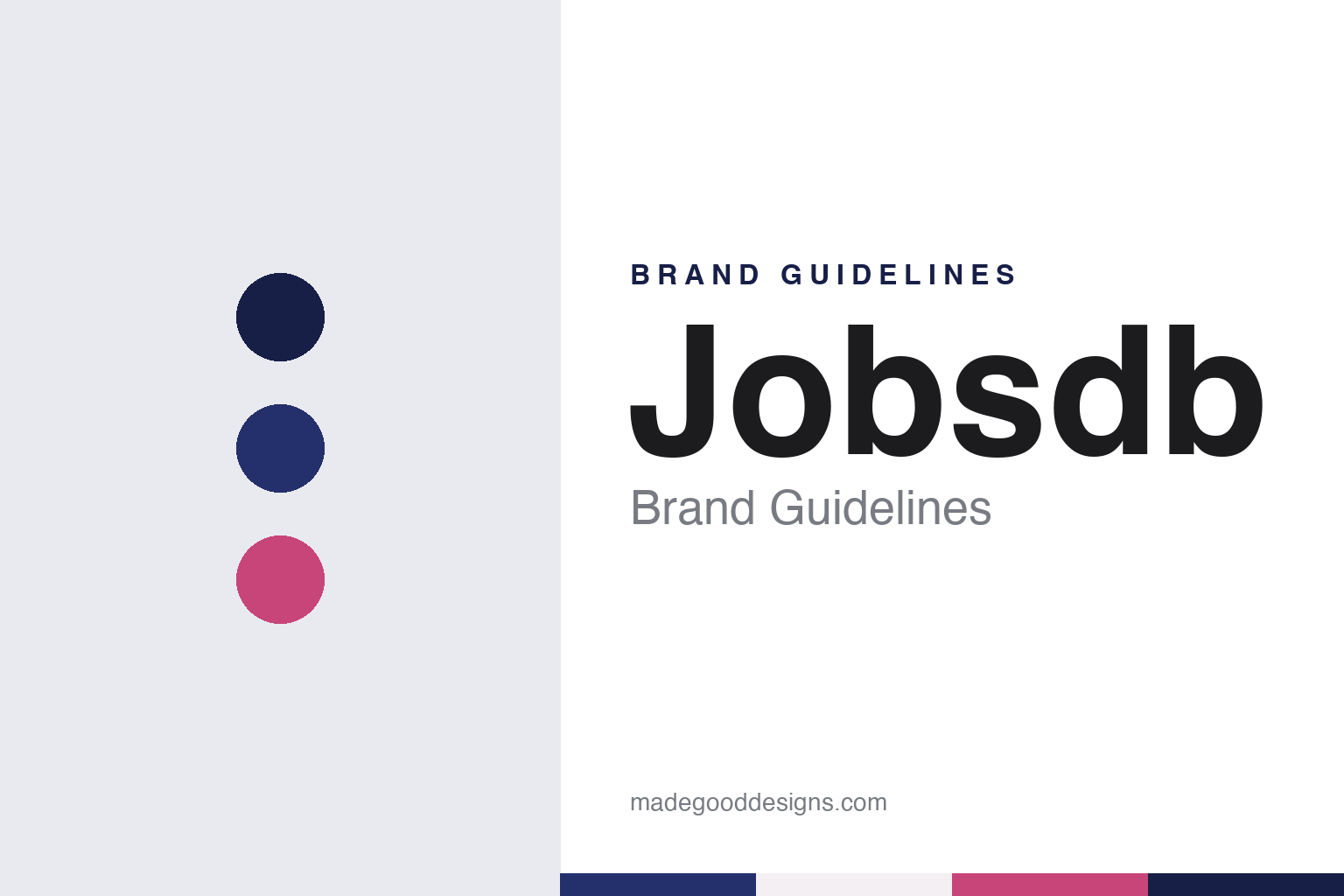
Two constants: a Jobsdb indigo, mist and pink palette and a geometric sans register. Abstract homage — not a Jobsdb product or mark; no logo, app screen or wordmark is reproduced.
JobsDB
A Hong Kong job site with a database in its name.
Jobsdb is a Hong Kong online job board, and its name says what it was built to be: a database of jobs. The company’s own regional site carries a copyright line running from 1998 to the present. For most of its life the name was written JobsDB, with a capital D and B, the form trade press such as Marketing-Interactive still used in 2020 and 2023; under its current owner the name is written Jobsdb, with only the J capitalised, and often paired with the owner’s name as “Jobsdb by SEEK.”
One documented step outside Hong Kong came in Singapore: on 1 August 2008, English Wikipedia says, Jobsdb bought Streetdirectory.com, the Singapore map and directory site, together with the remaining assets of its developer Virtual Map. A new company, Streetdirectory, was set up to run the Singapore, Indonesia and Malaysia sites.
The service itself follows the familiar pattern of a job board: candidates search vacancies, keep a profile and apply, while employers post jobs and look for candidates. Today the Hong Kong site also offers company profiles with reviews, career advice and a graduate section, alongside an employer site, in English and Chinese.
Its home market shows in its campaigns, which trade press has described in terms of Hong Kong working life, from office staff to delivery riders.
Colour
SEEK, Jobstreet and SEEK Asia.
Jobsdb’s owner is SEEK, the Australian jobs company. English Wikipedia says SEEK was founded in Melbourne in November 1997 by Andrew Bassat, Paul Bassat and Matt Rockman, launched its website in March 1998 and was floated on the Australian Securities Exchange in April 2005. Between 2000 and 2010, the same article says, SEEK expanded abroad with a focus on Asian and Latin American markets.
Jobsdb came into that group in stages. A history timeline published by SEEK says it began investing in Jobsdb in 2010, two years after it began investing in Jobstreet, the job board founded in Malaysia; in 2014 Jobstreet and Jobsdb were joined to form SEEK Asia, and in 2018 SEEK acquired 100 per cent of SEEK Asia, the same timeline says. Writing in January 2024, the Philippine broadcaster’s news site GMA News described SEEK as having acquired Jobstreet and JobsDB ten years earlier.
The biggest change for users came in 2024. On 31 January 2024 GMA News reported that SEEK had announced the completion of a single, AI-driven platform for Jobstreet, JobsDB and SEEK after three years of development, and that the three marketplaces would keep their individual brands. English Wikipedia’s Jobstreet article describes the same 2024 merger of SEEK’s Asia-Pacific employment marketplaces into one platform. The report said a key feature was AI job matching, and that SEEK was adding a search box that accepts plain sentences rather than keywords.
For users, the visible result is a shared frame. In November 2026 the Hong Kong site’s menu lists all eight of SEEK’s markets — Australia, Hong Kong, Indonesia, Malaysia, New Zealand, the Philippines, Singapore and Thailand — and lets visitors move between them. GMA News quoted a Jobstreet by SEEK manager saying the unified platform could match people by skills, job roles and career aspirations.
Typography
Design and documentation.
For a designer, a job board is mostly a search box and a list: a field for the job, a field for the place and a button, followed by a column of job cards giving the title, the employer, the location and the date. Where that pattern is shared, the brand has to work in the small places: the wordmark at the top of the page, the colour of the button, the app icon on a phone and the tone of the alerts that arrive by email.
The names do a lot of the work. Many are plain words or short compounds that say what the site is for, and some companies build their advertising directly on the name: SEEK, for example, has long used the line “SEEK and you shall find,” according to the trade title Campaign Brief. Others keep separate names market by market: SEEK’s group runs Jobstreet and Jobsdb sites in Asia alongside SEEK itself, according to its own website.
The second audience is the employer. Job sites sell advertising, résumé search and matching tools to hirers, and their corporate pages speak to recruiters as much as to candidates, with products for job posting, candidate search and employer branding presented next to the public job search.
Ownership is part of the story too. Many of these brands belong to larger groups, and their corporate pages list the countries and sites they run: SEEK’s about page names marketplaces in eight countries, and after the 2025 sale of CareerBuilder + Monster, the new owner BOLD listed CareerBuilder and Monster among its brands, HR Dive reported. This guide sets out who founded each brand, who owns it now and what has changed hands, and treats colours and type as an unofficial interpretation rather than an official specification.
Aa
A clean geometric sans for a bilingual job site. (Specimen set in Plus Jakarta Sans, a sans STAND-IN; NOT the Jobsdb logo.)
Jobsdb
Jobsdb by SEEK.
Jobsdb’s footprint has narrowed as SEEK has sorted its brands by country. In November 2026 the jobsdb.com address opens a country selector for Hong Kong, Singapore and Thailand, but the Singapore address forwards to SEEK’s Jora site and the old Indonesian address forwards to Jobstreet Indonesia. SEEK’s own description says it runs job sites including Jobstreet and Jobsdb in Asia, across markets that include Hong Kong and Thailand; it also says it holds ISO 27001 and ISO 42001 certification for information security and AI governance.
The brand’s marketing has followed the same arc from independent site to group member. In June 2020 Marketing-Interactive reported a JobsDB campaign that introduced a refreshed brand image and an upgraded AI job-search tool, using workers from different trades — an office worker, a delivery rider, a reporter, a social worker and a UI/UX designer — to argue that every job can carry meaning. The campaign ran as a thematic video and a series of key visuals, and Jobsdb’s Hong Kong head of marketing said the aim was to help job seekers find work that mattered to them rather than simply another job, the magazine reported. In July 2023 the same magazine covered a “JobsDB by SEEK” campaign, “Work in Hong Kong,” in which four business leaders illustrated SEEK’s four core values, with a later phase adding a referral rewards programme. Alongside YouTube, the campaign worked with the Hong Kong media outlet HK01 on interview videos, Marketing-Interactive said.
Much of Jobsdb’s public voice now comes through reports and events. The company’s newsroom lists a Salary Pulse report for Hong Kong in June 2026, a third HR Conference in August 2026 and a 2027 Hiring, Compensation and Benefits Survey released in October 2026, each under the “Jobsdb by SEEK” name.
For a design guide, Jobsdb shows how a local brand can keep its name and tone while its owner rebuilds everything underneath. Compare SEEK, its owner, and Naukri.com, another Asian job board. For this guide we use a harbour indigo, a night ink, mist and a lychee pink with a geometric sans, an unofficial interpretation; no product or logo is reproduced.
Explore & save
Keep Jobsdb’s identity on hand — save it to a board in the Made Good inspiration library.
Jobsdb identity set
Pin the Jobsdb indigo, mist and pink palette and the geometric sans register to your own board.