Karmakamet Brand Guidelines
A 1971 incense family trade, a 2001 shop and a scent library.
Aa
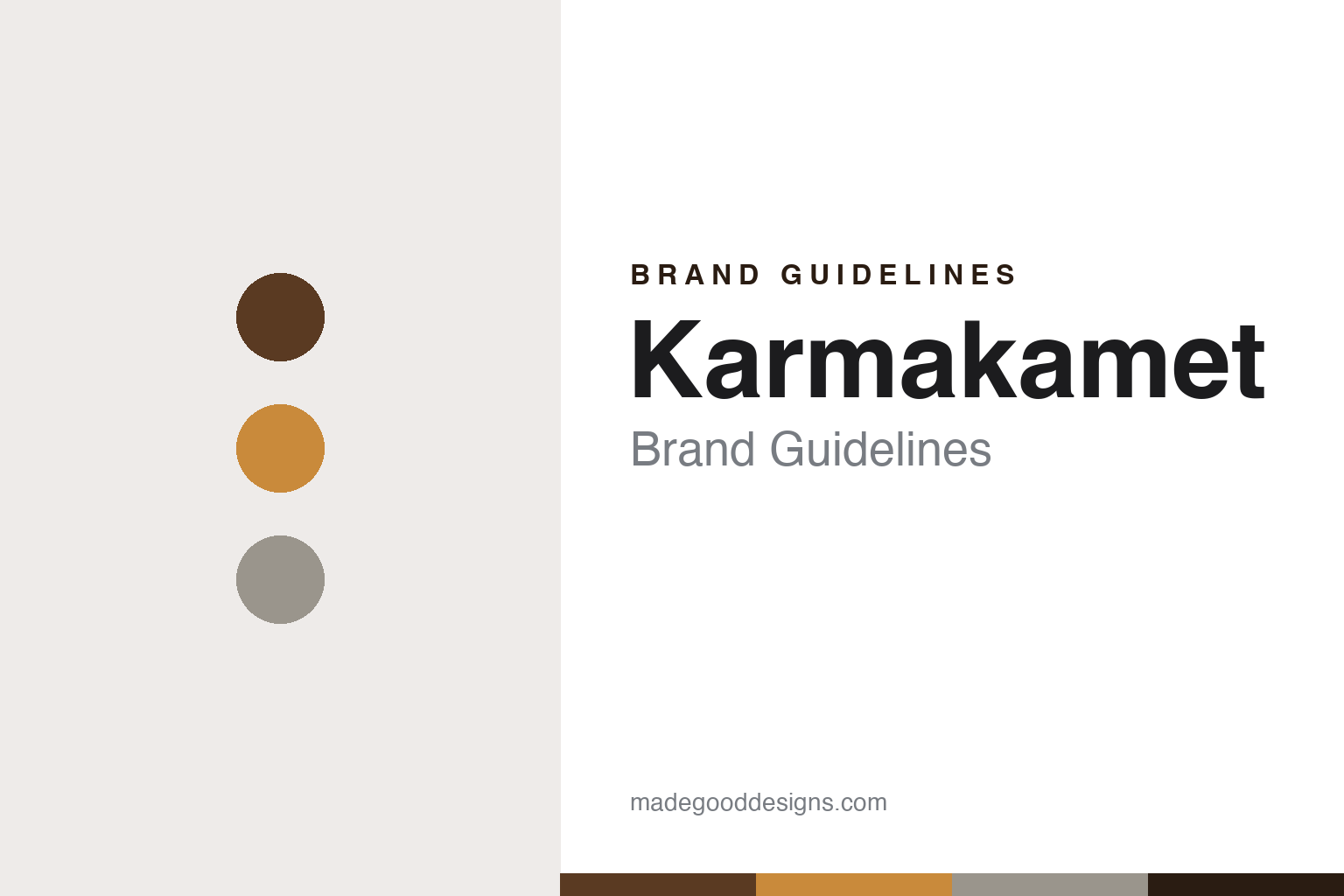
Two constants: an apothecary brown, amber and ash palette and an apothecary serif register. Abstract homage — not a Karmakamet product or mark; no bottle, label or logo is reproduced.
Medicine and incense
A family trade that took a new name in 1971.
Karmakamet is a Bangkok maker and retailer of scented products: essential and fragrance oils, incense, candles, dry and liquid perfumes for the home, and body products. Its own history begins well before the shops. The company says its origins lie in a Chinese migration in 1930 to the south of the Golden Peninsula, when the first generation of the family brought with them knowledge of Chinese medicine and traditional incense making. Tatler Asia, in an August 2025 overview of Thai wellness brands, traced the line to a grandfather’s trade in raw botanicals and incense sticks in Hainan, later carried to Kelantan and then to Bangkok.
The family sold Chinese medicine and incense for a living and, the company says, became Karmakamet in 1971, the year that now names its 1971 To Deng Karma & Son collection. Tatler Asia gives the same date, describing the brand as reviving that heritage in 1971. The retail business came three decades later: Karmakamet says its first store opened in 2001, and that the chain has expanded since.
The person most associated with the modern brand is Natthorn Rakchana. The Nation, in April 2013, described Karmakamet as his brand, one that had introduced its readers to Asian scents, and said it focused on premium scented products with elegant packaging. The company that runs the Karmakamet website today is named in its footer as Helmet Celt Company Limited of Bangkok.
Colour
Scent, stationery and a shophouse.
Karmakamet’s first move beyond fragrance came in 2013. The company says Karmakamet Diner and Everyday Karmakamet were launched that year. The Nation visited the second in April 2013, about a month after it opened: a zakka-style shop down a small alley off Silom, in a warehouse-like space with steel beams and air ducts, selling coffee and toast alongside simple everyday goods such as mugs and glasses, books and pens, cushions and shawls, and bathroom items. Natthorn Rakchana told the paper that the goods were sorted into plainly named groups such as “Eat,” “Work” and “ETC,” and that the shop also carried work by small Thai design labels. The paper placed it on the ground floor of the Yada Building on Silom Road, near Sala Daeng BTS station; the company’s store locator still lists a Karmakamet shop in that building.
The idea grew into a flagship. In September 2019 Time Out Bangkok reported that Karmakamet had opened a four-storey flagship called Everyday I Love My Life in Siam Square, fitted out with raw materials, glass windows, stainless-steel furniture and a wall bearing the line “You are my everyday.” BK Magazine placed it on Siam Square Soi 3, beside Lido Connect, and called the shophouse the brand’s biggest store: aromatic and beauty products on the ground floor, stationery and lifestyle goods above, men’s and women’s basics in black, white and deep blue on the third floor, and a café at the top. It also noted a green-apple “Sharing is Giving” icon on items sold only at that branch.
The scented range is organised into named collections. The company’s website groups its heritage lines under names such as Little India, Padang Bazaar and En Voyage, alongside 1971 To Deng Karma & Son, which it describes as seven portable products in more than 24 scents, sold at its Erawan Bangkok and CentralWorld shops and online. Its product menu is arranged by use rather than by collection: aromatic oils, home scent products and body scent products.
Typography
Design and documentation.
Southeast Asia’s fashion, bag, accessory and lifestyle brands mostly speak through their own channels: a wordmark over a shopfront, a seasonal campaign, a named collection and an online shop. Many began as small businesses (a leather wholesaler, a garment maker, a family shop) and only later built a retail identity, so the brand story is often told through a founding date, a first boutique and a list of markets reached.
Collections and collaborations do much of the visual work. Labels name their lines by occasion, material or season, and add licensed characters, local actors and regional pop stars as ambassadors or muses. These partnerships change from season to season, while the name, the lettering and the shop interior usually stay fixed.
Ownership is often layered. Several labels sit inside larger groups: in Malaysia, Padini Holdings runs Vincci alongside its own clothing labels and sells them together in its concept stores, and Bonia Corporation holds a family of leather goods brands. In the Philippines and Thailand, groups such as Golden ABC and Jaspal Group own more than one label each, and each guide in this series describes its group from that brand’s own sources. Some companies are listed on their home stock exchange and publish corporate pages on founders, directors, subsidiaries and shareholdings; others remain private.
This guide sets out what can be checked about each brand: who founded it and when, who owns it now, where it sells and how it presents its name, with dated reporting from newspapers and trade press, and with the companies’ own claims marked as theirs. The palettes and type samples are our own interpretations, not official brand assets.
Aa
A refined serif for a brand rooted in an old family trade. (Specimen set in Cormorant Garamond, a serif STAND-IN; NOT the Karmakamet logo.)
Karmakamet
A Bangkok chain with a scent library.
Karmakamet’s shops remain concentrated in and around Bangkok. As of November 2026, the company’s store locator listed 14 Karmakamet locations, including a pop-up at Central Westgate in Nonthaburi, a shop at Future Park & Zpell in Pathum Thani and a weekend shop in Section 2 of the Chatuchak Weekend Market, plus two Everyday & Friends stores. Several sit at transport stops: the Siam Square shop by Siam BTS station, the Silom shop at the Sala Daeng exit and a unit in the Metro Mall at Sukhumvit MRT station. Others are in malls such as CentralWorld, Fashion Island and The Mall Lifestore Bangkapi, and one is at a riverside hotel on Charoen Krung Road.
Its newest showcase is a scent library. In August 2026 Time Out Bangkok reported on SCENTORIUM, a free exhibition at Karmakamet’s branch in the Erawan Bangkok mall: a wall of 540 smells gathered from around the world, many of them far from perfume, and a short personality quiz that produces a scent profile and sends visitors looking for their match among the 540. Entry has to be booked in advance through the company’s website, the magazine said.
Memory is the thread the company itself draws through this work. On its About page it says the sense of smell is closely linked with memory, and it names its heritage collections after places and after the family’s 1971 trade.
For a design guide, Karmakamet shows how a family history of medicine, incense and a 1971 date can become the organising idea for a modern retail brand, from collection names to shop interiors and a scent library. Compare NaRaYa, another Bangkok brand that grew from a small shop, and Jaspal, a Bangkok fashion group. For this guide we use an apothecary brown, an amber and an ash grey with a serif, an unofficial interpretation; no product or logo is reproduced.
Explore & save
Keep Karmakamet’s identity on hand — save it to a board in the Made Good inspiration library.
Karmakamet identity set
Pin the Karmakamet apothecary brown, amber and ash palette and the apothecary serif register to your own board.
Source & notes
Frequently Asked Questions
What font can I use to match the Karmakamet look?
This guide describes Karmakamet’s type as “A refined serif for a brand rooted in an old family trade”. Its type specimen is set in Cormorant Garamond from Google Fonts as a stand-in; Cormorant Garamond is not Karmakamet’s own lettering.
What colours are in the Karmakamet palette?
This guide’s Karmakamet palette is Apothecary brown #5A3A22, Amber resin #C98A3B, Incense ash #9A958C, Smoked wood #2A1C12 and Rice paper #F6F1E7. The tones are the guide’s own unofficial interpretation, not official Karmakamet hex codes.