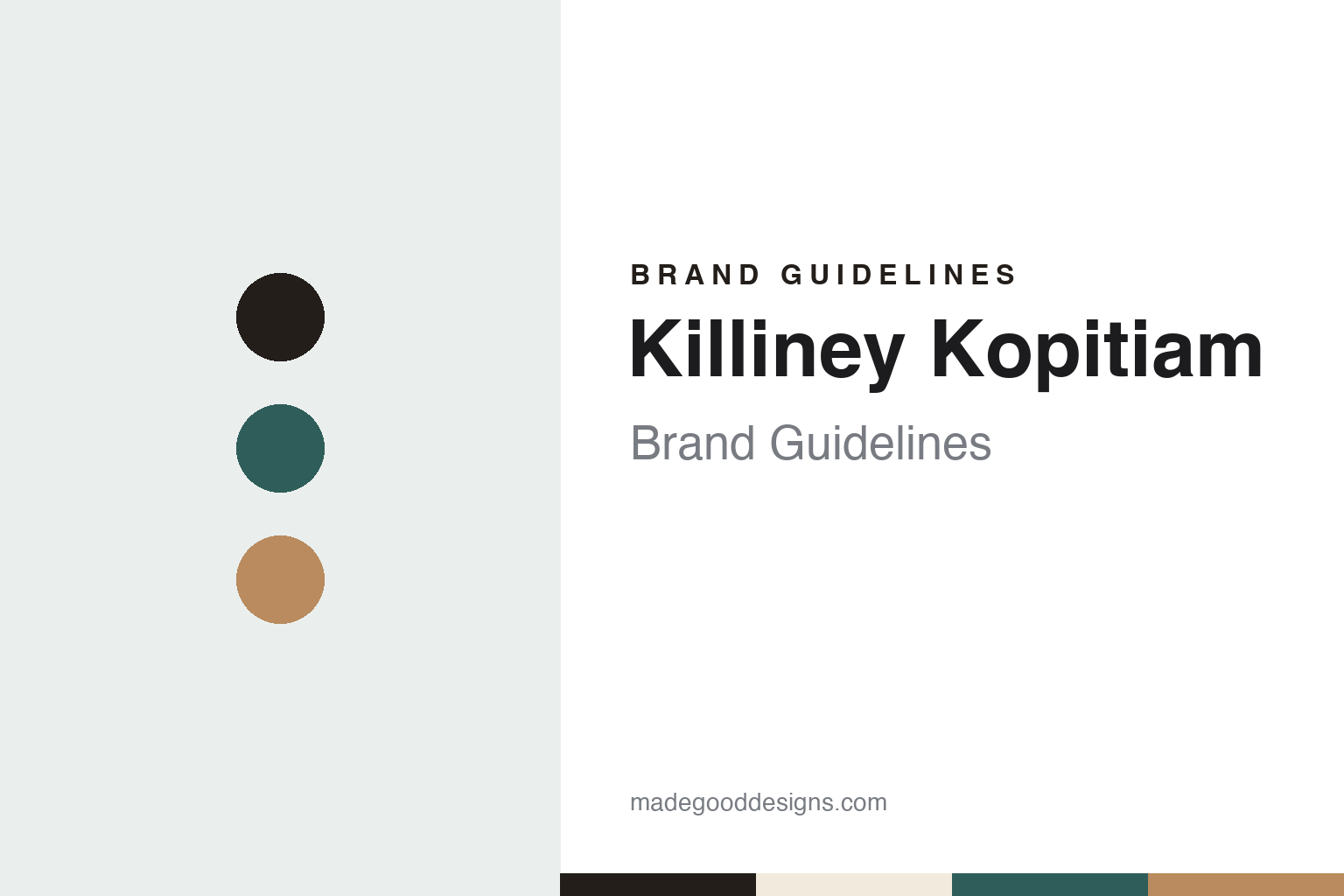
Killiney Kopitiam Brand Guidelines
A 1919 Hainanese coffee shop that lent its road’s name to a chain.
Aa
Two constants: a kopi black, shophouse teal and teh tarik palette and a shopfront sans register. Abstract homage — not a Killiney product or mark; no signboard, logo or packaging is reproduced.
Kheng Hoe Heng
A Hainanese coffee shop on Killiney Road.
Killiney Kopitiam is older than its name. The shop on Killiney Road began in late 1919 as Kheng Hoe Heng Coffeeshop, set up by a Hainanese immigrant, according to Roots.sg, the heritage website of Singapore’s National Heritage Board, in an entry that gives its facts as of October 2019; English Wikipedia says it was founded by Hainanese immigrants. It sold traditional charcoal-grilled white bread toast with coffee and tea, the staples of a Hainanese kopitiam, and the National Heritage Board describes it as Singapore’s oldest operating Hainanese coffee shop. The company’s own history also dates the shop front to late 1919.
The sources used for this guide do not say how Kheng Hoe Heng operated during the Japanese occupation of 1942–1945.
The change came when a regular customer bought the shop. Woon Tek Seng, a former broker of Hainanese descent, took it over and renamed it after the road it stands on. The year differs by source: the National Heritage Board, English Wikipedia and Tatler Asia, in 2023, give 1992, while the company’s own history gives 1993. The company says he renovated the shop but kept its traditional way of working, and that three workers who stayed on passed down their skills in making kaya, bread toast, coffee and tea; Roots.sg says the key Hainanese staff passed those skills on to later batches of employees.
The shop sits in a row of two-storey shophouses with tall ceilings and tall windows, Roots.sg notes, on a stretch of Killiney Road that it presents as an example of Hainanese influence on the area, alongside the restaurant group Jack’s Place, which began on the same row in 1966.
Colour
A franchise built on toast, eggs and kopi.
From one shop the name became a franchise. The company’s franchise page offers investors the right to run a Killiney outlet using its trade name, trademarks, business methods, training systems and food preparation procedure, with support on customer service, food and drink preparation, equipment and marketing; it describes the core offer as breakfast sets of soft-boiled eggs, kaya toast and hot drinks, from a history “dating back to 1919.” Roots.sg says the brand has gone overseas since 2001, with outlets in countries such as Malaysia and Indonesia. In November 2023 Tatler Asia put the network at over 40 outlets in Singapore and overseas.
The overseas list on the company’s website, read in November 2026, leans towards airports. It shows Killiney counters at Juanda in Surabaya, at Sultan Hasanuddin in Makassar and in three terminals at Soekarno–Hatta in Jakarta, alongside a shop at Mitsui Shopping Park LaLaport in Kuala Lumpur, one at SM Mall of Asia in Pasay, Metro Manila, and a food-court stall at the Broadway Shopping Centre in Sydney.
The menu has grown well beyond toast. The website lists kaya butter toast, French toast and soft-boiled eggs next to hawker dishes such as laksa, mee siam, mee rebus and curry chicken, and a run of coffee and tea written in kopitiam shorthand, such as coffee O and tea C, as well as an iced Milo Dinosaur. Its online shop sells breakfast collections and Singapore gift sets for home.
The menu also includes a Hainanese pork cutlet with fries and a chicken chop alongside chee cheong fun and fried carrot cake. Tatler Asia described the set the shop is known for as kaya toast, soft-boiled eggs and a cup of Nanyang-style coffee, and the company uses the same Nanyang-style label for its own coffee, including packaged sachets sold online. The name itself is specific to the shop. English Wikipedia notes that Killiney Kopitiam is not to be confused with Kopitiam, the Singapore food-court company.
Typography
How the region’s food chains present themselves.
Malaysian and Singaporean food chains tend to tell their story through the shop itself. Kopitiam chains present a coffee-shop past inside modern premises: Ya Kun Kaya Toast puts the same posters about its old stall in every outlet, according to a case study by the World Intellectual Property Organization, while Killiney Kopitiam still trades from the shophouse where its predecessor opened in 1919. Bakery, cake and bubble-tea chains often lean instead on bright counters, packaged goods and the look of the cup, box or bag a customer carries away.
Menus are written dish by dish and drink by drink. Kaya toast, soft-boiled eggs, laksa and nasi lemak appear under their everyday names, and coffee and tea orders often keep the local shorthand of the kopitiam, such as kopi O or teh C, which some chains explain on their own websites for newcomers.
Store networks are something the companies publish themselves. Websites list outlets at home and abroad, often in malls, food courts and airport terminals, and franchise pages set out what a partner receives: the trade name, trademarks, training and support. Counts change quickly, so this guide gives each one with the date and source it comes from.
Ownership is described plainly. Some chains remain family businesses passed to a second generation; others belong to listed groups or larger food companies, or have changed hands as their franchise networks grew. Corporate pages on founders, owners and franchise partners are where each company sets out its own account, and this guide marks clearly which facts rest only on that account.
Aa
A sturdy sans in the spirit of a painted shopfront. (Specimen set in Archivo, a sans STAND-IN; NOT the Killiney Kopitiam logo.)
Killiney Kopitiam
A second generation, new products and an airport shop.
A second generation now leads the business. Tatler Asia reported in November 2023 that Woon Tien Yuan, a second-generation business owner, became director of Killiney Kopitiam in 2019, after a joint venture between Killiney and the food-technology company Hoow Foods to develop instant beverages. The magazine listed three projects started in 2023: KillineyGO, Official Killiney Mart and The Killiney Experience, a retail shop at Changi Airport Terminal 1, opened in October 2023, that sells instant and ready-to-drink beverages and is aimed at travellers who want to take the Killiney story home. Woon told the magazine that any food and drink brand in Singapore has to understand local consumers and keep up with current trends to stay relevant, and that the family’s elders had backed the new lines of products launched in recent years.
That shift from café to packaged goods is the newest layer on an old shop. The Killiney name still rests on a single address in a row of shophouses, a Hainanese way of making kaya, toast and coffee that the company says was handed down by the staff who stayed on, and a franchise model that carries the same breakfast set to malls, food courts and airport gates in other countries.
For a design guide, Killiney Kopitiam shows how a place name, a founding year and a plain breakfast set can carry a franchise without a founder’s story at its centre. Compare Ya Kun Kaya Toast, another Singapore kaya-toast chain with Hainanese roots, and OLDTOWN White Coffee, the Malaysian white-coffee maker from Ipoh. For this guide we use kopi black, a shophouse teal and a teh-tarik brown with a sans, an unofficial interpretation; no product or logo is reproduced.
Explore & save
Keep Killiney Kopitiam’s identity on hand — save it to a board in the Made Good inspiration library.
Killiney Kopitiam identity set
Pin the Killiney kopi black, shophouse teal and teh tarik palette and the shopfront sans register to your own board.
Source & notes
Frequently Asked Questions
What font can I use to match the Killiney Kopitiam look?
This guide describes Killiney Kopitiam’s type as “A sturdy sans in the spirit of a painted shopfront”. Its type specimen is set in Archivo from Google Fonts as a stand-in; Archivo is not Killiney Kopitiam’s own lettering.
What colours are in the Killiney Kopitiam palette?
This guide’s Killiney Kopitiam palette is Kopi O black #231E1A, Shophouse teal #2F5E5A, Teh tarik #B98B5E, Pandan #6F8F4E and Tile cream #F2EBDD. The tones are the guide’s own unofficial interpretation, not official Killiney Kopitiam hex codes.
When was Killiney Kopitiam founded?
Killiney Kopitiam was founded in late 1919 (as Kheng Hoe Heng), in Killiney Road, Singapore.
Who owns Killiney Kopitiam?
Killiney Kopitiam is owned by The Woon family. Its signature, per this guide: Kaya toast, soft-boiled eggs, kopi.


