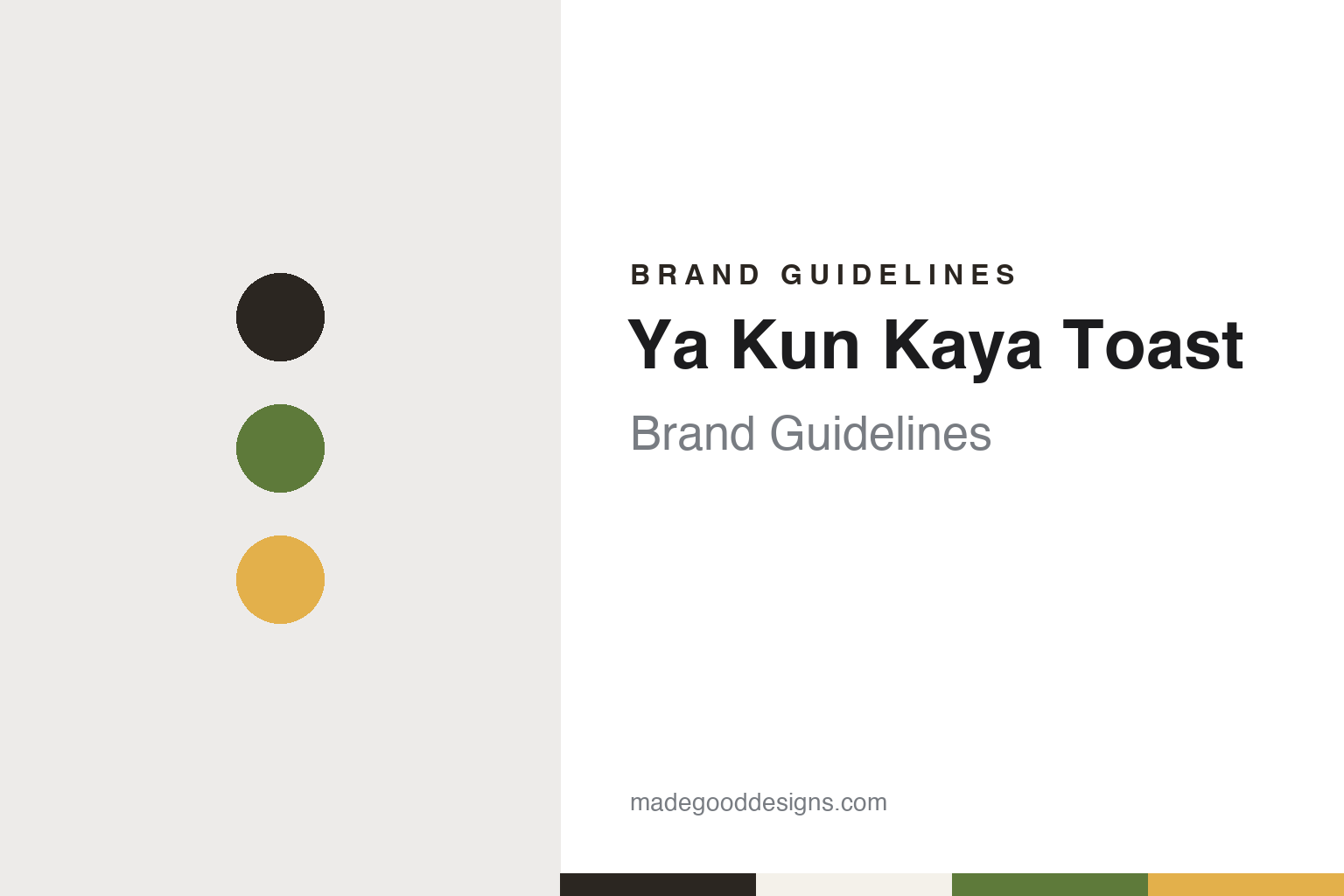
Ya Kun Kaya Toast Brand Guidelines
A Telok Ayer coffee stall that became a franchise chain.
Aa
Two constants: a charcoal, kaya green and egg-yolk palette and a heritage serif register. Abstract homage — not a Ya Kun product or mark; no signboard, logo or poster is reproduced.
Ya Kun Coffeestall
A Hainanese coffee stall on the Telok Ayer waterfront.
Ya Kun Kaya Toast takes its name from Loi Ah Koon, a Hainanese migrant who, the company says, arrived in Singapore in 1926 at the age of 15 and found work as an assistant in a Hainanese coffee stall. With two fellow migrants he later opened a stall of his own at Telok Ayer Basin, in the old business district, selling coffee, tea, eggs and toast; the partners later left, and he carried on alone. A 2010 case study by the World Intellectual Property Organization (WIPO) tells the same story and notes that “Ya Kun” is a romanisation of his name.
English Wikipedia, citing The Business Times and The Straits Times, says the stall was registered in 1944 as Ya Kun Coffeestall, and the year appears in a trademarked line, “Ya Kun Kaya Toast Coffee Stall Since 1944,” which WIPO lists among the company’s filings in Singapore. The sources used for this guide do not say how Ya Kun operated during the Japanese occupation of 1942–1945.
Kaya came into the business through Loi’s wife. The company says she joined him in Singapore in 1936 and made homemade kaya, a spread of egg and coconut, to go with the toast, while he roasted his own coffee beans over firewood at the back of the stall with margarine and sugar. English Wikipedia adds that she suggested cutting each slice of bread in half and pairing it with her kaya, the combination that became the stall’s signature.
The stall moved several times. The company says it spent more than 15 years at Telok Ayer Basin before crossing the street to Lau Pa Sat — English Wikipedia dates that move to 1972 — and moved back across the road to the Telok Ayer Transit Food Market in 1984, while Lau Pa Sat was renovated. In 1998 it settled at Far East Square and took the name Ya Kun Kaya Toast, run by Loi’s children.
Colour
A son, a franchise system and “the ambience of bygone days.”
The chain began with the next generation. WIPO’s case study says Loi’s youngest son, Adrin Loi, took over in 1999 and treated the Ya Kun name, its goodwill and its recipes as assets to build on. He brought in franchise consultants in 2000; the stall business became Ya Kun (S) Pte. Ltd., and in 2001 he set up Ya Kun International to run a franchise system. The opening franchise outlet, a Ya Kun Café at Robinson Point in the central business district, followed in September 2001, WIPO says. English Wikipedia mentions a second family store at Tanjong Pagar in the same period and lists Adrin Loi as executive chairman.
The look of those cafés was deliberate. According to WIPO, management wanted every outlet to offer “the ambience of bygone days” inside a modern, air-conditioned shop, and all outlets carry the same posters about the stall’s history, which the company protects through trademark filings and copyright. English Wikipedia describes the stores as having wooden tables and stools, Chinese calligraphy of the company name and history posters on the walls; the logo itself is the name written in traditional Chinese characters, it says.
Growth abroad came through master franchises. WIPO records an agreement with investors in Indonesia in 2003 — English Wikipedia dates the opening Indonesian outlet to 2002 — agreements for Taiwan and South Korea in 2005 and the opening Japanese outlet in 2007. By 2010, WIPO says, Ya Kun International had 40 locations in Singapore and 30 abroad, in Brunei, Indonesia, Japan, the Philippines, South Korea and Taiwan. It also notes that the company stopped granting new franchises in Singapore in 2004. Today the company’s website says it runs “a mixture of corporate and franchise stores.”
Typography
How the region’s food chains present themselves.
Malaysian and Singaporean food chains tend to tell their story through the shop itself. Kopitiam chains present a coffee-shop past inside modern premises: Ya Kun Kaya Toast puts the same posters about its old stall in every outlet, according to a case study by the World Intellectual Property Organization, while Killiney Kopitiam still trades from the shophouse where its predecessor opened in 1919. Bakery, cake and bubble-tea chains often lean instead on bright counters, packaged goods and the look of the cup, box or bag a customer carries away.
Menus are written dish by dish and drink by drink. Kaya toast, soft-boiled eggs, laksa and nasi lemak appear under their everyday names, and coffee and tea orders often keep the local shorthand of the kopitiam, such as kopi O or teh C, which some chains explain on their own websites for newcomers.
Store networks are something the companies publish themselves. Websites list outlets at home and abroad, often in malls, food courts and airport terminals, and franchise pages set out what a partner receives: the trade name, trademarks, training and support. Counts change quickly, so this guide gives each one with the date and source it comes from.
Ownership is described plainly. Some chains remain family businesses passed to a second generation; others belong to listed groups or larger food companies, or have changed hands as their franchise networks grew. Corporate pages on founders, owners and franchise partners are where each company sets out its own account, and this guide marks clearly which facts rest only on that account.
Aa
A heritage serif for a stall with a founding year on its sign. (Specimen set in DM Serif Display, a serif STAND-IN; NOT the Ya Kun Kaya Toast logo, which is calligraphy.)
Ya Kun Kaya Toast
Toast, kopi and a map that keeps changing.
The menu stays close to the stall. The company’s website groups it into value set meals, toast, the Toastwich — a name WIPO lists among the company’s trademarks — all-day sides and hot and cold drinks, with a guide to ordering kopi in local terms and a separate “Ya Kun Family Café” range of Asian dishes. English Wikipedia says the chain added ice-cream toast and the Toastwich after 2001, and that the kaya and coffee powder are made at a Ya Kun factory in Bedok; WIPO describes the kaya recipe as a family trade secret, made in a family-owned facility.
The international map has kept changing. In June 2020 Mothership reported a new Ya Kun outlet in Shinjuku, Tokyo, opening with drinks first and food from July, and noted that an earlier Japanese outlet, from about a decade before, had closed; the Japanese website explained kaya toast to local readers as a Singapore “soul food” made from sugar, egg, coconut milk and pandan leaf. In December 2023 the same publication reported an outlet at One Ayala in Makati, Manila, opened on 10 December with an interior similar to those in Singapore, and said that as of April 2021 there were over 70 Ya Kun outlets in Singapore and 70 overseas. English Wikipedia also records a 2025 apparel line with Uniqlo featuring Ya Kun’s food, timed to Singapore’s SG60 celebrations.
For a design guide, Ya Kun Kaya Toast shows how a coffee stall’s own past — a founder’s name, a founding year, a calligraphic signboard and a wall of old photographs — can become the identity of a franchise chain. Compare Killiney Kopitiam, another Hainanese kopitiam name from Singapore, and Toast Box, a newer Singapore chain of toast and kopi. For this guide we use charcoal brown, a kaya green and a warm egg-yolk yellow with a serif, an unofficial interpretation; no product or logo is reproduced.
Explore & save
Keep Ya Kun Kaya Toast’s identity on hand — save it to a board in the Made Good inspiration library.
Ya Kun Kaya Toast identity set
Pin the Ya Kun charcoal, kaya green and egg-yolk palette and the heritage serif register to your own board.
Source & notes
Frequently Asked Questions
What font can I use to match the Ya Kun Kaya Toast look?
This guide describes Ya Kun Kaya Toast’s type as “A heritage serif for a stall with a founding year on its sign”. Its type specimen is set in DM Serif Display from Google Fonts as a stand-in; DM Serif Display is not Ya Kun Kaya Toast’s own lettering.
What colours are in the Ya Kun Kaya Toast palette?
This guide’s Ya Kun Kaya Toast palette is Charcoal toast #2B2621, Kopi brown #4A3524, Kaya green #5E7A3A, Egg yolk #E3B04B and Marble white #F4F1EA. The tones are the guide’s own unofficial interpretation, not official Ya Kun Kaya Toast hex codes.
When was Ya Kun Kaya Toast founded?
Ya Kun Kaya Toast was founded in 1944 (registered as Ya Kun Coffeestall), in Telok Ayer Basin, Singapore.
Who founded Ya Kun Kaya Toast?
Ya Kun Kaya Toast was founded by Loi Ah Koon in 1944 (registered as Ya Kun Coffeestall).


