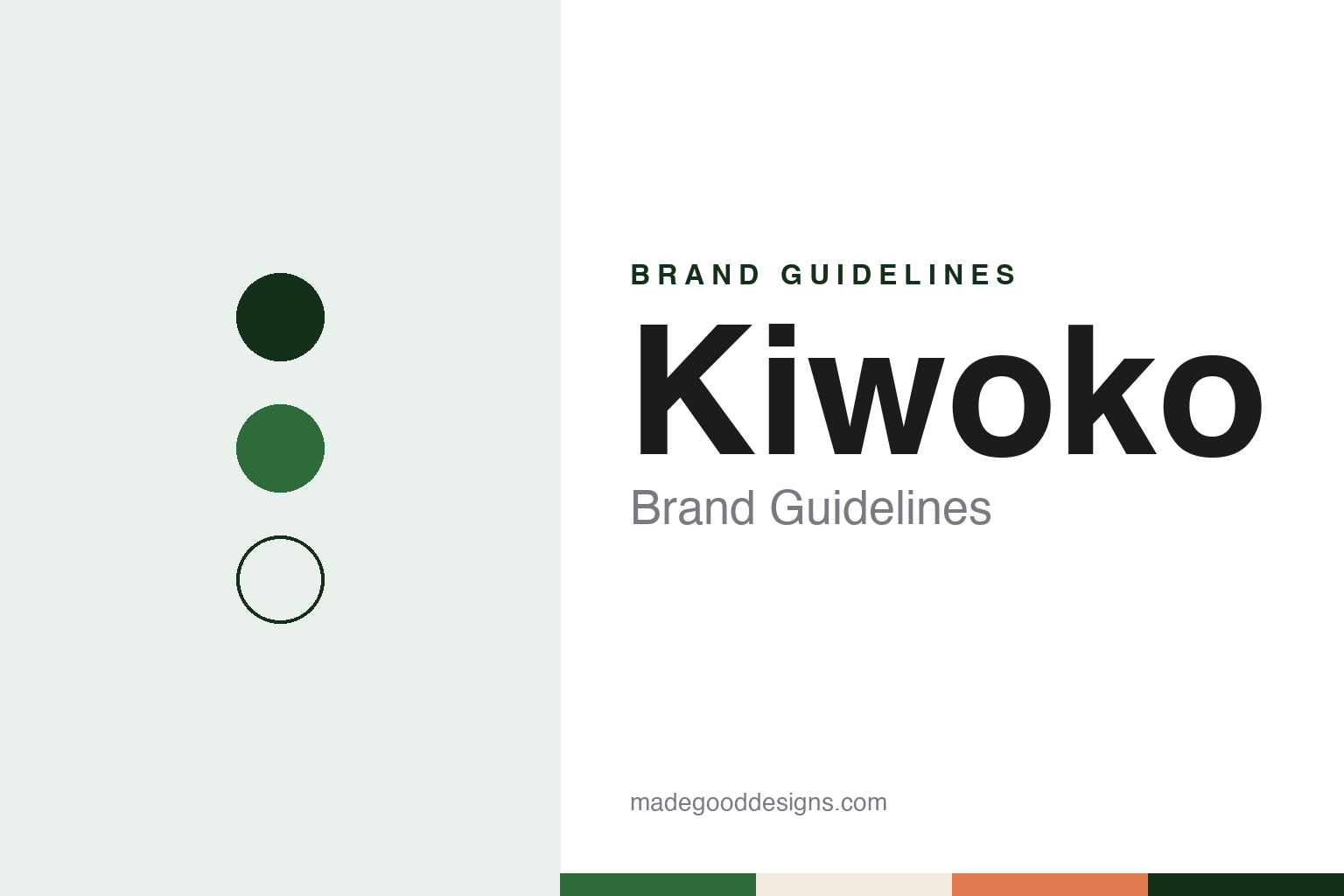
Kiwoko Brand Guidelines
Masquepet’s Madrid pet chain, from 2007 stores to the IskayPet group.
Aa
Two constants: a leaf green, sand and terracotta palette and a rounded sans register. Abstract homage — not a Kiwoko product or mark; no logo, sign or store design is reproduced.
Masquepet
A Madrid company and five stores.
Kiwoko is a Spanish chain of pet supply stores, run from Madrid. Its operating company was Masquepet, which began trading in November 2007, according to the Spanish trade publication Alimarket in 2012. The German-published trade magazine PET worldwide reported in 2011 that the first five outlets opened that month, and that the Kiwoko name appeared in December 2008, a year after the company was set up; the website followed in September 2009, and Alimarket dates the online shop to the same year.
The early management team, as PET worldwide listed it in 2011, was chief executive Álvaro Gutiérrez, finance director Javier Osa and operations director Emilio Goyanes, with the private equity fund Prince Capital Partners as investor. Alimarket later described Osa as the founder and chief executive of the group’s parent. At that point every store was owned by the company and run from Madrid, and Osa told the magazine the company was not keen on franchising because it wanted tight control over its shops.
Growth came partly through purchases. PET worldwide wrote in 2016 that the company started out in 2008 by acquiring existing shops and opened its own first store a year later. Alimarket named the smaller chains it took over as Multipez, Bierzoo and Maxizoo; PET worldwide reported that former Maxi Zoo stores, the foreign banner of Germany’s Fressnapf, joined Kiwoko in June 2010. By January 2011 there were 26 more outlets on top of the original five, the magazine said, and by March 2012 Alimarket counted 30 Kiwoko stores in five regions: Galicia, Asturias, Madrid, Castilla-La Mancha and the Valencian Community.
Colour
Six families, a colour for each.
The look of a Kiwoko store has been described in the trade press for more than a decade. In 2011 PET worldwide said the shops were meant to be youthful and colourful, with an emotional appeal aimed at children and families. The range was split into six product families, dogs, cats, fish, birds, small animals and reptiles, and a colour concept let shoppers tell each section apart at a glance. Smaller “proximity” stores were under 250 square metres and sat mainly in shopping centres.
By 2016 the formats had grown. PET worldwide counted 82 outlets that year, mostly in Catalonia, Madrid and the north-west of Spain. Forty of them had 600 to 1,200 square metres of selling space in retail parks, with veterinary clinics and grooming salons built in; another 35, between 350 and 500 square metres, were in shopping malls. That October Alimarket reported a 640-square-metre shop in the Carrefour Jerez Norte centre in Cádiz province, the fifth Kiwoko in a centre run by Carmila, the property company linked to Carrefour, after sites in Madrid, Santander, Zaragoza and A Coruña.
The company’s own website still uses the six-family structure. It says even the smallest Kiwoko stores carry more than five thousand items for dogs, cats, birds, rodents, reptiles and fish, and it describes the shops as places where children and adults can simply come and look. Its parent group calls the Kiwoko network “Kiwoko Mundo Animal,” with grooming salons under the name Mundo Belleza and veterinary clinics under Kivet.
In 2011 the company had no brand of its own, because it ran no warehouse and stores took deliveries direct from suppliers, PET worldwide reported; a private label was something it said it would look at later.
Typography
Pet retail and its brands.
Pet-store chains present themselves above all through the shopfront: a sign that has to read from a retail park, a high street or a shopping-centre corridor, and a logo repeated on loyalty cards, carrier bags, delivery apps and, increasingly, shop-in-shops inside other retailers. For chains that began online, the website and the app do the work of the sign. Tiendanimal, for example, started as an online shop in Málaga in 2006 and opened its first physical store there in 2012, according to Spanish trade press.
Ownership shapes these brands as much as design does. Many chains have passed from their founders to private-equity investors, family offices or larger retail groups, and some now sit beside former rivals under one parent. Arcaplanet, founded in Liguria in 1995, passed through several investors before the German Fressnapf group completed its takeover in December 2024, RetailDetail reported; in Spain, Tiendanimal and Kiwoko have shared an owner, the Peruvian Mulder family’s Emefin, since 2020, and trade under the IskayPet group name. Corporate pages on founders and owners are often the plainest record of these changes, and this guide states each owner with a date.
Store formats vary widely: large out-of-town units, small city shops, grooming salons, clinics run under separate names, and corners inside DIY or farm-supply stores. Networks change quickly, so every store or country count in these guides is given with its date and its source. Own-label ranges, mascots and loyalty schemes are named only as the companies name them.
The chains and online retailers in this group come from Europe, Asia, Latin America and Australia. Each guide sets out what can be checked — who founded the business, who owns it now and how its network is published — and marks plainly what rests only on the company’s own word. The colours and type in each guide are our unofficial interpretation, not the companies’ own.
Aa
A rounded, friendly sans for a family pet store. (Specimen set in Nunito, a sans STAND-IN; NOT the Kiwoko logo.)
Kiwoko
Investors, then a Peruvian family group.
Ownership changed several times. In March 2012 the private equity firm Corpfin Capital took a majority of Masquepet, buying part of Prince Capital Partners’ stake and investing directly, Alimarket reported; Prince stayed on with a significant holding. According to Alimarket in December 2019, TA Associates later bought a majority from Corpfin and Prince, and Meridia held a minority stake for about eight months in 2019. The parent by then was Kipenzi, a Madrid holding company that also controlled the veterinary networks Kivet and Vetsum.
In October 2019 the Peruvian investment company Emefin bought TA Associates’ stake, and in December Meridia sold its share too, Alimarket reported. Kiwoko thereby joined the business holdings of the Peruvian Mulder family, which also owned pet chains in Latin America, among them Superpet and Chile’s Tiendapet. At the time the Spanish network had more than 130 stores and 65 veterinary clinics, the publication said.
Emefin then bought a second Spanish chain. PET worldwide reported in February 2020 that it had completed the purchase of Tiendanimal, the Málaga-based retailer that began as an online shop, and that the two chains were to keep operating separately; at that point the deal still needed competition clearance. Portugal’s business news site ECO reported in March 2022 that the combined group, IskayPet, had been formed in 2020 from Kiwoko, Tiendanimal and the clinic networks Kivet and Clinicanimal, that it was based in Madrid and controlled by Emefin, and that it had just bought the Portuguese chain Ornimundo, with 32 stores. IskayPet says its name comes from the Quechua word “iskay,” which it translates as a union of two.
The two banners still trade side by side. In October 2025 Alimarket counted 262 IskayPet stores under the Kiwoko and Tiendanimal names, said the group had opened more than 70 since 2021, and reported that Alberto Álvarez Ayuso had replaced Marcos Ruao as chief executive that year. The same Peruvian owner also bought the French chain Animalis with effect from the start of 2021, PET worldwide reported.
For a design guide, Kiwoko shows how a chain built by acquisition can still give its stores one consistent system: six families, a colour for each, and a friendly tone aimed at children. Compare Tiendanimal, its sister chain under the same group, and Fressnapf, whose former Maxi Zoo shops in Spain became Kiwoko stores. For this guide we use leaf green, warm sand and terracotta with a rounded sans, an unofficial interpretation; no product or logo is reproduced.
Explore & save
Keep Kiwoko’s identity on hand — save it to a board in the Made Good inspiration library.
Kiwoko identity set
Pin the Kiwoko leaf green, sand and terracotta palette and the rounded sans register to your own board.
Source & notes
Frequently Asked Questions
What font can I use to match the Kiwoko look?
This guide describes Kiwoko’s type as “A rounded, friendly sans for a family pet store”. Its type specimen is set in Nunito from Google Fonts as a stand-in; Nunito is not Kiwoko’s own lettering.
What colours are in the Kiwoko palette?
This guide’s Kiwoko palette is Leaf green #2E6B3A, Forest ink #14301A, Warm sand #F2EBDD, Terracotta #E07A4F and Paper #FAF8F4. The tones are the guide’s own unofficial interpretation, not official Kiwoko hex codes.
When was Kiwoko founded?
Kiwoko was founded in November 2007 (as Masquepet), in Madrid, Spain.
Who owns Kiwoko?
Kiwoko is owned by IskayPet, controlled by Emefin (since 2019–2020).


