Kyser Brand Guidelines
The Texas capo maker that made one clamp in a hundred colours.
Aa
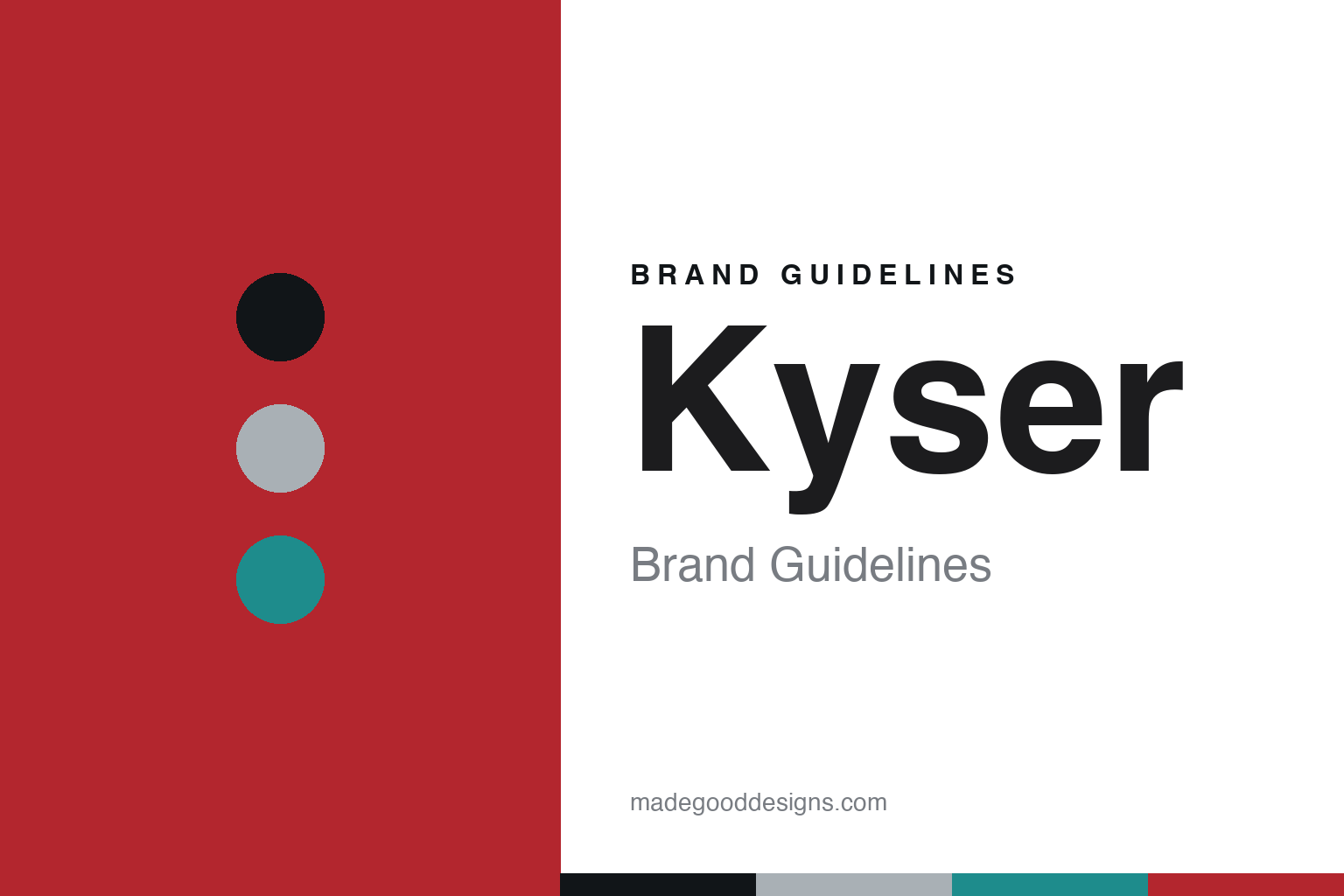
Two constants: a Kyser black, aluminium, teal and red palette and an Industrial sans register. Abstract homage — not a Kyser product or mark; no capo, stamp or logo is reproduced.
Kaufman, Texas
A retired machinist and a garage.
Kyser Musical Products was built by Milton Kyser, a Texas machinist. The company’s account of him reads like a regional legend in miniature: the son of cotton farmers who, it says, left school after second grade, served in the United States Air Force from 1949 to 1952, and spent decades as a machinist making ball bearings for oil and gas rigs, retiring from Halliburton around 1979.
The capo began as a side project. In 1975, the company says, Milton Kyser bought a patent from a friend and began developing what became the Kyser Quick-Change capo, then created a design of his own and received a patent for it. He made the first capos by hand in his garage, and by 1980 Kyser Musical Products was incorporated in Texas. Dates for the capo itself vary a little: Acoustic Guitar magazine gave its introduction as 1978 in a 2018 review, while the retailer Chicago Music Exchange dates the trigger mechanism to 1979.
Distribution began by word of mouth. Well into his sixties, the company says, Kyser went round the clubs of Dallas’s Deep Ellum district handing capos to local musicians along with his phone number; it says its capos were soon sold across the United States, and worldwide by 1990. The company says it has made capos “for decades” in Kaufman, Texas, south-east of Dallas, which it describes as a town of 5.6 square miles with a little more than 3,500 people “and 4 barbecue restaurants.”
Colour
One spring, one trigger, many colours.
The Quick-Change is a spring-loaded clamp that a guitarist squeezes open with one hand and clips on to the neck, or parks on the headstock between songs. The company says the original design has changed little, and Acoustic Guitar’s Adam Perlmutter wrote in December 2018 that it had received “only minor tweaks,” such as the texture of the aluminium body and a widening range of colours. Kyser says Milton later added the curled handle on the top of the body because he thought it looked better and it stopped fingers slipping off.
Variants filled out the line. The company dates its first electric-guitar capo, with a special radius and lower tension, to 1999, and its first sublimated, printed-pattern capo to 2000. In 2018 Acoustic Guitar reviewed the Low-Tension Quick-Change, with a spring 25 percent lighter, calling it the most significant variation on the design in 40 years. Kyser also makes versions for 12-string and classical guitar, banjo, mandolin and ukulele, partial “Short-Cut” capos, and a series with Fender: the company says a red Fender x Kyser electric capo of 2013–14 was their first collaboration, and later “Classic Colors” capos were matched to Fender finishes.
The company sets out its production on its website: aluminium extrusions cut and milled on custom machinery designed by Milton Kyser, tumbled smooth, powder-coated by hand and cured in a walk-in oven, stamped with the Kyser name, then fitted with a silicone “boot” to protect the instrument and riveted together. It says “it takes 20 people to make just one Kyser capo.” In 2006, it says, it changed the way its logo is applied, from pressing it into the aluminium body to a special ink stamp.
Colour has been the main way the line changes. The company’s own history of discontinued models recalls a wavy-bodied acoustic capo with ridges for grip, made from the mid to late 2000s, and the Copper Vein and Silver Vein finishes of the early 2010s, which it describes as among the last capos Milton Kyser brought to market himself; it says he liked the Copper Vein’s worn, brown-leather look. Retailers also list special finishes such as a digital-camouflage capo for the Guitars 4 Vets charity.
Typography
Design and documentation.
The seven makers in this guide each hold one corner of the guitar-accessory trade — straps, capos, tuners or picks — and most are still tied to a founder or a founding family.
Levy’s, which makes straps, was founded in 1973 by Dennis Levy, its 2009 website said, describing factories in Winnipeg and in Antigonish, Nova Scotia. In January 2019 Gator Co., the Tampa case maker, said it had acquired Levy’s the year before, and Levy’s now gives a Tampa address.
Three make capos. Shubb was formed in California in 1974 by Rick Shubb and Dave Coontz; Rick Shubb’s own history says a dedicated shop in Qingdao, China, was making about 80% of its capos by 2016, the year its founding partnership ended. Kyser says the machinist Milton Kyser had incorporated it in Texas by 1980, and that it makes its capos in Kaufman, Texas, under his great-niece Meredith McClung-Attebery. Paige, begun by Bryan Paige and his father Ralph in Michigan, says it now operates only from Erwin, Tennessee.
Two make tuners. Peterson Electro-Musical Products, founded by the inventor Richard H. Peterson, has been based in Alsip, outside Chicago, since 1964, its history says. Snark says it launched in 2010; in 2013 its warranty address was Evets Corporation’s, in Camarillo, California; English Wikipedia names Evets as the owner of Danelectro. Gravity Picks, the youngest, says it began in early 2011 and makes its acrylic picks in California.
This guide sets out what can be checked about each brand — who founded it, who owns it, and what it says about where its products are made — and marks clearly what rests only on the company’s own word.
Aa
A compact industrial sans — the plain voice of a stamped tool. (Specimen set in Archivo, a sans STAND-IN; NOT the Kyser logo.)
The family firm
Handed to a great-niece in 2012.
Kyser has stayed in the family. In 2012, the company says, Milton Kyser — then nearly 80 — handed the business to his great-niece Meredith McClung-Attebery, who became owner and president. In January 2020 Premier Guitar reported that Kyser had appointed her husband, Scott Attebery, as chief executive, succeeding her in that role.
The company marked 40 years in 2020 with two signature capos. The “Milton” was a run of 2,020 chrome-finished capos with his original signature stamp and black components, the company said. The “Meredith,” reported by Music Inc. in August 2020, was a Candy Teal capo with her silver signature and the low-tension spring, also limited to 2,020, with certificates signed by “the women of Kyser, who lead the charge on handcrafting all of its capos.”
Where Kyser capos are made is the core of the brand. The company says each one is hand-crafted in Kaufman “from the best American-made materials available,” a company blog post calls Kyser “100-percent Texas made,” and the capos carry a lifetime guarantee. Acoustic Guitar wrote in 2018 that Kyser products “have always been made by hand, from domestic components, at the company’s Texas headquarters.” Its tagline is “World’s Most Trusted Capo.”
For a design guide, Kyser shows how a single, barely changed product can carry a brand through colour and finish alone. Compare G7th, another capo specialist, and Fender, its partner on electric capos. For this guide we use black, aluminium grey, teal and red with a sans, an unofficial interpretation; no product or logo is reproduced.
Explore & save
Keep Kyser’s identity on hand — save it to a board in the Made Good inspiration library.
Kyser identity set
Pin the Kyser black, aluminium, teal and red palette and the Industrial sans register to your own board.