María Blanchard built pictures the way a designer builds a layout: in overlapping planes, each with its own colour and surface. Her Cubist still lifes stack a cup, a bottle, a patterned cloth and a dotted card into one tight structure, then roughen parts of the canvas with sand so that texture becomes part of the composition. People searching for Maria Blanchard often meet her beside Juan Gris, her friend and studio neighbour, but her surfaces and colour are her own.
This guide covers what to look at, a short sourced career outline with dated works, her technique and ideas you can borrow today. Only one of her works is currently flagged CC0 by the museums used here, so most works are described in text.
Who was María Blanchard?
The Cleveland Museum of Art and the Art Institute of Chicago both record María Blanchard as Spanish, born in 1881 and died in 1932. The French Ministry of Culture gives her birthplace as Santander and her place of death as Paris. According to AWARE (Archives of Women Artists, Research and Exhibitions), she received a grant from Santander that took her to Paris in 1909, where she enrolled at the Académie Vitti.
The Museo Carmen Thyssen Málaga’s biography, written for its exhibition pairing her with Juan Gris, dates her meeting with Gris to 1912. Back in Spain, she took part in the 1915 Madrid exhibition of Los pintores íntegros organised by the writer Ramón Gómez de la Serna, an event recorded in several accounts of Spanish Cubism.
The Cleveland Museum of Art states that she worked in Paris as a Cubist between 1916 and 1919 and shared studios with Juan Gris and Diego Rivera. The museum also reports that Rivera ranked her Cubist paintings just behind those of Picasso. In the 1920s she moved toward a figurative style; AWARE notes that her large painting La comulgante (Girl at Her First Communion) made an impression at the Salon des Indépendants in 1921.
Recent exhibitions have brought her back into view. The Museo Reina Sofía in Madrid held a retrospective from October 2012 to February 2013, organised with the Fundación Botín, which first showed it in Santander in 2012. The Museo Picasso Málaga later presented María Blanchard: A Painter in Spite of Cubism.
Key works, with dates
- La comulgante, 1914. The Museo Reina Sofía dates this oil on canvas, 180 by 124 centimetres, to 1914; the museum’s 2012 exhibition dossier gives 1914–1920.
- Woman with Fan (Mujer con abanico), 1916. An oil on canvas in the Reina Sofía collection, according to the museum.
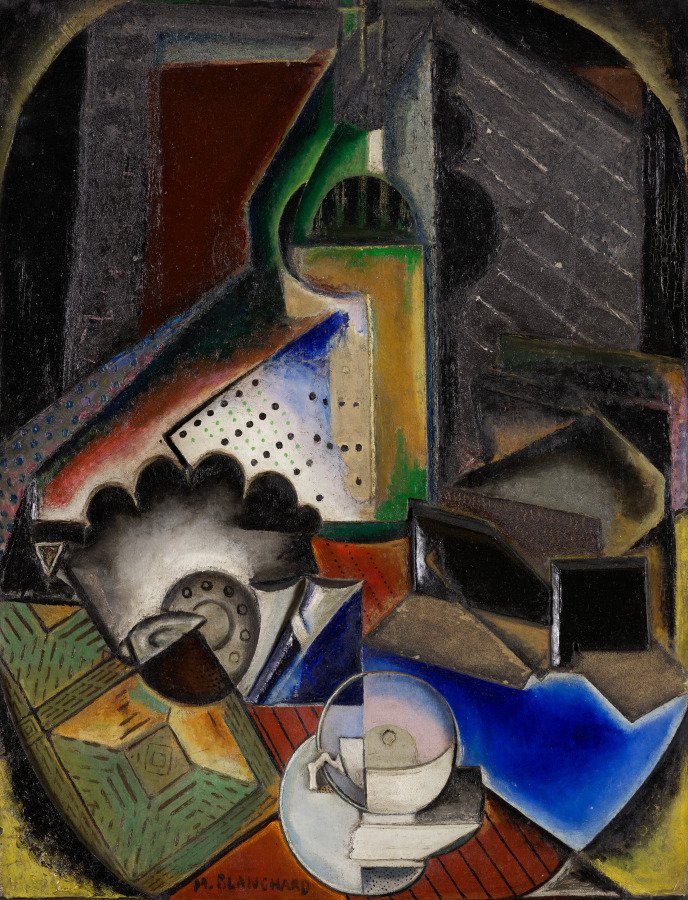
- Still Life, about 1916. Oil, sand and mixed-media collage on canvas, 65.8 by 52.4 centimetres, at the Cleveland Museum of Art (shown above).
- Cubist Composition (Composición cubista), 1916–19. Also in the Reina Sofía collection.
- Still Life with a Box of Matches, 1918. Oil, sand and glass on canvas, 74 by 50 centimetres, at the Art Institute of Chicago. The museum does not flag it public domain, so it is described here in text only.
- Still Life, about 1918. Held by the Museum of Fine Arts, Boston.
- The Saxophonist, about 1919. Acquired by the Detroit Institute of Arts in 2022. The museum describes the musician and instrument broken into flat planes of yellow, green, blue and maroon.
What to look at in María Blanchard’s still lifes
The Cleveland Still Life is a good place to start. A white cup and saucer sit at the bottom centre, cut in half by a vertical line so one side reads as light and the other as shadow. Above them, a green bottle rises through the middle of the canvas. To the left, a scalloped grey shape and a card punched with rows of dots tilt across the picture. On the right, a hard, bright blue plane cuts in like a tablecloth seen from above.
- A dark frame for bright shapes. Black and charcoal corners curve in at the top, like an arch or a vignette, and push the lighter objects forward.
- Pattern as information. Dots on the card, stripes on the red table edge and a hatched diamond on the green cloth tell you what each surface is without modelling it.
- Several viewpoints at once. The Cleveland museum describes her showing multiple, simultaneous viewpoints in a geometric style built on flat planes. The cup is seen both from the side and from above.
- A signature as a design element. “M. BLANCHARD” is painted in small capitals along the lower edge, set into the composition rather than floating on it.
Measured from the Cleveland Museum of Art’s scan of this painting, the ground runs from near-black #0a0a16 through charcoal #3a3d3f to a warm brown #4a2a1e. The accents are an intense blue at about #02096a, a rust red near #6a3111 and an olive green around #66633a, with a pale card tone of #c9c4b3. These are values from the museum’s photograph, not original pigments.
Technique: sand, collage and paint
Cleveland lists the medium of its painting as oil, sand and mixed-media collage on canvas, and the Art Institute of Chicago lists oil, sand and glass for its 1918 still life. The Cleveland museum notes that other Cubists used collage, but that Blanchard added three-dimensional elements, so that the image shifts between the real and the illusory.
You can see this in the scan. The dark wall at the upper right has a gritty, raised surface crossed by pale diagonal strokes, unlike the smoother paint of the cup. The texture is used selectively, on some planes and not others, so that touch and colour work together to separate the layers. A designer can read it as a lesson in using one tactile material to group elements.
Her colour also follows a clear rule: large areas of muted, earthy tone, broken by a few small, saturated accents. The blue plane in Cleveland’s picture covers only a fraction of the canvas, yet it anchors the whole right side. Compare the work of Juan Gris in our guide to Juan Gris, whose synthetic Cubism the Museo Carmen Thyssen Málaga links to her work while calling her approach very personal.
From Cubism to figures
In the 1920s figurative painting took over María Blanchard’s work. La comulgante, dated by the Reina Sofía to 1914 but shown in Paris in 1921, is a key example: a girl at her first communion on a canvas nearly two metres tall. The Museo Picasso Málaga’s exhibition title, A Painter in Spite of Cubism, frames her career as more than one movement.
For designers, the shift is useful to study because the Cubist habits remain: simplified forms, strong outlines and a limited, warm palette. Her friend Diego Rivera, who shared a studio with her, followed his own path from Cubism to mural painting; see our guide to Diego Rivera for that route.
A note on rights: Cleveland flags its Still Life as CC0. The other works named here are not flagged public domain by their museums, and this guide describes them in text only.
How designers can borrow María Blanchard’s ideas
- Build with planes. Split a composition into overlapping shapes, each with its own tone or pattern, and let the overlaps create depth instead of shadows.
- Use texture to group. Apply one tactile treatment, such as grain, halftone or a paper scan, to a few related elements only.
- Keep accents small and strong. A dark, earthy base with one saturated blue does more than many bright colours at once.
- Let pattern label things. Dots, stripes and hatching can signal different surfaces or categories in an illustration or infographic.
- Sample the palette. Take the measured values above into the MGD colour palette generator, or read our guide to vintage colour palettes for related schemes.
For more public domain paintings and design to study, browse the MGD museum inspiration collection.
Frequently asked questions
Who was María Blanchard?
A Spanish painter born in Santander in 1881 who died in Paris in 1932. She worked in Paris as a Cubist between 1916 and 1919, according to the Cleveland Museum of Art, and later painted figurative works such as La comulgante.
What materials did María Blanchard use?
Oil paint, often combined with sand. Cleveland lists oil, sand and mixed-media collage for its still life of about 1916, and the Art Institute of Chicago lists oil, sand and glass for its 1918 still life.
Was María Blanchard connected to Juan Gris?
Yes. The Museo Carmen Thyssen Málaga dates their meeting to 1912, and the Cleveland Museum of Art says they shared studios in Paris. The Thyssen museum devoted an exhibition to the two artists together.
Where can I see María Blanchard’s work?
The Museo Reina Sofía in Madrid, the Cleveland Museum of Art, the Art Institute of Chicago, the Museum of Fine Arts, Boston and the Detroit Institute of Arts all hold paintings by her. Not every work is on view.
