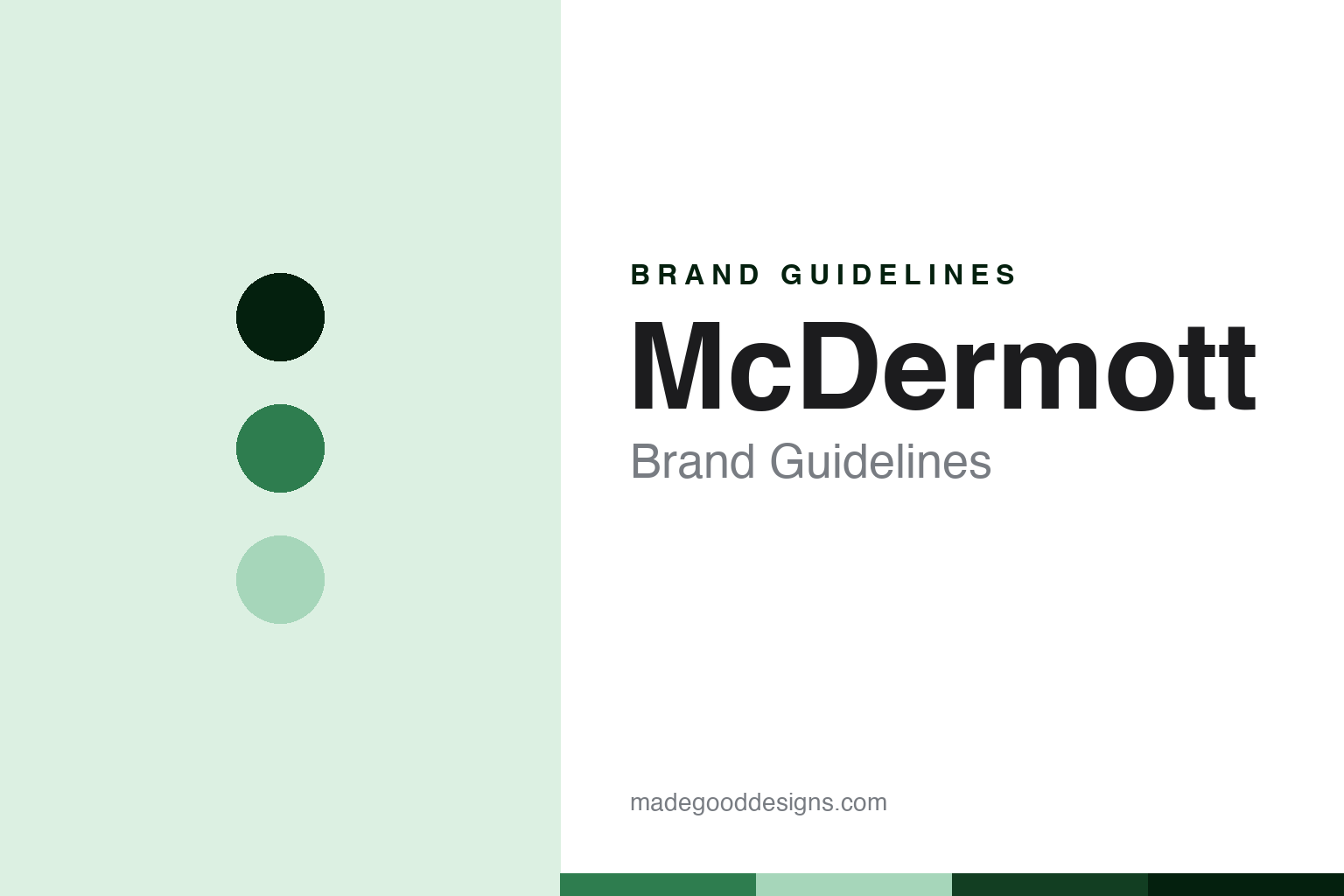
McDermott Brand Guidelines
The US cue maker that owns its imported value line.
Aa
Two constants: a McDermott-green palette and a cue-sans register. Abstract homage — not a McDermott product or mark; no cue, chalk or logo is reproduced.
The US cue maker that owns its imported value line
McDermott is the 1975 Wisconsin brand, American-made, whose Star cues are the overseas-built value line — and which, contrary to a common mix-up, does not own Lucasi.
McDermott follows Brunswick as the round’s two-tier-maker node — the American cue brand whose own cues are US-made but whose value line is built overseas, and which is often wrongly credited with a rival brand. Its answer to a round about who owns the game is the tiering: a US cue maker that owns its imported value line.
Its identity is the US cue maker that owns its imported value line. The 1975 origin, the American making and the Star line are the story here. Two tiers. The US cue maker that owns its imported value line.
(Honest notes, so the origin, the ownership, the making and a correction are framed accurately. McDermott sells cues as its heroes; we report its language as the brand’s own. On origin: McDermott Cue Mfg. was founded in 1975, with its current address in Menomonee Falls, Wisconsin, and we do not assert a founder name we could not confirm. On ownership: it is privately held, with no owner named, and it owns and operates the Star line, plus Lucky, Stinger, Sledgehammer and Vanquish. On a correction: it does not own Lucasi, which is a Cue and Case brand under Escalade’s Brunswick Billiards Group, a common mix-up we correct. On the making: McDermott-branded cues are Made in the USA, in Wisconsin, while its Star value line is manufactured globally using McDermott’s technology, a clean sourced contrast. On the products: custom and production cues and carbon-fiber shafts, with specific product names left as reported. On a trap: it is not McDermott International, the unrelated oil-and-gas engineering firm. Its designs and the McDermott name are IP we describe but do not reproduce; there is no official brand hex; these tones are an unofficial interpretation.)
Colour
McDermott lives in a McDermott green. Click a swatch to copy the hex.
McDermott’s identity is American, two-tier and cue-focused — a McDermott green, an ink, a pale green, a deep forest, and a paper. The palette leans McDermott green and deep forest: a clean, workmanlike register that stands in for a US cue maker rather than a loud logo colour. It signals the US cue maker that owns its imported value line — American, two-tier and cue-focused. The honest caveat: with no official brand hex, these values are a workmanlike, unofficial interpretation, not first-party colours.
The lesson is a McDermott green signals an American, two-tier identity. McDermott’s world is the American cue bench and the value line. For designers, it is a reminder that a clean green and a pale green can carry an American, two-tier brand — a workmanlike tone held as an accent, not a product shot. Because a mid hue can fail as small text, keep type dark and let the colour live in the accents, palette and band. The takeaways: date the founding to 1975; leave the founder unnamed; name the Star line and correct the Lucasi mix-up; and draw the US-made-versus-imported contrast.
Typography
The register is a cue sans — American, two-tier, cue-focused.
McDermott’s identity carries an American, two-tier spirit — a maker of its own cues and a value line. A cue sans captures the mood: clean, workmanlike and precise, the register of a cue maker. Set in a McDermott-green palette, the cue sans feels dependable and grounded — exactly the personality McDermott carries. It behaves like a made, turned thing rather than a loud logo, mirroring a chalk-dot and a felt-band. (McDermott’s real products and the name are things we describe but do not reproduce, and the exact typeface is not ours to use.) Because it is not ours to use, the honest description is “a cue-sans brand,” shown here in a stand-in. The type behaves like the brand: American, two-tier and cue-focused.
Aa
A cue-sans brand — dependable and grounded. (Specimen set in Archivo, a cue-sans STAND-IN; NOT the McDermott logo or products.)
The billiards node
McDermott stands for the US cue maker that owns its imported value line.
McDermott sits third in the round as its two-tier-maker node. A McDermott-green palette, a cue sans and a 1975 origin make one thing — the US cue maker that owns its imported value line — the whole identity: American, two-tier and cue-focused. The 1975 origin is the pitch, the American making is the frame, and the Star line is the substance. The point is a US maker with an overseas value line, in a round about who owns the game.
Put to work, the identity is the brand told straight, the Star line named and the Lucasi mix-up corrected. A brand in this spirit would date the founding to 1975, leave the founder unnamed, name the Star line and correct the Lucasi mix-up, and draw the US-made-versus-imported contrast. A reader in this spirit would keep the facts right: McDermott makes cues; it dates to 1975; it owns Star; and it does not own Lucasi. McDermott sits after Brunswick and before Diamond. The honest editorial moves are to date the founding, to name the Star line, to correct the mix-up, and to draw the contrast.
For designers and brand-builders, McDermott carries the billiards node: a US maker can own an imported value line — and get the family tree right. The lessons: a national cue maker can run its own American line and an overseas value line, here McDermott and Star; a founding is dated to 1975, in Menomonee Falls, Wisconsin, the founder’s name unconfirmed and so not asserted; an ownership is named, that it owns and operates the Star line plus Lucky, Stinger, Sledgehammer and Vanquish, and it does not own Lucasi, which is a Cue and Case brand under Escalade’s Brunswick Billiards Group; a making is drawn, that McDermott-branded cues are Made in the USA in Wisconsin while Star is manufactured globally; and a trap is cleared, that it is not McDermott International, the oil-and-gas firm. It is also a reminder to stay precise: McDermott is the American, two-tier cue maker of the billiards aisle that owns Star, not Lucasi — with the palette here an unofficial interpretation. The hook is that tiering: McDermott is the US cue maker that owns its imported value line, the 1975 Wisconsin brand, American-made, whose Star cues are the overseas-built value line, and which, contrary to a common mix-up, does not own Lucasi. Read that way, McDermott is less a single cue than the US cue maker that owns its imported value line: American, two-tier, cue-focused. The lesson for a brand is that a US maker can own an imported value line and get the family tree right, and dating the founding keeps it earned. McDermott made the-US-cue-maker-that-owns-its-imported-value-line the identity — proof that a two-tier maker can anchor a node.
Explore & save
Keep McDermott’s identity on hand — save it to a board in the Made Good inspiration library.
McDermott identity set
Pin the McDermott-green palette and the cue-sans register to your own board.